

Southwest Assigned Seating Changes Boarding January 2026
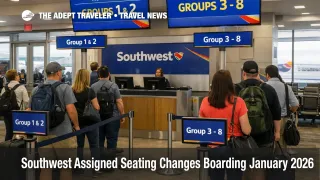
Southwest Airlines began assigned seating across U.S. airports on January 27, 2026, replacing its long running open seating process with seat selection and a new boarding structure. Travelers who previously optimized for an early boarding position by checking in exactly 24 hours before departure now receive a seat assignment and a boarding group on the boarding pass. The practical move is to choose seats at booking when your fare allows it, save a screenshot or wallet pass of your boarding pass, and plan for a different style of line at the gate.
Southwest assigned seating January 2026 changes how you secure where you sit, how you line up, and which upgrades actually move the needle on boarding order.
The biggest behavioral shift is that check in time is no longer the primary lever for seat quality on most fares, seat selection is. Southwest is pairing this with three seat types, Extra Legroom, Preferred, and Standard, so the upsell is tied to a visible map instead of a boarding position. Extra Legroom seats are concentrated toward the front of the cabin and near exit rows, and Southwest says they can offer up to five additional inches of pitch on some aircraft, plus onboard extras tied to that seat type.
Boarding also changes in a way that will feel familiar to travelers who fly other U.S. carriers. Instead of A, B, and C groups with numbered posts, Southwest is calling passengers in Groups 1 to 8. Your group placement can reflect your seat location, your fare bundle, your tier status, and eligible credit card benefits, which means two travelers on the same flight can have very different boarding outcomes even if they check in at the same minute.
For travelers who want a deeper primer on the pre launch details, earlier Adept Traveler coverage is still useful context, even though today is the go live day, see Southwest Assigned Seating Starts January 27, 2026 and Southwest Airlines Sets January 2026 Launch for Assigned Seating.
Who Is Affected
Any traveler flying Southwest on flights departing January 27, 2026, or later is affected, including those on domestic connections, leisure trips with families, and business travelers who value speed off the plane. The change matters most for travelers who previously relied on open seating tactics, checking in the second the clock hit 24 hours, paying for EarlyBird Check In, or buying a last minute boarding upgrade to avoid middle seats and protect overhead bin access.
Basic fare travelers have the most to watch, because Southwest indicates that Basic seats are assigned at check in, rather than chosen at booking, unless tier status or eligible card benefits apply. That creates a familiar trade, pay more to control seat choice earlier, or accept whatever is available later when the cabin map has already been picked over by travelers with earlier access.
Families and groups are also exposed in a different way than under open seating. Under the old system, families could often solve seating by boarding early and spreading across a row, then negotiating with other passengers. Under assigned seating, success is more about selecting seats intentionally as soon as you can, keeping everyone on one reservation, and avoiding a last minute scramble when only scattered seats remain.
Travelers with disabilities, active duty U.S. military, and others eligible for preboarding or priority processes still receive those options, but the visible manifestation at the gate is changing. Southwest is moving away from numbered stanchions, and many airports are shifting to alternating lanes with group displays during a phased conversion, so even experienced Southwest flyers should expect a different physical flow at familiar gates.
What Travelers Should Do
If you have Southwest travel coming up, open your reservation now and confirm whether you can pick a seat today, and if so, pick it. Then save your boarding pass to your phone wallet, take a screenshot as a backup, and keep your party on a single reservation so you do not create a self inflicted boarding split at the gate.
If you are deciding whether to pay more or wait, use a simple threshold. If sitting together matters, if you are traveling with a child, or if you have a tight connection where a forward seat can reduce misconnect risk, paying for earlier seat access or a Preferred location is often rational. If you are flying point to point, traveling light, and do not care about a specific seat, waiting can be fine, but do not assume you will avoid a middle seat on peak flights if you are in a late group.
Over the next 24 to 72 hours, monitor three things, your seat assignment status in the app, any prompts to purchase Priority Boarding within the 24 hour window, and how your departure airport has implemented the new lane layout. The first week of a new boarding flow is when small inconsistencies, staffing patterns, and passenger confusion can create real line friction, so arrive with a buffer if you are checking bags, traveling in a group, or departing in an early morning peak.
Background
Southwest built its brand on open seating for decades, using a check in driven boarding order to keep aircraft turns fast and the product simple. That simplicity also constrained monetization, because the airline was not selling the two things travelers reliably pay for, certainty and space. Assigned seating turns the seat map into a pricing surface, with Standard seats toward the back, Preferred seats nearer the front, and Extra Legroom seats clustered near the front and at exit rows, with some onboard perks tied to those premium locations.
The system ripple starts at the reservation layer. When a seat map becomes the key decision point, the trip planning workload shifts earlier, and customer service demand often moves from the gate to pre departure digital support, especially for families, irregular operations reaccommodation, and same day changes. Next, it hits the airport layer. Removing stanchion based line choreography changes how crowds form at the podium, and it can move pressure toward Priority and early groups, especially when flights are full and bin space is scarce. Finally, it touches onboard flow. Southwest is also rolling out cabin upgrades, including RECARO R2 seats with device holders and in seat power on equipped aircraft, plus larger overhead bins on refreshed interiors, which can reduce bag juggling, but it also raises expectations, and expectations amplify frustration when a boarding process feels unclear.
This change also sits alongside broader Southwest fare and benefit restructuring. Southwest's public materials show that checked bag inclusion is now tied more directly to fare type and benefits, rather than being a universal traveler assumption, and that makes pre trip math more important, especially for groups checking bags.