

Southwest Assigned Seating Flights Start, Boarding Groups
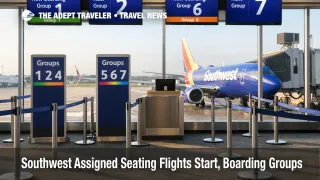
Southwest has begun operating flights with assigned seats, ending the airline's signature open seating model for departures on and after January 27, 2026. The change affects how travelers book, how they line up at the gate, and what they may pay to sit closer to the front or in a roomier row. For travelers, the practical move is simple: treat seat selection as a booking step, not a check in game, then show up at the gate ready for an eight group boarding call rather than the old A, B, and C lineup.
On the morning the switch went live, early departures illustrated the new reality. Southwest flight WN3575 operated from Luis Muñoz Marín International Airport (SJU) to Orlando International Airport (MCO), and Southwest flight WN4974 operated from Manchester Boston Regional Airport (MHT) to Chicago Midway International Airport (MDW), both as assigned seat operations that would previously have been "pick any open seat" flights. Flight tracking data for those routes shows they ran on January 27, 2026, with early morning departures that put the new boarding flow to an immediate stress test.
The assigned seat rollout is paired with new seat categories and fare bundle logic. Southwest is selling Extra Legroom seats and Preferred seats as differentiated products, and it is also tying boarding position to where your seat is and what you paid, rather than relying primarily on who checked in fastest. Southwest's own fare and enhancement pages describe the new seat categories, the January 27, 2026, start date, and how boarding group priority begins with Extra Legroom customers in Groups 1 and 2, while other bundles and benefits flow later in the sequence.
For travelers who want deeper pre trip context on the mechanics and the reasoning, earlier Adept Traveler coverage remains useful alongside today's go live reality, see Southwest Assigned Seating Starts January 27, 2026.
Who Is Affected
Any traveler flying Southwest on a flight departing January 27, 2026, or later is affected, including business travelers who care about getting off the plane quickly, families trying to sit together, and leisure travelers connecting onward to cruises, rental cars, and timed tours. The biggest behavioral shift is that check in time is no longer the main lever for seat quality on most fares. Seat selection timing, seat map availability, and bundle choice now do more of the work.
Travelers on the new Basic fare structure have the most at stake, because Basic is designed to be restrictive and can involve later seat assignment unless the traveler has qualifying benefits. That creates a predictable pattern: parties on Basic risk being split, and they may also land in later boarding groups, which increases competition for overhead bin space. Meanwhile, travelers buying higher bundles, paying for Extra Legroom, or holding higher Rapid Rewards tier status should expect earlier boarding, earlier bin access, and more control over where they sit, but they will also see more line items in the trip cost than legacy Southwest loyalists were used to.
Travel advisors and corporate travel managers are affected as well, because the policy change reshapes how travelers compare Southwest to other carriers. Once seats are assigned and upsells exist, the "Southwest is simpler" argument weakens, and the decision shifts toward total trip cost, schedule resilience, baggage fees, and how reliably the new process runs at the gate during irregular operations.
What Travelers Should Do
Make your seat decisions at booking, not at the airport. If sitting together matters, select seats as soon as your fare bundle allows, and do not assume that checking in exactly 24 hours before departure will solve it, because boarding order and seat location are now linked to fare, seat type, and benefits more than a stopwatch. On travel days, arrive with extra time at the gate until you see how your departure station handles the two lane boarding flow and the separate preboarding and priority areas.
If you are debating whether to upgrade, use a simple threshold: upgrade when the cost of being split or being seated farther back is higher than the seat fee. That threshold is usually met on short connections, family trips where adjacency is non negotiable, and itineraries with tight ground transfers on arrival. It is usually not met on point to point trips where you can tolerate a middle seat, you have only a personal item, or you have plenty of buffer after landing.
Over the next 24 to 72 hours, monitor how your specific airport is executing the new gate layout and whether Southwest issues any local advisories about boarding, seat assignment timing for Basic, or technology hiccups in the app and boarding pass display. If your flight is within that window and you see irregular operations, prioritize a seat that improves your contingency options, for example a forward Preferred seat for faster deplaning when you have a tight onward leg, or an aisle seat if you expect a gate checked bag cascade on a full flight.
How It Works
Open seating worked for Southwest because it aligned incentives around fast turns, a simple cabin product, and a check in driven boarding order that was easy to explain. Assigned seating changes that system at its source, which is the booking flow. Once seat maps exist and seat types are sold, the "best seat" competition moves earlier in time, and the airline can monetize location and legroom the way most U.S. carriers already do.
That first order change propagates through the travel system in two big ways. First, it changes the gate and boarding layer, because Southwest can no longer rely on a single undifferentiated stream of passengers who self sort by a letter and number. It must run a group sequence, manage priority areas, and keep two boarding lanes moving while scanning boarding passes that now embed seat and group information. Second, it changes connection performance and downstream recovery, because seat location influences deplaning speed. Faster deplaning can reduce misconnect risk for travelers, but it can also concentrate foot traffic into the jet bridge and terminal corridors in tighter pulses, which matters at banks of departures and during weather driven delays.
There is also an operational ripple into overhead bins and carry on behavior. Earlier groups tend to capture more bin space, which pushes later boarders toward gate checking, and that increases variability in time to exit the airport on arrival. For travelers with rail tickets, cruise pier check in windows, or timed pickups, this is not theoretical, it is a real schedule risk that used to be less predictable under open seating because boarding order was more uniformly competitive. Now, that competition is structured, and travelers can buy their way into earlier access, which changes both expectations and crowd dynamics.