

Hawaii Marijuana Legalization Vote Tourism Impact
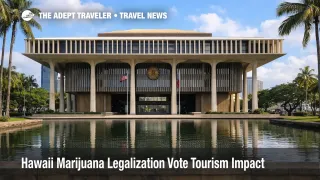
Hawaii health officials are publicly weighing how adult use marijuana legalization could change the state's economy, and its visitor mix, after a new Department of Health commissioned analysis modeled sales, taxes, and tourism sensitivity. Visitors, travel advisors, and hospitality operators are the most affected audiences because the report explicitly treats tourists as early demand drivers, and it tests whether key source markets would alter Hawaii trip decisions. For now, travelers should treat this as forward looking policy planning, not an immediate change, and keep current rules and federal travel constraints as the baseline for any 2026 bookings.
The Department of Health report projects that by the fifth year of legalization, Hawaii's total cannabis market could reach $46 million (USD) to $90 million (USD) per month after adjusting for consumer participation under a 15 percent total tax rate. It also estimates tourists could contribute at least $11.5 million (USD) per month, with domestic visitors expected to account for most of that tourist demand. The same analysis says the net tourism effect from legalization is likely modest because most surveyed respondents in Canada and Japan said legalization would not influence their decision to visit.
Separately, Hawaii lawmakers have introduced measures that would put adult use legalization to voters via a constitutional amendment pathway, rather than relying on a standard legalization bill that has repeatedly stalled in prior years. That matters for travelers because the most realistic timeline for any statewide vote would align with the November 3, 2026 general election, and because Hawaii does not have a citizen initiative process that lets voters place a measure on the ballot by petition.
Who Is Affected
Leisure travelers are affected first, especially repeat visitors who plan resort stays around lifestyle amenities and who may interpret legalization as permission to consume anywhere. The practical reality, even under legalization, is likely to be narrower because consumption rules typically restrict public use, and hotels, condo buildings, and vacation rentals can still enforce their own property policies, including smoke free rules and nuisance standards.
Travel advisors and tour operators are affected because the report's tourism modeling suggests demand will not surge across the board, meaning legalization is unlikely to be a reliable selling point for most clients, but it could still create edge case friction for specific segments. In the report's own data, a minority of respondents in Canada and Japan say legalization could make them more likely to visit, while another minority say it would deter them on moral, comfort, or safety perception grounds. That is exactly the kind of split that can complicate group travel, incentive trips, multigenerational bookings, and tours that rely on shared norms.
Hospitality operators and transportation providers are affected next because any real adult use market would change operating assumptions around odor complaints, designated consumption spaces, and impaired driving risk management. The first order effect is local, where sales would happen, and where enforcement resources would shift. The second order effects are travel system ripples, such as how visitors move between islands, how rental car providers handle impairment policies, how nightlife areas handle complaints, and how medical and adult use supply channels interact during ramp up.
What Travelers Should Do
If you are traveling to Hawaii in 2026, plan as if current rules remain in place, and do not assume a ballot proposal means cannabis will be legal during your trip. Avoid building "cannabis tourism" into nonrefundable plans, and treat any legalization debate as a background factor, not a trip driver, unless you are already comfortable traveling in destinations where cannabis is legal.
For flights, the safest decision threshold is simple, do not carry marijuana through airport security or onto a plane, even if you are flying between two places that permit adult use, because marijuana remains illegal under U.S. federal law, and Transportation Security Administration screening operates under federal rules. If you want to avoid risk, assume any cannabis possession during travel days can create delays, missed connections, and unwanted law enforcement contact.
Over the next 24 to 72 hours when tracking this story, focus on whether the legislature advances a constitutional amendment measure far enough to credibly reach the November 3, 2026 ballot, and whether state agencies signal what a regulated visitor facing market would look like, including rules around retail locations, taxation, and consumption restrictions. Until those details exist, travelers should monitor official state updates, not social media claims, and keep hotel and rental property rules as the practical constraint for any future legalization scenario.
Background
Hawaii's Department of Health commissioned the economic and policy analysis to model both the current medical cannabis system and a potential adult use market, including how pricing, taxation, licensing, and consumer behavior could shift spending from illicit or gray channels into regulated retail. In the report's year five scenario, the projected sales range depends on participation under a 15 percent total tax rate, and the tourism component is treated as a meaningful baseline demand layer, not a rounding error. The same report also warns, indirectly through survey results, that legalization is not a decisive travel factor for most Canadian and Japanese respondents, which is why it projects only a modest net tourism effect even if some subgroups become more interested.
The ballot mechanics are easy to misunderstand. Hawaii does not offer a statewide citizen initiative process, so any referendum style vote on legalization would come from the legislature proposing a constitutional amendment and sending it to voters. Bills introduced in the 2026 session would aim to authorize adult use through a constitutional amendment framework, which, if advanced, could place the question before voters in the November 3, 2026 general election. This is fundamentally different from states where voters can qualify a measure directly by petition.
For travelers, the most important systems point is that state legalization does not erase federal constraints. Even in states with adult use markets, transporting marijuana across jurisdictions, bringing it through airport screening, or carrying it on flights remains a legal risk because federal law still applies at airports and in aviation security. That mismatch is where disruptions propagate through the travel system, a policy change can increase local availability and reshape visitor behavior on the ground, while the aviation layer continues to treat cannabis as contraband, and the hospitality layer continues to enforce property rules that may be stricter than state law. The result is a destination where "legal to buy" does not automatically mean "easy to travel with," and where hotels, tours, and transportation providers may adjust policies to manage odor complaints, impairment risk, and guest expectations.
Sources
- An Economic Analysis of the Current Medical and Future Adult Use Cannabis Market in Hawai'i (Hawaii Department of Health PDF)
- State Constitutional Amendments Fact Sheet (Hawaii Office of Elections PDF)
- Hawaii House Bill HB1624 (LegiScan)
- Hawaii Senate Bill SB2420 (LegiScan)
- Medical Marijuana (Transportation Security Administration)
- Bill Text HI HB1383, 2019 (LegiScan)