

PONANT Great Courses Cruises In Greece And Iceland
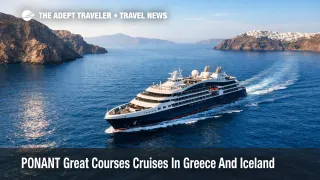
PONANT Explorations and The Great Courses Journeys are launching a new set of expert hosted expedition style voyages beginning in 2026, built around onboard instruction paired with immersive field time ashore. The offering targets travelers who want structured learning, smaller ship access, and curated experiences that go beyond standard port day touring. The practical change for trip planning is that these sailings behave less like interchangeable cruises and more like fixed schedule programs, so travelers should book flights and pre cruise hotels with larger buffers, and treat cancellation deadlines and documentation as central parts of the purchase decision.
The PONANT Great Courses cruises calendar published so far includes Iceland in the Wake of the Vikings (July 26 to August 3, 2026) aboard Le Lapérouse with Professor Jennifer Verdolin starting at $10,995 per person. Adriatic Odyssey: Venice to Dubrovnik (August 5 to 13, 2026) sails on Le Bougainville with Professor Thomas F. X. Noble starting at $9,480 per person. Greece anchored options include The World of the Greeks: From Myth to Empire (October 24 to November 1, 2026) on Le Champlain with Dr. Sheila Hoffman starting at $9,740 per person, plus Greek Odysseys: From Athens to Syracuse (November 7 to 16, 2026) on Le Champlain with Professor Robert S. J. Garland starting at $9,995 per person. A follow on itinerary, Treasures of Central America: The Panama Canal and Marvels of Costa Rica, is listed for January 14 to 22, 2027 on Le Lapérouse with Professor Scott Solomon starting at $8,800 per person.
Who Is Affected
These departures will matter most to travelers who already buy enrichment travel, and who prefer smaller ships where shore logistics can be more controlled, and more intimate. They also affect travelers who normally build their own trips but want a single booking that bundles expert interpretation with pre planned access, because the cruise format shifts the risk profile, you can rebook hotels and tours, but you cannot recreate a missed embarkation or a professor led field day on short notice.
Travel advisors and group organizers should pay attention because this product sits at the intersection of expedition cruising and educational travel, where expectations are higher and tolerance for friction is lower. Travelers flying long haul into embarkation cities, or connecting from separate tickets, are the most exposed group, especially on summer departures when air irregular operations and hotel compression are common. Anyone planning add on land arrangements in Greece, Italy, Croatia, Iceland, Panama, or Costa Rica should also expect tighter scheduling, because the onboard learning program tends to lock in meal times, lectures, and guided shore windows that can limit independent touring flexibility.
What Travelers Should Do
Start by treating embarkation as a hard deadline, not a suggestion. Book flights that arrive at least one day before sailing, and add a same city hotel night even if the cruise line does not require it, because a delay that would be annoying on a beach vacation can become trip ending on a program style voyage with fixed lectures and guided access.
Use a clear threshold for rebooking versus waiting. If your inbound flight is forecast to arrive after early afternoon on embarkation day, or if you are relying on a tight same day connection, rebook to an earlier arrival or shift to an overnight route, even if it costs more. These sailings are priced and marketed around the expert component, so protecting day one attendance is usually worth the premium, especially when alternative sailings are limited.
Over the next 24 to 72 hours after booking, confirm three operational items in writing: what is included in the fare, the cancellation timeline that applies to your departure year, and what receipts are required if you later need to document disruptions for insurance or reimbursement. Then keep monitoring airfare schedule changes and port city hotel rates as your departure window approaches, because small ship itineraries can concentrate demand in specific cities on specific dates.
Background
The Great Courses Journeys is expanding the long running Great Courses expert model into in person travel, positioning each trip as a guided learning experience led by subject matter experts rather than conventional tour guides. In a January 7, 2026 release, the company said it soft launched with seven departures, and plans to expand to more than 35 departures in 2026 and more than 60 in 2027, spanning themes like history, archaeology, art, astronomy, culinary traditions, and rail travel. That same release frames the core value proposition as deeper context, meaningful access, and travel alongside like minded learners, which matches the cruise collaboration approach.
For travelers, the key systems insight is how a learning cruise propagates through the broader trip. First order effects begin onboard, the programming anchors daily timing, which makes missed embarkation and late returns more costly. Second order effects show up in flights and hotels, embarkation city overnights become more valuable, and last minute changes can be more expensive because the ship's schedule is not elastic. A third layer shows up in tours and ground transfers, many shore experiences are guided and timed, so independently booked add ons need bigger buffers to avoid cascading missed reservations.
Sources
- Adriatic Sea Cruise | The Great Courses Journeys | TGC Journeys
- The World of The Greeks Cruise | The Great Courses Journeys
- Greek Islands Cruise | The Great Courses Journeys
- Iceland Cruise | The Great Courses Journeys
- Panama Canal Cruise | The Great Courses Journeys
- PONANT Cruise Live Events | The Great Courses Journeys
- The Great Courses Journeys Launch Press Release, January 7, 2026
- The Great Courses Journeys Terms & Conditions