

Storm Fern DFW Flight Delays, American Recovery Lags
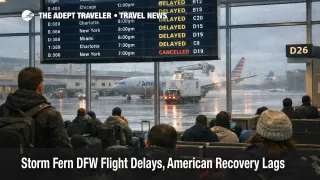
Storm Fern continues to disrupt American Airlines' network as the carrier works to restore predictable operations after days of cancellations and rolling delays centered on Dallas Fort Worth International Airport (DFW). Travelers are most affected when itineraries rely on hub connections, late day departures, or regional feeder flights that are easier to trim while the airline decongests gates and resets rotations. The practical next step is to use active travel alerts where eligible, rebuild plans with wider buffers, and treat app updates and gate information as changeable until the recovery stabilizes.
Storm Fern DFW flight delays now reflect a recovery problem, not just a weather problem, because aircraft, crews, gates, and hotels must realign before the published schedule becomes trustworthy again.
American has pointed to improving airfield and ramp conditions at Dallas Fort Worth, including reduced deicing needs as temperatures rise and residual ice clears, but third order effects are still showing up as crew legality, staffing, and accommodations pinch points. Reuters has reported that some crews faced long waits for help and hotel shortages, and that the disruption has tested the airline's recovery systems. American has also told customers to check the app and its website frequently, and to use the added flexibility from travel alerts that were extended through January 29, 2026.
Who Is Affected
Travelers booked to, from, or through Dallas Fort Worth sit at the center of the risk because a stalled departure bank there can strand aircraft and crews that were meant to operate later flights in other cities. Charlotte Douglas International Airport (CLT) also matters because American's hub structure amplifies disruption into hundreds of downstream city pairs when connections stop flowing. Even if a traveler is not flying through Texas or North Carolina, their flight can still be affected when the inbound aircraft or crew sequence was scheduled to pass through one of these hubs earlier in the day.
International trips and event anchored itineraries are the next most exposed group. Travelers returning from Punta Cana International Airport (PUJ), or connecting onward to cruises, weddings, medical appointments, or conferences, face the risk that a single missed leg shifts arrival by a full day once rebooking inventory compresses. Travel advisors and corporate travel managers are also absorbing the operational costs of uneven communication, shifting seat availability, and rebooking friction, especially when clients are traveling with essential medications or cannot absorb additional overnight stays.
Employees are part of the traveler impact layer because crew constraints directly shape what flights can operate. When crews time out under duty rules or cannot secure rest due to hotel shortages, flights can cancel late, even after boarding processes begin, and that pattern drives missed connections, airport crowding, and last minute hotel demand around hub markets. Parallel labor and financial tensions have added scrutiny to the recovery, including public statements from the Association of Professional Flight Attendants about leadership and performance.
What Travelers Should Do
Start with immediate actions that reduce exposure to the recovery queue. If a travel alert applies to the ticket, changing sooner is usually easier than waiting until airport lines build and the remaining seats become expensive or scarce. Favor nonstop options, earlier departures, and longer connection windows, and keep essentials, chargers, and any medications in a personal item in case the trip turns into an overnight.
Use clear decision thresholds for rebooking versus waiting. If an itinerary requires a short connection through Dallas Fort Worth or Charlotte Douglas during the current recovery window, or if a missed first leg would strand the traveler until the next day, rebooking to a longer layover or a different hub is usually the safer choice. If arrival is time critical, the most reliable hedge is shifting to an earlier flight even if it is less convenient, because recovery days often see late cancellations that arrive after alternatives have already been claimed.
Monitor three layers over the next 24 to 72 hours, flight status changes, travel alert terms, and hub level recovery signals that affect hotels and ground transport. Watch for late day rolling delays, gate congestion, and inbound aircraft swaps, because these often precede last minute cancellations. Save screenshots of cancellation notices and chat transcripts, keep receipts for meals, hotels, and transport, and record the timeline of assistance attempts, because documentation is frequently decisive for reimbursement requests and insurance claims.
How It Works
Large winter events disrupt air travel in phases. The first phase is capacity loss during the storm, when freezing precipitation, low visibility, and extreme cold reduce arrival and departure rates, extend taxi times, and increase turnaround time due to deicing and ramp safety limits. The second phase is the fragile rebuild, where airlines must re stitch aircraft rotations and crew pairings that were designed for tight timing and high utilization, and where a single missing aircraft or crew can cancel multiple downline flights.
The propagation is not confined to the storm footprint. When a hub loses a departure bank, aircraft end up out of position, crews run into duty and rest constraints, and airlines often cancel additional flights to protect the next day's schedule rather than keep operating a broken sequence. That disruption then spills into hotels and surface transport because crews and displaced passengers compete for the same limited inventory near hub airports, pushing prices up and forcing longer commutes for rest, which can further constrain next day operations.
The ripple extends beyond aviation. Missed arrivals break prepaid tours, rail connections, cruise embarkations, and meeting schedules, and they can trigger secondary costs that are harder to recover when trips are built on separate tickets or nonrefundable reservations. In recovery windows, the traveler advantage comes from reducing dependencies, adding buffer time, and treating the schedule as probabilistic until the airline's network has fully reset.
Sources
- American makes continued progress in its recovery from Winter Storm Fern
- Travel alerts, Travel information, American Airlines
- January Major Winter Storm Travel Advisory, American Airlines SalesLink
- Storm tests American Airlines as stranded crews face hotel shortages, long waits for help
- American Airlines works to rebound flights after major weather-related disruptions
- While Competitors Surge Ahead, American Falls Further Behind, APFA
- Refunds, U.S. Department of Transportation