

Munich Lufthansa A380 Business Seats Start April 2026
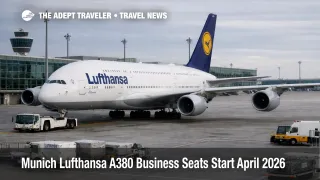
Lufthansa is starting a fleetwide refresh of its Airbus A380 Business Class cabins, with the first aircraft entering conversion work in Dresden, Germany. The change matters most for long haul travelers booking Munich based A380 flights, because cabin work and routine maintenance can trigger aircraft swaps and seat map changes even if your flight number stays the same. The practical move is to watch your aircraft assignment and seat map closely, then decide whether you care more about flying the A380 specifically, or about locking in a particular seat and cabin product.
The Lufthansa A380 business retrofit centers on new Thompson Business Class seats with direct aisle access, a quoted seat width of 58 cm, a bed length of at least two meters, Bluetooth connectivity, and adjustable partitions designed to add privacy. Lufthansa says it can use an existing certification for the cabin, which should shorten the path from workshop to passenger service compared with brand new, unapproved seat programs.
Who Is Affected
The most affected travelers are those booked on Lufthansa Airbus A380 flights that operate to and from Munich Airport (MUC), because Lufthansa's A380 fleet is based in Munich and the first aircraft is scheduled to return there after the retrofit. Lufthansa's first retrofitted aircraft is expected back in Munich in April 2026, and Lufthansa's stated plan is to complete all eight aircraft by mid 2027, meaning product and assignment variability can persist across multiple travel seasons.
Business Class travelers should also plan for capacity and numbering changes. Lufthansa says each A380 will have 68 Business Class seats after the retrofit, and reporting on the program indicates that is fewer Business Class seats than today, which can affect upgrades, award inventory, and the odds of being reseated if Lufthansa changes aircraft types at the last minute.
Travelers connecting onward on separate tickets, especially those trying to protect a specific premium seat selection, face a different risk profile than travelers who just need to get to the destination. During a rolling cabin program, the system is stressed in predictable ways, the aircraft being worked on is out of rotation, scheduling planners may substitute another widebody, and seat maps can reflow even when the departure time does not. That is why the retrofit timeline matters to trip design, not just to comfort.
What Travelers Should Do
If you have an A380 booking in the next few months, treat your seat assignment as provisional until close to departure. Check the aircraft type and seat map right after ticketing, again after any schedule change email, and again in the final week, because the seat numbering and cabin layout may change when Lufthansa swaps equipment, or when your flight changes from a non retrofitted A380 to a retrofitted one, or vice versa.
Use decision thresholds instead of hope. If your trip is driven by flying the A380 specifically, you can tolerate some seat movement as long as the aircraft type stays the same. If your trip is driven by the cabin product and a particular seat, for example a preferred aisle, or a paired seat plan, be ready to rebook when a swap appears, because reaccommodation often happens after the best seats are already taken. The earlier you act, the better your odds.
Over the next 24 to 72 hours before departure, monitor three things: the aircraft type field in your booking, the seat map itself, and Lufthansa's operational messaging around the retrofit and maintenance cycle. The first aircraft is scheduled to return to Munich in April 2026, so April and the early summer shoulder can be a period where mixed configurations, and last minute substitutions, are more likely than during steady state periods.
Background
A retrofit is a conversion program that installs a new interior into an aircraft already in service, typically combining cabin work with scheduled maintenance to reduce downtime. In Lufthansa's case, the A380 retrofit is being done at Elbe Flugzeugwerke in Dresden, and Lufthansa says the seat upgrade can rely on existing certification, which reduces approval lead time and makes it more plausible that customers see the new cabin within weeks rather than quarters.
This kind of change propagates through the travel system in two layers. First order effects show up as aircraft downtime, rotation changes, and occasional aircraft swaps that change seat maps, the inflight product, and sometimes total premium capacity on a specific departure. Second order effects ripple into rebooking pressure on nearby flights, tighter upgrade space when premium seats are reduced, and misconnect risk for travelers who built tight or separate ticket itineraries around a specific long haul arrival time. Certification reality is a recurring constraint across aviation programs, so Lufthansa's choice to use an already certified approach on the A380 sits in the broader pattern where certification timing can shape capacity and product promises, as seen in other aircraft programs. FAA Delays on Boeing 737 MAX 10 Hit Airline Capacity