

Fontainebleau Las Vegas Vegas Loop Station Opens
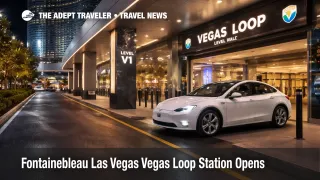
Fontainebleau Las Vegas has opened a passenger station on the Vegas Loop, The Boring Company's tunnel based shuttle system, giving guests a new way to move between the north Strip and the Las Vegas Convention Center area without relying on surface traffic. The new stop sits at Level V1 near the resort's South Valet rideshare pickup area, and Fontainebleau says rides to and from the property will be complimentary for hotel guests. For travelers, the practical change is that convention days and show nights now have a predictable, fixed pickup point that can be faster than walking or waiting for rideshare during peak surges.
Who Is Affected
The immediate winners are Fontainebleau guests whose plans revolve around the Las Vegas Convention Center, especially attendees moving between the resort and the convention campus multiple times per day. Fontainebleau's published station information also frames the Loop as a direct link to nearby resort stops, including Wynn and Encore, Resorts World, and Westgate, which can matter for travelers meeting friends, dining off property, or chasing ticketed events across the north Strip corridor.
Travelers focused on airport transfers are affected in a different way. The Boring Company has begun limited service that drops passengers at Harry Reid International Airport (LAS), but current reporting indicates those airport drop offs are only offered from specific Loop origins, not from every resort station. The Las Vegas Review Journal reports the airport ride price is listed as $12 per person from Resorts World or Westgate, with drop offs directed to the departures curb, and that airport pick ups will not begin until each Loop vehicle has an installed transponder.
If you are staying at Fontainebleau, this means the new station improves your convention connectivity right away, but it does not automatically create a direct, one seat Loop transfer to LAS. In practice, the Loop changes the middle leg of many itineraries, hotel to convention center and nearby resorts, while the airport leg remains constrained by origin rules, daily limits, and operational approvals for surface travel segments.
What Travelers Should Do
If you are a Fontainebleau guest, treat the new Loop station like a scheduled shuttle that happens to run underground. Before you build a tight morning plan, confirm the latest hours in the Loop booking flow, then add a buffer for the first ride of the day, because small operational changes can have outsized effects when conventions start. If your day includes timed entry, badge pickup, or a speaker slot, aim to arrive at the convention center earlier than you think you need, because the Loop can deliver you faster, but venue lines can still be the real bottleneck.
For airport departures, set a clear decision threshold for when the Loop is worth it versus a traditional rideshare or taxi. A $12 per person fare can be competitive for solo travelers and pairs, but it can become expensive for families or groups compared with one vehicle pricing, especially if you have luggage that complicates splitting into multiple cars. If your flight is early morning or very late night, plan to default to a standard curb to curb option unless you can verify the Loop airport window and confirm you can actually book a ride from an eligible origin at that time.
Over the next 24 to 72 hours, monitor three signals rather than generic hype. First, watch whether airport pick ups are announced as live, because that depends on transponder installation and airport operational approval, and it changes the usefulness for arrivals. Second, watch whether published airport drop off hours converge across outlets, because current reporting has cited different end times, which suggests the operating window may be adjusting as the service scales. Third, if you are traveling during a major convention week, assume demand spikes will stress any limited capacity product, so keep a backup transfer plan and do not anchor critical connections to a single new service.
How It Works
The Vegas Loop is a point to point shuttle system using Tesla vehicles that move through dedicated tunnels and passenger stations, originally built to connect the Las Vegas Convention Center campus and later expanded to nearby resort stations. On the convention campus, the Las Vegas Convention and Visitors Authority describes a four station system that can cut a long walk down to a short ride, which is why Loop access is most valuable when show schedules require repeated cross campus movement.
What travelers feel first is the direct effect at the source, which is easier, more predictable travel between a resort station and the convention center stations without strip traffic and without rideshare pickup confusion. The second order ripple shows up across two other layers of the travel system. On the street layer, shifting some short north Strip trips into the tunnels can reduce demand spikes at certain curb zones, but it can also concentrate arrivals at convention entrances in sharper waves, which increases security, badge pickup, and lobby congestion. On the airport connection layer, the newly permitted airport drop off service is not fully underground yet, so it includes a surface segment that will later shift to subsurface when the planned airport connector tunnels open, and that hybrid design means travel time predictability can vary more than a fully separated guideway would.
For scale and timing context, the Las Vegas Review Journal reports more than 10 miles of Vegas Loop tunnels have been dug with about four miles operational, and it describes a planned buildout of 68 miles with more than 100 stations. The initial convention center project traces back to the Las Vegas Convention and Visitors Authority approving a contract in 2019, and The Boring Company has described the LVCC Loop opening for events in 2021 as the early operating base that later expansions build on.
Sources
- Vegas LOOP - Fontainebleau Las Vegas
- The Fontainebleau becomes Vegas Loop's latest stop
- Boring Co. Vegas Loop hits another milestone with Reid Airport rides
- Vegas Loop gets approval to take passengers to airport
- Las Vegas Moves Forward with First Underground People Mover
- LVCC - The Boring Company
- Vegas Loop at LVCC - LVCVA