

Germany Transit Strike Disrupts Berlin Transfers, NE Rail
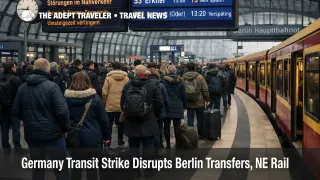
A Verdi led warning strike sharply reduced or halted municipal public transport across much of Germany on February 2, 2026, with the heaviest traveler impact on city buses, trams, and municipal U Bahn systems rather than national rail. Visitors and business travelers are most exposed when they depend on a city transit leg to reach a mainline station, a long distance departure, or an airport transfer window. The practical move is to anchor your day on rail services that are still operating, then rebuild the last mile with walking, S Bahn where available, and only limited taxi use when road travel time remains predictable.
The Germany transit strike Berlin transfers problem is that even when long distance trains and many S Bahn lines run, the feeder layer can fail, which turns a normal 20 minute hotel to station hop into an open ended search for a workable route.
Who Is Affected
Travelers in major metros across Germany are the top risk group, especially in places where local operators run most surface transport and urban rail. Reporting and labor advisories around the February 2 action pointed to broad impact across multiple federal states and roughly 150 municipal transport companies, with major cities such as Berlin, Germany, Hamburg, Germany, and Bremen, Germany, among those affected. In parts of Baden Württemberg, including Stuttgart, Germany, Karlsruhe, Germany, and Freiburg, Germany, services were described as fully halted for the day, which is the worst case for visitors who assumed they could solve gaps by simply waiting for the next departure.
In North Rhine Westphalia, Germany, the strike created a different failure mode, density without reliability. Even if some subcontracted buses operate, headways can be irregular and hard to model in an itinerary. ZDF's overview of the day highlighted multiple NRW cities where municipal buses and rail based local transit were expected to be heavily constrained, which matters because NRW travelers often rely on a short local leg to reach an intercity station for onward travel.
Berlin, Germany is a special case because the city has parallel layers that do not fail together. During the BVG strike window, S Bahn Berlin and DB regional services were not part of the labor action, and S Bahn Berlin publicly stated the BVG strike window as running from 300 a.m. on February 2 to 300 a.m. on February 3. That protects many cross city moves, but it does not protect the last mile if your plan requires a BVG bus or tram to reach the correct S Bahn station. It can also create a spillover effect on the morning of February 3 as depots restart and vehicles reposition, even after the formal window ends.
For travelers flying out of Berlin Brandenburg Airport Willy Brandt (BER), the rail link can remain workable, but only if you can reliably reach the right rail station. If your neighborhood access is normally a BVG bus or tram, treat the first leg as the fragile one, and shift your departure earlier than you normally would to preserve options.
What Travelers Should Do
Start with immediate actions and buffers. If you are moving on February 2 or early February 3, check your local operator status first, then rebuild your route so the final approach to a station or terminal is walkable wherever possible. If you must use a taxi or rideshare, request it earlier than you normally would, and consider a pickup point on a main road rather than a small residential street where vehicles can stack and waste time.
Use a clear decision threshold for rebooking versus waiting. If a missed local leg would cause you to miss a long distance departure you cannot easily change, or a flight on a separate ticket, re time the day now by moving the departure earlier or by adding a positioning night near the station or airport. If your plans are flexible and the main goal is city mobility, it can be reasonable to hold and adapt in real time, but only if you are not chaining timed entries, tours, or reservation windows that punish late arrival.
Monitor the right signals over the next 24 to 72 hours. First, watch your specific city operator for the restart cadence after depots reopen, because "service resumes" can still mean uneven gaps for several hours. Second, if you are traveling in Brandenburg or Mecklenburg Vorpommern, track regional rail updates for corridors affected by Regio Infra Nord Ost infrastructure, because the EVG action was timed to the morning peak and can knock out thin frequency lines. Third, watch substitution pressure, such as hotel availability tightening near major stations and taxi pricing spikes, because those are early indicators that many travelers are being pushed into the same few alternatives. If your trip continues into other European rail systems this week, also keep an eye on linked network disruptions such as Paris Metro And RER Works Disrupt Travel Feb 2 to 8 and Spain Rail Strike Feb 9 to 11 Hits Trains Nationwide.
How It Works
A large municipal transit strike propagates through the travel system in layers, and the key is that the most visible layer is not always the most important one for travelers. The first order effect is direct capacity loss at the city operator level, buses stay in depots, tram service collapses, and municipal U Bahn frequency can drop to near zero. That immediately breaks routine hotel to station transfers, airport bus links, and cross town moves that are normally "too small to think about," which is why travelers miss departures even when long distance rail and flights operate normally.
The second order ripple is demand compression onto whatever still runs. In Berlin, Germany, S Bahn Berlin emphasized that it was not affected by the BVG strike, and it added extra frequency on the S1 between Zehlendorf and Potsdamer Platz to absorb displaced riders. That is helpful, but it also concentrates crowds at certain stations, increases platform dwell time, and makes the last mile from your hotel to the S Bahn station the deciding variable.
A separate but compounding mechanism shows up when infrastructure rather than train operations is targeted. In Brandenburg and Mecklenburg Vorpommern, the EVG called a warning strike at Regio Infra Nord Ost during the morning peak, and industry reporting flagged potential knock on effects for operators that use those tracks, including regional services. When an infrastructure operator is disrupted, the impact can be uneven and route specific, which is exactly the pattern that breaks thin frequency lines where missing one departure can remove your entire buffer.
Sources
- ver.di ruft zu bundesweiten Streiks im Nahverkehr auf | DGB
- Tens of thousands of transport workers walk off job in Germany | Reuters
- Warnstreik im ÖPNV: Wo gestreikt wird - und wo nicht | ZDFheute
- BVG wird am 02.02. bestreikt - S-Bahn bietet mehr Fahrten an | S-Bahn Berlin GmbH
- ÖPNV-Streik am Montag: Auswirkungen auf Berlin und Brandenburg | VBB
- Warnstreik bei Regio Infra Nord-Ost: EVG ruft erneut zur Arbeitsniederlegung auf | eisenbahn.de
- EVG ruft zu Bahnstreik im Regionalverkehr am 2. Februar auf | Märkische Allgemeine Zeitung