

International US Travel Decline Hits Disney Parks
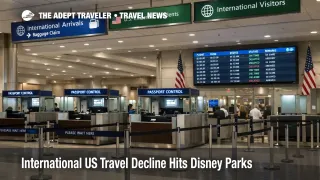
A pullback in international demand for the United States is showing up in big, traveler facing businesses, not just airline and border statistics. The Walt Disney Company told investors it is seeing "headwinds" from international visitors at its U.S. theme parks, and its CFO said the company is shifting promotional focus toward U.S. consumers because it has less visibility into inbound demand. For travelers, the practical takeaway is that costs, screening expectations, and destination crowding may diverge by segment in 2026, so you should price trips with added fees in mind and build more buffer around entry formalities.
The International Travel to US Decline matters because it changes what is expensive, what is crowded, and what is operationally risky on an international itinerary. When inbound volume softens, destinations and suppliers often pivot marketing and inventory toward domestic travelers, while policymakers may still add friction through fees or vetting that disproportionately affects nonresidents.
Who Is Affected
International leisure travelers aiming for U.S. theme parks and resort corridors are directly in scope because Disney tied its U.S. parks performance to weaker international visitation, even as its experiences segment posted about $10 billion in revenue for the quarter ending in late December 2025. That mix can translate into selective discounting on slower dates alongside continued high prices where domestic demand remains strong.
International city travelers and tour groups are also exposed through lodging dynamics. CoStar Group reporting that includes STR data showed U.S. hotel occupancy of 57.9 percent in November 2025, down 2.8 percent year over year, which is consistent with softer demand in parts of the market. In practical terms, that can mean better availability in some downtown cores and shoulder periods, but it will not override the usual spikes from conventions, sports, and holiday travel.
Travelers planning national park heavy itineraries, especially first time visitors, are affected by higher nonresident costs that start to matter at the itinerary level. The U.S. Department of the Interior announced a $100.00 (USD) per person nonresident fee at 11 high visitation parks, plus a $250.00 (USD) annual pass for nonresidents, with an effective date of January 1, 2026. National Park Service guidance explains how the nonresident fee works and how residency is checked at purchase.
Business travelers and families from visa waiver countries are affected by potential changes to U.S. pre travel screening expectations. A Federal Register notice tied to U.S. Customs and Border Protection information collection updates described making social media a mandatory data element for Electronic System for Travel Authorization applications, requiring the last five years of social media, and reporting also noted the proposal was open for public comment at the time.
Finally, travelers should treat government travel advice as an operational input, not background noise, because advisories can drive corporate duty of care rules and traveler confidence. Government of Canada travel advice for the United States includes guidance on border procedures and device searches, and Auswärtiges Amt travel and security advice highlighted the potential for protests and clashes in Minneapolis in late January 2026 updates.
What Travelers Should Do
If you are traveling to the United States in the next few months, build friction into your plan upfront. Budget for higher nonresident national park costs if parks are part of your itinerary, confirm whether anyone in your party needs a visa versus visa waiver authorization, and keep extra document copies and proof of onward travel accessible in case border processing slows.
If your trip is discretionary and price sensitive, set a clear rebooking threshold. If the added fees and screening expectations push your total trip cost materially higher than comparable alternatives, or if your employer or insurer flags new advisory language, it can be rational to shift dates, choose a different U.S. gateway, or swap a national park heavy plan for a city itinerary that is less fee exposed.
Over the next 24 to 72 hours before departure, monitor official rulemaking and advisory updates rather than social media summaries. Check your government's destination page, confirm current park fee rules on the National Park Service site, and watch for updates on ESTA data requirements because proposals can change during the public comment and implementation process.
How It Works
Inbound demand shifts propagate through travel in layers. The first order effect is straightforward, fewer international arrivals mean fewer room nights, attraction visits, and package sales in destinations that rely on overseas travelers. That is the backdrop for Disney's comment that international visitor headwinds are affecting its U.S. parks, and for industry level reporting that foreign visitors to the United States fell in 2025 even as global tourism spending rose, with some travelers choosing alternatives such as Spain, France, and Japan.
The second order effects show up where travelers feel them most: capacity, staffing, and rules. Hotels respond to softer demand with yield tactics that can improve availability on some dates, but big event calendars still create localized sellouts. Attractions and tour operators may retarget marketing toward domestic travelers, which can keep peak crowding high even if inbound volume is down. At the same time, policy changes can increase the "cost and compliance" load of a U.S. trip, such as the January 1, 2026 national park nonresident fees, or the proposed expansion of ESTA data collection to include mandatory social media history.
A third layer is perception and duty of care. When governments update travel advice, even if the on the ground risk is localized, corporate travel programs and insurers may tighten requirements, and that can suppress bookings further. Canada's advisory posture on border device searches, and Germany's guidance around protests, are examples of how traveler behavior can change without any single airline cancellation or airport closure. In that environment, travelers should treat "what changed" as a set of inputs, cost, screening, and situational awareness, and then choose itineraries with enough slack to absorb variability.
Sources
- Disney shares fall as US theme parks see fewer international visitors
- Fewer foreigners visited US in 2025 as global tourism spending rose
- U.S. weekly hotel performance for November 2025
- Nonresident Fees
- Department of the Interior Announces Modernized, More Affordable National Park Access
- Agency Information Collection Activities, Revision, Arrival and Departure Record (Form I-94) and ESTA
- US travel group, foreign tourists leery of Trump plan to vet social media
- Travel advice and advisories for United States (USA)
- United States of America (USA) Travel Advice
- Vereinigte Staaten von Amerika: Reise und Sicherheitshinweise