

Smithsonian Journeys 2027 Solar Eclipse Trips in Spain
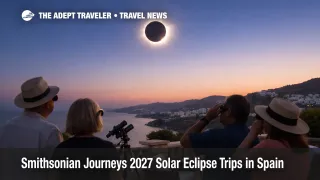
Smithsonian Journeys opened booking for a new slate of 2027 departures that leans into longer stays, scholar led programming, and event driven travel, with solar eclipse itineraries positioned as the headline draw. Travelers planning for southern Spain, Portugal, and Egypt in late July and early August 2027 are the most directly affected because those dates align with the August 2, 2027 total solar eclipse. The practical next step is to pick a viewing style, land based resort stay, small ship voyage, or Nile cruise, then lock deposits early if August 2027 timing is nonnegotiable.
The change matters because eclipse travel behaves differently than normal peak season demand. The eclipse date is fixed, the prime viewing geography is narrow, and capacity is capped by ship berths and hotel room blocks, which pushes earlier sellouts and higher air and ground costs than a typical summer trip. The National Solar Observatory map for August 2, 2027 shows the path of totality crossing southern Spain and continuing across North Africa and into the Middle East, with maximum totality near Luxor lasting about 6 minutes, 22 seconds.
Within Spain, Smithsonian Journeys is selling an eight day Andalusia program timed to eclipse week, while its PONANT partnership is selling a weeklong Iberian Peninsula voyage designed to view totality from a ship positioned within the band of totality offshore. In Egypt, the operator is also marketing Nile cruise based eclipse programs that combine temple touring with eclipse day operations near Luxor.
For travelers who want more time in place rather than a fast moving circuit, the same 2027 release expands longer format products, including a 23 day Living In stay on Poros in Greece, and new Cultural Stay style trips such as Copenhagen, plus art history focused stays in Paris and Madrid. Separately, two river cruise options with AmaWaterways add capacity in France and on the Mekong, extending the operator's alliance in a part of the market where sailings can sell out far in advance. For related context on prior Smithsonian Journeys cruise inventory, see Smithsonian Journeys and PONANT Are Adding 2027 Eclipse Sailings and Smithsonian Journeys Adds 42 River Cruises for 2027.
Who Is Affected
Travelers with fixed vacation windows around late July and early August 2027 are the core audience for the eclipse departures, especially those who need specific school break weeks or who are coordinating multi generational travel. Advisors and independent travelers who typically book last minute are also affected because eclipse inventory can disappear before air schedules for 2027 are fully mature, which increases the chance of paying more for suboptimal flight times or needing extra hotel nights.
Spain bound travelers are affected in two different ways. The Andalusia stay is built around being on the ground, in a resort base, and moving by road to planned viewing and touring sites, which favors travelers who want a stable home base and predictable nights. The Iberian Peninsula voyage favors travelers who want a controlled viewing environment at sea, fewer moving parts on eclipse day, and a built in commentary program, but it also concentrates capacity into a few hundred berths, which can create earlier sellout pressure than land programs.
Egypt bound travelers are affected by both the opportunity and the operational constraints of Nile cruising during a global event week. The upside is access to eclipse viewing near Luxor paired with guided temple touring. The constraint is that Nile cruise operations depend on coordinated docking, convoy style movements, and tight day by day timing, so changes to one segment can ripple into the rest of the program more than a typical land tour would.
Separately, travelers who are not eclipse focused but want long, immersive trips are affected by the expansion of Living In and Cultural Stay style products, which tend to appeal to slower travelers, remote workers with flexible calendars, and repeat Europe visitors who want depth rather than distance. The Poros Living In program and the Copenhagen and art history stays are examples of trips where hotel location, included talks, and day trip logistics matter more than ticking off a long list of cities.
What Travelers Should Do
If August 2027 eclipse viewing is the goal, decide first whether you want land based certainty or ship based flexibility, then book the trip style that matches your risk tolerance. Land stays usually require you to manage airports, transfers, and sometimes long road moves on eclipse day, but they offer stable lodging and easier add on nights. Ship based viewing reduces day of positioning decisions, but you are buying limited cabin inventory and a fixed sailing plan, so the best cabins can vanish early.
Use a simple threshold for rebooking versus waiting. If your preferred departure is already waitlisted, or if only higher cabin categories remain on the voyage option, assume pricing will not improve and look at alternate dates, alternate trip styles, or alternate departure gateways immediately. If your departure is available but air schedules are not yet ideal, it can still be rational to secure the tour first, then hold airfare until schedule changes settle, provided your tour cancellation terms, and your insurance strategy, support that approach.
Over the next 24 to 72 hours, monitor three things that change the real cost of these trips. First, whether the operator is releasing additional departures for the eclipse products, which can relieve scarcity. Second, whether hotel categories and pre or post nights are still available around the program dates, because that is often the first pressure point in event weeks. Third, whether your likely gateways, especially Madrid, Malaga, Lisbon, and Cairo, are showing early signs of constrained inventory for August 2027, which is when locking refundable hotel and air options can reduce downstream stress.
Background
A total solar eclipse is a narrow path event, meaning only travelers inside the band of totality see full totality, and everyone else sees a partial eclipse. For August 2, 2027, authoritative eclipse mapping shows totality crossing southern Spain and continuing across North Africa and into the Middle East, with the longest totality near Luxor. That geographic funnel is why eclipse travel triggers earlier booking behavior, and why prices often rise in gateway markets even when the viewing location itself is not a traditional mass tourism hotspot.
In travel system terms, the first order effect starts at inventory. Tours have hard caps, hotel blocks are finite, and small ships have limited berths, so demand concentrates quickly into specific departures and lodging categories. The second order effects show up in air schedules and ground transport. Travelers arriving on the same narrow set of days create spikes in airport and hotel demand, and they also load up rail, car, and driver guide capacity on the same corridors, especially if everyone is trying to position into Andalusia or Luxor within a short time window.
A third layer of ripple comes from how a traveler's risk management choices interact with the operator program. Land based eclipse stays require dependable road transfers and clear decision points for weather contingencies, while cruise based viewing shifts that risk into ship routing, port timing, and sea state considerations. Separately, the expansion of longer format Cultural Stays and Living In programs changes how travelers build their overall year. Longer stays can reduce the number of flights and transfers, but they can increase exposure to one destination's local transportation, seasonal events, and accommodation constraints. River cruises add another system layer, because waterborne itineraries have fixed embarkation points and limited weekly departures, which makes missed connections more expensive than on a daily city break.
Sources
- Smithsonian Journeys Announces New Trips for 2027, GlobeNewswire via Business Insider
- Smithsonian Journeys reveals 2027 trips, including solar eclipse tours, Travel Weekly
- Solar Eclipse Over Andalusia: A One-Week Stay in Spain, Smithsonian Journeys
- A Solar Eclipse at Sea: Voyage Along the Iberian Peninsula, Smithsonian Journeys
- Solar Eclipse Over Egypt: A Nile Cruise in the Path of Totality, Smithsonian Journeys
- August 2, 2027 Solar Eclipse Map, National Solar Observatory
- Living in the Greek Isles: A Stay on Poros, Smithsonian Journeys
- Copenhagen: A One-Week Stay in Denmark, Smithsonian Journeys
- A Stay in Paris: An Art History Journey from the Medieval to Monet, Smithsonian Journeys