

United Starlink Wi-Fi Expands On Regional Jets
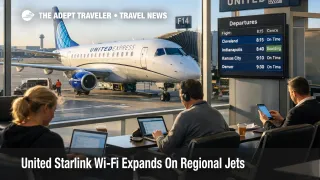
United Airlines says it has completed Starlink Wi-Fi installation across most of its two-cabin regional fleet, putting the high-speed satellite service on more than 300 regional aircraft. The change affects travelers flying on United Express routes that use larger regional jets, including much of the Embraer 175 flying, and United says more than 25% of its daily departures, about 1,200 flights, now have Starlink onboard. Travelers who care about staying connected should confirm the aircraft type before booking, make sure they can log into a MileagePlus account, and keep an offline fallback in case of aircraft swaps.
The practical meaning of this milestone is that "regional jet" no longer automatically implies unreliable internet for many United itineraries. United says Starlink-equipped regional aircraft have carried more than 7 million passengers over more than 129,000 flights in the last 10 months, powering 3.7 million devices, and the airline reports that Wi-Fi satisfaction scores on those aircraft have nearly doubled. For travelers, that combination matters because it signals both scale and operational confidence, not just a limited trial on a handful of routes.
United is also tying the regional rollout to a broader fleet plan. The airline says it expects to equip more than 500 mainline aircraft with Starlink by the end of 2026, which would put the total number of Starlink-equipped planes across its fleet above 800. United has already used the mainline program to demonstrate "gate to gate" connectivity as a selling point, including a high-profile first mainline Starlink flight in late 2025.
Who Is Affected
United Express travelers on two-cabin regional jets are the primary beneficiaries right now, especially on routes where the timetable frequently shows an Embraer 175. In the real world, aircraft assignment is what drives your experience, not the route name, so the same city pair can alternate between an equipped jet and a non-equipped jet depending on rotations, maintenance, and last-minute substitutions.
The biggest near-term winners are travelers who need consistent connectivity for work, or who want reliable streaming on shorter hops that previously had uneven performance. United has been explicit about using Starlink to enable onboard streaming, gaming, and real-time productivity tasks that are sensitive to latency and dropouts, and that matters most on itineraries where you do not want to bet on airport Wi-Fi during a connection.
There is also an indirect benefit for disruption management. When irregular operations hit, a working connection can let passengers rebook, message hotels, and coordinate pickups while still in the air, which can be the difference between landing into a sold-out last flight bank and landing with a protected alternative already in place. This dovetails with what travelers have been seeing in other United-heavy hubs, including capacity changes and competitive schedule churn at Chicago O'Hare International Airport (ORD) O'Hare United American Fare War Hits Summer Flights.
What Travelers Should Do
Start with the one thing you can control, confirm your aircraft type. On United, the booking flow and the trip details page typically show the operating carrier and aircraft (for example, Embraer 175), and that is your best proxy for whether you are likely to see Starlink on a regional itinerary. If connectivity is mission-critical, pick flights where the aircraft type is shown clearly, avoid ultra-tight connection plans that leave no room for an aircraft swap, and build your work plan assuming you might still need to function offline.
Decide what would make you rebook versus wait if you do not see the aircraft you want. If you are taking a short flight where connectivity is a nice-to-have, it may not be worth paying extra for the possibility of Starlink. If you have a live meeting, time-sensitive file work, or you are coordinating ground logistics at arrival, it can be rational to choose an itinerary with more aircraft certainty, even if it costs more or adds time, because a single missed deliverable can be more expensive than the fare difference.
Over the next 24 to 72 hours before departure, monitor the operational signals that change onboard experience, including aircraft assignment updates, app notifications, and seat map shifts that sometimes accompany an equipment change. United has said MileagePlus members will receive a notification before their flight if it is equipped with Starlink, so treat that as the most actionable traveler-facing confirmation. If you do not get the confirmation, assume you might be on legacy Wi-Fi and pre-download anything you cannot risk losing.
How It Works
In-flight Wi-Fi quality is mostly a systems problem, not a marketing problem. Satellite internet performance depends on the link budget, antenna design, coverage along the route, and how the onboard network manages many devices simultaneously. Traditional inflight systems can struggle with latency and consistency, which is why many travelers experience "connected but unusable" moments, especially when trying to stream, use VPN, or collaborate in real time.
United is positioning Starlink as a step-change because it is designed for low latency connectivity, and because the airline is pairing the service with a fleetwide installation push rather than leaving it as a premium add-on on a handful of aircraft. That scale matters operationally, because it reduces the odds that a crew swap or aircraft swap forces customers into a completely different connectivity experience without warning, and it lets United standardize onboard support and troubleshooting.
The ripple effects show up across the travel system. First-order, the change improves what you can do onboard, which can make short business trips more workable and reduce the need to pad itineraries with long airport dwell time. Second-order, better connectivity can change passenger behavior during disruptions, because people rebook earlier and more aggressively when they can do it in flight, which can tighten the window for last-seat inventory on popular routes. On the airline side, the rollout is gated by FAA approvals for each aircraft type, and United has said it is seeking approval across additional models, which is why travelers should expect an uneven transition period where some fleets have Starlink and others do not.