

A939 Snow Gates Close Highlands Route Feb 4
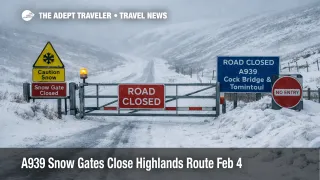
Snow gate closures are active on the A939 mountain route in northeast Scotland, a key winter crossing used by drivers moving between Speyside and Deeside. Traffic Scotland's snow gates page lists the A939 at Cock Bridge as closed, and it also shows a second A939 closure near Tomintoul, both due to adverse weather. When these gates shut, the direct line across the high ground can stop abruptly, turning what looks like a short reposition into a long, lower elevation detour.
For travelers, the practical problem is not only the extra mileage. It is the loss of predictability. A closure that begins in the evening can break a next morning plan, and a closure that extends through daylight can cascade into missed distillery tour slots, skipped lodge check ins, and abandoned same day rail connections that had tight margins. In winter conditions, even "open" alternatives can run slower than mapping apps suggest, so the time risk often exceeds the distance risk.
The safest way to treat active snow gate operations is to assume the mountain crossing is unavailable until you have confirmed otherwise from a live status source shortly before departure. In this corridor, the gate decision is an operational control that prioritizes safety on exposed road sections, and it can move faster than third party navigation updates, especially during drifting snow and low visibility conditions.
Who Is Affected
Drivers doing any Speyside to Deeside crossing planning are the core affected group, including travelers staying at rural hotels, lodges, and small towns that sit on opposite sides of the high route. If your itinerary includes whisky visits, ski access, or guided day tours that depend on early arrivals, snow gate closures can turn an on time plan into a late arrival without much warning, because detours tend to pull you onto fewer main corridors where congestion and winter speeds compound.
Travelers trying to make timed connections are also exposed. If you are driving to meet a train departure, or you are positioning for a flight the same day, your risk is not just arriving late. The bigger issue is that the detour may not be obvious until you are committed to the approach roads, at which point your remaining options shrink. This is especially relevant for travelers aiming to reach Inverness Airport (INV) or Aberdeen International Airport (ABZ) for departures, because winter reroutes can push you into busier arterial corridors where a single incident can add another layer of delay.
Tour operators and transfer providers are the next layer. When gates close, drivers who are still moving often cluster onto the same lower routes, and that can cause missed pickup windows, delayed private transfers, and reshuffled day plans. That, in turn, drives second order ripples such as last minute accommodation demand, restaurant capacity pressure in the nearest open towns, and higher car rental replacement demand when a planned one way segment becomes impossible within the original time box.
What Travelers Should Do
If you are traveling on February 4, 2026, treat the A939 snow gate status check as a pre departure requirement, not a nice to have. Use Traffic Scotland's snow gates list and its incident feed to confirm whether the A939 is open at Cock Bridge and near Tomintoul shortly before you leave, and again if conditions worsen. If the gates are closed, reroute early rather than driving toward the closure and hoping it reopens, because you can lose time twice, once on the approach and again on the backtrack.
Set a decision threshold that protects your hard cutoffs. If you must reach a station or an airport the same day, a conservative rule during active snow gate operations is to add at least 90 minutes beyond your normal winter drive estimate for any plan that would have used an exposed mountain crossing. If your drive would have depended on the A939 high segment specifically, consider an even larger cushion or an overnight near your departure point, because the "reopen time" can be uncertain and can change with wind and drifting.
Over the next 24 to 72 hours, watch three signals together. First, the live snow gate status and incident notes from Traffic Scotland, because that is the authoritative operational control for whether the route is actually passable. Second, local enforcement or operator updates, such as Police Scotland regional posts and local roads authority updates, which can confirm deteriorating conditions and reinforce that closures are not speculative. Third, Met Office warnings, which explain the broader weather pattern that can keep high routes closed even when lower roads look manageable.
For practical detours, prioritize lower, trunk road corridors where services, lighting, and winter response are typically stronger than on exposed passes. Many travelers shifting between Inverness side routes and Aberdeen side routes will find the A96 corridor a more resilient backbone during snow gate periods, even if it is longer than the direct mountain line. If you are staying rural, the key is to choose a detour that keeps you on maintained main roads sooner, rather than chaining multiple minor roads to recreate the direct crossing, because those smaller links can degrade faster in drifting conditions.
Related coverage that may help you plan around broader Scotland weather impacts includes UK Snow Warnings Disrupt Rail and Ferries Feb 3 and Loganair Scotland Snow Waiver Feb 3 to 4 Flights, especially if your itinerary mixes road transfers with rail, ferries, or flights.
Background
Snow gates are a safety control used on some of Scotland's most exposed roads to prevent traffic from entering high risk segments when snow, drifting, or visibility make conditions unsafe. For travel planning, that means a route can shift from "open" to "not usable" quickly, and reopening can depend on both snowfall rates and wind, because wind can refill cleared sections and reduce visibility even after plowing.
The first order effect is straightforward, a closed gate breaks the direct driving line, adds distance, and adds time. The second order ripple is where many trips fail: detours push more vehicles onto fewer trunk corridors, which increases the odds of congestion and secondary incidents, then that drives missed tour pickups, missed check in windows at rural properties, and misconnects into rail and flights that have fixed departure times. Because alternatives in rural areas are thinner, the recovery path often becomes an unplanned overnight, and that is why same day plans should be built with a bigger buffer when gates are active.