

Flight Delays and Airport Impacts: February 4, 2026
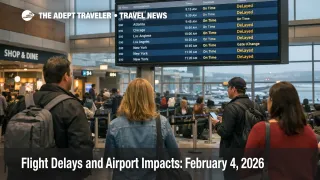
Low clouds are the main operational watch item for U.S. flying on February 4, 2026, with the Federal Aviation Administration calling out possible delay pressure in Nashville International Airport (BNA) and Seattle Tacoma International Airport (SEA). Travelers connecting through Charlotte Douglas International Airport (CLT) also face added risk because low ceilings at a hub can quickly reduce arrival rates and turn a normal schedule into rolling gate holds. For many travelers, the practical move is simple, add time buffers, avoid razor thin connections, and monitor FAA and airline updates so you can pivot before airport lines build.
The second factor today is demand, not weather. The FAA also warned that high Super Bowl travel volume may affect Bay Area flying, especially through San Francisco International Airport (SFO), Oakland International Airport (OAK), and San Jose International Airport (SJC), which can amplify delay impact when there is less slack in gates, crews, and spare seats.
Who Is Affected
The most exposed group is anyone whose itinerary depends on a connection at Charlotte. When ceilings drop, the airport can accept fewer arrivals per hour, and the system responds by metering departures headed to that hub. That is why a traveler can see a departure delay at an origin airport that has clear weather, the constraint is downstream, and the delay is created upstream to prevent airborne congestion and missed spacing requirements.
Travelers flying into or out of Nashville and Seattle should treat the day as condition dependent. Low cloud and ceiling forecasts often translate into intermittent flow programs rather than a single, clean disruption window, so flight status can look stable and then deteriorate as arrival rates tighten. The risk is not only a late arrival, it is the cascade into missed connections, rebookings onto later banks, and fewer remaining seats if the day gets compressed.
In the Bay Area, higher passenger volume tied to Super Bowl travel can make small operational slowdowns feel bigger. When flights are fuller, rebooking choices shrink, standby clears less often, and a single missed connection is more likely to become an overnight problem. If your itinerary relies on SFO, OAK, or SJC, the smart posture is to protect your first departure and keep buffers on both ends, including ground transfers and hotel check in timing.
What Travelers Should Do
Start with immediate actions that reduce exposure to surprise holds. Check your airline app before you leave for the airport, then cross check the FAA's National Airspace System status tools for any emerging delay programs affecting your destination or connection point. If you are connecting, prioritize the earlier of two workable options, because earlier departures preserve reroute and reaccommodation inventory when the system tightens.
Use clear decision thresholds for rebooking versus waiting. If your connection through Charlotte is tight enough that a modest arrival delay breaks it, or if you are booked on the last reasonable departure bank of the day, moving to a nonstop, a different hub, or an earlier routing is usually the safer trade while seats still exist. If your delay is still measured in minutes and you have multiple later options, waiting can be rational, but only if you have a credible backup for an overnight and you are not chaining separate tickets.
Over the next 24 to 72 hours, monitor whether the low cloud forecast verifies and whether event volume begins to trigger flow management into the Bay Area. Watch for signs like rising average delay times, frequent gate holds on inbound flights, and airline notifications offering flexible changes, which often signal the carrier expects continued irregular operations. If you have a high stakes arrival, such as a cruise embarkation, a medical appointment, or a ticketed event, treat any deterioration in hub reliability as a trigger to de risk the itinerary early.
How It Works
The FAA daily outlook is an operations planning snapshot, it highlights the specific constraints most likely to reduce capacity at major airports and airspace regions. Low clouds and low ceilings matter because they can force instrument arrival spacing and reduce how many aircraft can safely land per hour. Once a hub's arrival acceptance rate drops, traffic managers protect the system by slowing departures headed there, which shows up to travelers as gate holds, longer taxi outs, and missed connection windows even far from the weather.
Demand surges, like Super Bowl travel volume, are a different kind of constraint. Higher load factors reduce the system's ability to self heal because there are fewer empty seats to absorb misconnects, and gate and ramp resources are used more continuously. That combination can turn a modest weather or traffic management issue into a bigger traveler problem, especially later in the day when crews are closer to duty limits and there is less remaining schedule to recover.