

South East England Rail Disruption Hits Gatwick Links
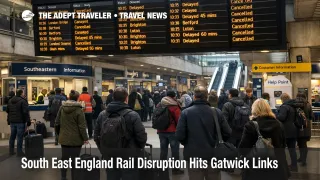
Rail travel across South East England was hit by major disruption after multiple incidents, including a derailment inside Selhurst depot in south London and a signalling fault on the corridor between Norwood Junction and London Blackfriars. Southern, Thameslink, and Gatwick Express services were affected, with widespread cancellations, alterations, and severe delays reported through the morning and into the day. Travelers heading for airport rail connections, especially those using central London terminals, needed to protect check in and bag drop windows by adding time, switching routes, or moving to road transport earlier than planned.
The South East England rail disruption changed the reliability of the main London, Sussex, and Thameslink corridors on February 4, 2026, which increases the chance that an otherwise normal airport transfer turns into a missed flight.
Who Is Affected
Travelers using Southern, Thameslink, and Gatwick Express are the core group, but the impact spreads to anyone whose journey depends on the same tracks and junctions. The highest risk itineraries are those that rely on London Bridge as the key interchange, or that run through Norwood Junction and East Croydon, because those locations sit on the Brighton Main Line and several branches that feed the airport and London terminals. National Rail warned that journeys could be delayed by up to 60 minutes and advised allowing at least an extra 45 minutes in general, and at least an extra 60 minutes for trips to London Gatwick Airport (LGW) or London Luton Airport (LTN).
If you are traveling to or from London Bridge, the practical constraint is reduced service and unpredictable platforming, not just slower running. Several Thameslink services were diverted after East Croydon and London Blackfriars and did not call at London Bridge for part of the day, which matters because a "short hop" between terminals can become a forced reroute through a different station, plus extra walking, plus extra waiting. Routes that were suspended or heavily altered also change passenger loading across the network, so even trains that run can become crowded earlier than usual, especially on the remaining paths into central London and on any remaining airport bound departures.
What Travelers Should Do
Start by treating your airport arrival time as a hard deadline, then work backward with a larger buffer than usual. If your rail plan no longer gets you to the terminal at least two to three hours earlier than you would normally aim for, shift immediately to an alternative route or road transport rather than waiting for incremental updates that may not restore headways fast enough. For London Gatwick, the real risk window is not only the final approach, it is the whole chain, because one cancelled train can push you onto the next service that is already crowded or short formed.
Use decision thresholds that protect you from late day recovery fragility. If you are still outside London and your best rail option depends on a single interchange at London Bridge, consider routing to London Victoria instead, because official disruption advice flagged Victoria as a better alternative for many passengers trying to reach central London when London Bridge service is significantly reduced. If your itinerary involves separate tickets, an inflexible long haul departure, or checked baggage with a firm cut off, the bar for switching to road should be lower, because the cost of being wrong is higher than the cost of a taxi or rideshare.
Over the next 24 to 72 hours, monitor two signals, not just one. First, watch for operator updates that confirm normal depot movements and stable headways, because a depot derailment can keep the timetable thin even after the peak delay headlines fade. Second, watch for any renewed signalling limitations on the Norwood Junction to London Blackfriars corridor, because the described failure mode forces slower running and can keep delays sticky even when services are technically operating. If your trip is tomorrow or later this week and you can choose between a same day airport transfer and an overnight near the airport, choose the option that removes the tightest connection from your plan.
How It Works
This disruption is a classic example of how a problem at a depot and a problem on a mainline corridor combine into a network wide reliability hit. A derailment at Selhurst depot limits how many trains can leave the depot to enter service, which reduces the available fleet at exactly the time commuter and airport demand ramps up. With fewer trains to cover the timetable, cancellations increase, gaps widen, and crowding builds, which then slows station dwell times and makes on time running harder to recover.
At the same time, signalling faults on busy junction corridors reduce throughput even for the trains that are available. National Rail's incident explanation noted that the affected area uses track circuits to detect trains, and when a circuit fails, the system may treat a section as occupied, which forces trains to proceed more cautiously under restrictive instructions. That is why you can see a full service pattern on paper but still experience long delays and sudden platform changes in practice, especially through pinch points like Norwood Junction, East Croydon, and the London Bridge and London Blackfriars approaches.
The second order ripple hits travel decisions beyond rail. When rail becomes unreliable, taxi and ride hail demand spikes, road congestion increases around station forecourts and airport approaches, and hotel inventory tightens near major terminals as travelers choose not to risk same day repositioning. For London Gatwick Airport, missed rail transfers often compress airline check in windows and can force expensive same day flight changes, or an unplanned overnight, especially for early afternoon departures where you do not have a later train bank that still protects the airport arrival buffer. That is why the correct response is not only to "leave earlier," it is to decide, based on your risk tolerance and fare rules, when to switch modes or rebook rather than absorbing uncertainty.
Sources
- Major disruption affecting Gatwick Express, Southern and Thameslink expected until the end of the day, National Rail
- South-east England 'do not travel' rail alert lifted but disruption continues, The Guardian
- Train cancellations and delays hit routes across South East England after multiple incidents, Sky News
- 'Do not travel' alert lifted by UK's biggest train franchise, ITV News Meridian
- TSSA comment on major rail disruption across south-east England, TSSA