

Super Bowl LX Santa Clara TFR Limits Flights
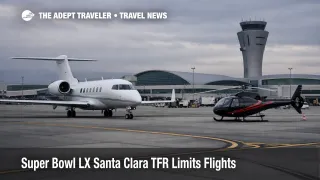
The Federal Aviation Administration is tightening Bay Area airspace for Super Bowl LX with a temporary flight restriction, or TFR, centered on Levi's Stadium in Santa Clara, California, on February 8, 2026. The travelers most affected are those using private aviation, on demand charters, sightseeing helicopters, and any short hop repositioning flights that normally move under visual flight rules, or VFR, between reliever airports. If you have an event timed arrival, the practical move is to shift flight timing outside the core restriction window, or plan to complete the last leg by car once you are positioned outside the ring.
The expected restriction window for the game day TFR is 230 p.m. to 830 p.m. Pacific Time on February 8, 2026, and the FAA's published materials describe a 30 nautical mile outer ring with a more restrictive 10 nautical mile inner core. In plain traveler terms, this is the kind of special event airspace that can turn a simple Bay Area hop into a longer routing with mandatory ATC coordination, plus the risk that controllers may deny certain requests when workload spikes.
Who Is Affected
Business aviation and charter passengers are the primary audience because many trips that look straightforward on a map rely on VFR flexibility, quick turn times, and short reposition legs. Operators serving San José Mineta International Airport (SJC), Oakland International Airport (OAK), and the reliever network that includes Palo Alto Airport (PAO), San Carlos Airport (SQL), Reid Hillview Airport (RHV), and Hayward Executive Airport (HWD) should expect constraints that show up as longer routes, delayed releases, and stricter instructions on where you can transit and how long you can remain in a given area.
Helicopter travelers and sightseeing flights are also exposed because the same event security posture that drives the TFR also tends to reduce tolerance for holding, loitering, and ad hoc routing near the venue corridor. Even when a flight is technically allowed, ATC may limit discretionary movements to keep traffic predictable. That is why helicopter tours that normally hug the Bay shoreline or circle landmarks often shorten routes, shift to different times of day, or cancel outright.
Drone operators, including travelers who planned aerial shots as part of a Super Bowl week itinerary, face a separate set of no drone zones that extend beyond the stadium itself. FAA and FBI messaging for Super Bowl LX includes downtown San Francisco venue protections in the days leading up to the game, plus a game day set of restrictions that include smaller radius blocks around the stadium outside the main game window, and the larger 30 nautical mile restriction during the game window. If you are traveling with a drone, assume you may not be able to fly it legally anywhere near official event venues, even if you are not at the stadium.
What Travelers Should Do
Take immediate actions and build buffers. If you are flying private or charter into the Bay Area for Super Bowl LX, ask your operator to translate the TFR into your exact local schedule, including the latest safe arrival time before restrictions tighten, and the earliest realistic departure time after they lift. Lock your ground transfer early, because when aircraft cannot reposition freely, the shortage often shows up as higher priced last minute cars, and longer pickup windows.
Use a clear decision threshold for moving earlier versus waiting. If your trip depends on arriving in the South Bay during the afternoon, treat the TFR start time as a hard operational boundary, not a suggestion, because a small upstream delay can push you into the restricted period and trigger a cascade of ATC constraints. A practical threshold is this, if your wheels down time would be within two hours of the restriction start, move earlier, or position to a farther out airport and drive the final leg, because you are trading a known ground delay for an unknown airspace delay that can grow quickly when demand spikes.
Monitor specific signals in the 24 to 72 hours ahead. Watch for FAA or industry flight advisories that update the exact NOTAM timing, watch your operator's slot, parking, and handling confirmations at your destination airport, and watch for local ramp advisories that hint at congestion at relievers. For drones, monitor the FAA and FBI no drone zone guidance for the venue list and time windows, and treat any uncertainty as a no fly decision, because enforcement actions and safety risks rise sharply around high profile events.
How It Works
A Super Bowl TFR is a security and traffic management tool that reshapes normal airspace rules to protect the venue and reduce complexity for air traffic control, or ATC, during a high demand period. The FAA's Super Bowl LX materials describe a 30 nautical mile ring and a more restrictive 10 nautical mile inner core around Levi's Stadium, with the main game window expected to run 230 p.m. to 830 p.m. PT on February 8, 2026. In that window, the rules shift from flexible VFR transits to tightly managed operations, where aircraft often need specific ATC authorization, must follow defined procedures, and may be prohibited from loitering.
The first order effects start at the source, which is flight planning and ATC workload. When a large ring restricts routes, aircraft that would normally cross the South Bay directly may be pushed to the edges of the ring, and that concentrates traffic into fewer corridors. At the same time, controllers have to manage compliance, sequencing, and coordination, so they have less capacity for discretionary requests, which is why short notice charters and helicopter tours are the first services to get squeezed.
The second order ripples show up across at least two other layers of the travel system. First, charter availability and pricing can tighten because operators reposition aircraft earlier and keep them staged where they can guarantee legal access, which reduces the pool of aircraft willing to accept late booked or tight turnaround trips. Second, reliever airports and ground transfers take on more load because travelers shift to airports outside the most constrained areas and finish the last leg by car, which can create ramp congestion, parking constraints, and longer waits for cars and drivers. If you want a broader reliability lens on how staffing and capacity limits propagate through the U.S. airspace system during peaks, see U.S. Air Traffic Control Privatization: Reality Check.