

American Airlines Fern Crew Fallout, U.S. Delay Risk
American Airlines has started processing compensation claims for flight attendants affected by Winter Storm Fern, and the paperwork trail is a useful signal for travelers watching reliability after a major disruption. When a carrier is untangling hotel failures, transportation gaps, and rescheduling violations for thousands of crew members, it usually means the operation did not just lose flights to weather, it also lost the predictable crew positioning that keeps a network stable. For passengers, that translates into a higher chance of short notice cancellations, last minute equipment swaps, and missed connections that show up days after the storm headline fades.
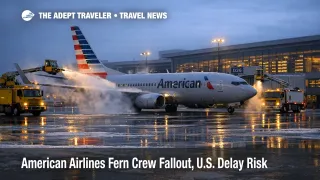
Winter Storm Fern hit multiple parts of the U.S. system hard, and American itself described it as a historically severe weather disruption for the airline, with five of its nine hubs significantly impacted. Dallas Fort Worth International Airport (DFW) was a central pressure point because prolonged ice and below freezing temperatures reduced safe departure rates, created gate congestion, and complicated deicing timing. As the storm moved and airport conditions changed rapidly, the operational problem became less about a single airport closure and more about the chain reaction, aircraft out of place, crews timed out, and limited hotel capacity where both passengers and crews needed rooms at the same time.
Who Is Affected
Travelers flying American Airlines in the next few recovery days are the most exposed when their itinerary touches major hubs, especially Dallas Fort Worth and Charlotte Douglas International Airport (CLT), because hub banks concentrate risk. If an inbound aircraft arrives late, or if a crew times out at the end of a duty day, the next bank can unravel quickly, and the disruption spreads beyond the original weather footprint.
Passengers with tight connections are the second group at risk, particularly those connecting from regional flights into long haul or final bank departures. Recovery periods often look stable early in the day, then deteriorate in the afternoon when aircraft rotations are delayed, reserve staffing thins, and gate availability becomes the constraint rather than weather. When that happens, the same day reaccommodation pool shrinks fast.
Anyone traveling on separate tickets, or protecting a hard deadline like a cruise embarkation, a wedding, a medical appointment, or a time fixed event, should treat this as a higher risk category. Even if American rebooks a disrupted flight, the downstream provider usually does not owe protection, and a missed connection can become an overnight with out of pocket costs.
What Travelers Should Do
Start with immediate actions and buffers. If you are flying American in the next 24 to 72 hours, move to an earlier departure if you can, and avoid the last reasonable flight of the day on any segment that must work. Use the airline app to monitor status, and screenshot alerts and receipts, because recovery days can produce fast changes, and documentation matters for reimbursements and insurance.
Use a clear decision threshold for rebooking versus waiting. If your first leg is already delayed, if your connection is under about two hours, or if you are routing through Dallas Fort Worth or Charlotte during peak banks, it is often smarter to lock in an alternative while seats still exist, even if you hope the original plan holds. Once reaccommodation surges, the travel day can flip from "late" to "tomorrow," especially on hub to hub flights where every disrupted passenger is chasing the same limited inventory.
Monitor a few concrete signals over the next 24 to 72 hours. Watch whether the airline is still canceling a meaningful share of flights at the big hubs, and whether your specific flight is part of a late day bank that depends on multiple inbound aircraft. If your trip is high stakes, consider rerouting through a different hub, or shifting the trip by a day, because the operational aftershocks of crew displacement can linger even after local weather improves.
Background
Airline recovery is a logistics problem, not a single weather event. A network carrier schedules aircraft and crews in tightly linked rotations, and a large storm breaks those rotations in two ways at once. First, reduced departure rates and ground stops strand aircraft and crews away from where the next flights were supposed to start, and second, crew duty time rules mean delays can make a crew illegal to operate later flights even if the aircraft is ready.
The crew side is where the compensation story matters. Flight attendants and pilots need hotels, transportation, and timely rescheduling during irregular operations. When those systems fail at scale, crews can be effectively removed from the usable pool, either because they are stuck waiting, because scheduling cannot legally assign them, or because the next day sequence can no longer be built reliably. American's own storm updates emphasize how gate constraints, deicing limits, and staffing challenges across airport partners can slow the restart.
Second order ripples hit travelers beyond the airport itself. Misconnects rise as hubs run out of slack, and reaccommodation pushes passengers into later flights that are already full. Hotels near hub airports can tighten as displaced passengers and crews compete for the same inventory, which can raise prices and force longer ground transfers. Even routes far from the storm can see delays if inbound aircraft and crews are late arriving from disrupted hubs, a classic cascade effect that makes reliability uneven until the network is fully rebalanced.
Sources
- American makes continued progress in its recovery from Winter Storm Fern
- Company Accountability for Contract Violations: Winter Storm Fern
- Winter Storm Fern Update, January 26, 2026
- Winter storm snarls US travel, forces mass flight cancellations
- American Airlines starts compensating flight attendants left stranded during Winter Storm Fern
- American still cancelling hundreds of flights as rivals resume normal operations