

Spirit O'Hare Gate Sale To United Set For Feb 24
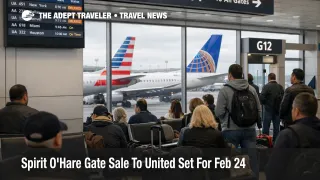
Spirit Airlines has asked a bankruptcy court to approve a $30.2 million gate transfer that would move two Spirit gates, G12 and G14 in Concourse G, to United Airlines at Chicago O'Hare International Airport (ORD). The request comes as Spirit continues to shrink its footprint at O'Hare, after previously selling two other O'Hare gates to American Airlines for $30 million in early December 2025. For travelers, the immediate issue is not the price tag, it is how gate access shapes flight schedules, gate holds, and last minute gate swaps at one of the country's busiest hubs.
The court timeline is short and specific. Objections to the proposed transfer are due February 17, 2026, and a hearing is scheduled for February 24, 2026 in the U.S. Bankruptcy Court for the Southern District of New York. If the deal is approved, United has told employees it expects to begin operating from the gates late in the second quarter of 2026.
United's internal message adds an important nuance for how long any gate advantage might last. United's Chicago O'Hare vice president, Omar Idris, wrote that one of the gates would return to the Chicago Department of Aviation for reallocation at the end of September, and the other would remain with United longer term. That split matters because a temporary gate can still support seasonal schedule peaks, but it does not guarantee durable capacity in future years.
Who Is Affected
United and American passengers are the ones most likely to feel second order effects, even if they never set foot in Concourse G. Gates are a hard constraint on how airlines build "banks" of arrivals and departures, which in turn sets connection windows, aircraft turns, and crew flows. When gate frontage is tight, arriving aircraft can wait for an open gate, and those minutes roll forward into missed departure slots, longer connection walks, and more aggressive gate swapping that can confuse travelers already navigating delays.
The backdrop is a long running gate fight between United and American at Chicago O'Hare, which escalated after the City of Chicago reallocated gates based on flying levels. United's CEO, Scott Kirby, publicly framed 2026 as a "line in the sand" moment, signaling United would add flights as needed to protect its gate position. The Spirit gate deal, if approved, is a different tactic, it is a direct purchase of capacity access rather than purely a schedule response.
Spirit travelers are also affected, but in a different way. Spirit has been operating a reduced schedule at O'Hare, and the bankruptcy filing argues the transfer produces better recovery for creditors than alternatives, while Spirit can rely on common use gates for whatever flying remains. For travelers, the practical takeaway is that Spirit's O'Hare footprint is likely to stay smaller and more flexible, which can mean more day to day variability in where a flight parks, and how long it takes to get passengers on and off during busy periods.
What Travelers Should Do
Travelers flying through Chicago O'Hare in spring and summer 2026 should plan for gate changes to show up as operational friction, not as a neat before and after map. Keep airline app notifications on, because gate changes and terminal instructions are most useful when they arrive early enough to change your walking plan, your lounge plan, or your connection strategy.
If your itinerary includes a short connection at Chicago O'Hare, treat this as a reason to add buffer, especially on separate tickets. A gate hold on arrival is invisible when you are still taxiing, but it can wipe out the margin that made a 45 minute connection feel safe on paper. If rebooking options are limited, prioritize earlier flights, because late day delays can compress recovery options and increase the odds of an overnight stay.
Over the next 24 to 72 hours, watch for two things, the legal milestone, and the schedule response. The legal milestone is whether any objections are filed by February 17, 2026, and how the judge rules at the February 24, 2026 hearing. The schedule response is whether either airline loads additional frequencies, or shifts departure times, around peak travel weeks as they position for the summer push at Chicago O'Hare.
How It Works
At U.S. hub airports, gates are more than parking spots, they are the scarce resource that determines how many aircraft can be turned per hour, and how reliably an airline can recover when something goes wrong. A gate supports an arriving flight, a deplaning flow, servicing and fueling, catering, boarding, and a departure push, all under time pressure. When flights arrive in clusters, a gate shortage can force arrivals to wait, and that wait drives knock on delay minutes that propagate into later legs of the same aircraft and crew.
The competitive layer matters because Chicago O'Hare hosts two large network carriers with different strategic goals, and both can change schedules quickly. When one carrier adds flights to defend market share or gate metrics, the airport's shared systems feel it, ramp staffing, baggage belts, security queues, taxi out lines, and even hotel demand near the airport when misconnects spike. This is why a gate transfer tied to a bankruptcy case can still show up as traveler facing disruption, even before any construction, weather, or air traffic control issue enters the picture.
Sources
- Spirit Airlines looks to transfer two Chicago airport gates to United Airlines for $30 million
- Spirit Requests Sale of Two O'Hare Gates to United
- United draws 'line in the sand' in escalating Chicago O'Hare fight with American Airlines
- O'Hare Gate Fight Drives United, American Flight Surge
- O'Hare United American Fare War Hits Summer Flights