

American Airlines Centennial Menus Start March 2026
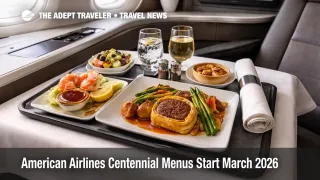
American Airlines is adding a limited run of centennial themed inflight dining tied to its 100th anniversary in 2026. Beginning February 9, 2026, customers will be able to preorder select special dishes ahead of travel. The menus are scheduled to appear first in March 2026 for international and premium transcontinental Flagship First and Flagship Business, then expand in April 2026 to domestic First Class.
The practical traveler takeaway is that American is putting its most distinctive items behind the preorder flow, rather than treating them as a guaranteed onboard default. That makes planning simpler if you value a specific meal, but it also adds a deadline that can be easy to miss when a trip is booked far in advance or changed close in.
The airline says the concept is inspired by 1920s era flavors, updated for modern airline service constraints. Domestic First Class examples include a Waldorf salad, a Boursin cream cheese dip, a Beef Wellington style entree with vegetables and asparagus with bearnaise sauce, plus a pecan tart. In Flagship cabins, the early roll out includes classic starters like prawn cocktail and Waldorf salad, with an April addition of caviar and blinis, alongside entrees such as Beef Wellington and a chicken Florentine roulade.
Who Is Affected
This update matters most for travelers booked in American's premium cabins on routes where meal service is part of the value proposition, namely international Flagship itineraries and long premium transcontinental flights. If you are choosing between carriers or cabins for a long haul overnight, the ability to lock in a preferred meal ahead of time can reduce uncertainty, especially when traveling for a time sensitive arrival day plan.
Domestic First Class travelers also have exposure once the menu expands in April 2026, but the impact is more variable because domestic catering consistency depends heavily on departure station, flight length, and the exact service standards on your route. If you are on a shorter segment, the menu may be less central than schedule reliability, lounge access, or connection protection.
Travel advisors should also treat this as a soft signal about how American wants premium customers to interact with the product in 2026. A preorder driven "signature dish" approach can improve consistency when it works, but it can also create disappointment when an aircraft swap, a late catering change, or irregular operations trigger substitutions.
What Travelers Should Do
If you care about trying the centennial dishes, set a calendar reminder for February 9, 2026, then place the preorder as soon as your flight is eligible. American's preorder model typically has a cutoff before departure, so waiting until the day before travel increases the odds you miss the window or your preferred selection is not available.
Use a simple decision threshold for whether to rebook around this. If the flight time and routing are already ideal, do not move trips just to chase a menu, because disruptions, equipment swaps, and station catering constraints can still change what is actually served. If you are already comparing two similar options, the centennial menu can be a reasonable tiebreaker, but only after you have checked total travel time, connection risk, and seat product.
Over the next 24 to 72 hours before departure, monitor three things: your preorder confirmation in the American app or on aa.com, any aircraft type changes that show up in your reservation, and any same day schedule shifts that could push you onto a different departure station or flight number. Those are the most common pathways for advertised dining to diverge from the onboard reality, particularly during busy travel periods.
Background
Inflight dining is constrained by catering logistics, not just by what an airline wants to serve. Meals are built, stored, transported, and loaded under tight time windows, and changes like a special menu increase coordination demands at departure stations. The first order effect is operational, since a premium menu needs reliable ingredient sourcing, standardized preparation, and predictable loading procedures across the stations that handle Flagship service.
The second order ripple shows up when travel does not run perfectly. A delayed departure, an aircraft swap, or a last minute reroute can force catering substitutions, and that can cascade into traveler satisfaction issues and crew workload changes onboard. Separately, preorder driven dining can influence traveler behavior on the ground, since passengers who expect a specific onboard meal may skip airport dining, which can be a problem if a long delay stretches beyond meal service windows or if a misconnect forces an unplanned overnight.
For more context on how airlines are competing on premium cabin food in 2026, Air France US Premium Meals Get Michelin Upgrade offers a useful comparison point. For another recent American network move that can shape premium cabin demand, American PHL Porto Flights Launch Summer 2027 shows how the carrier is positioning Flagship style products on newer long range routes.