

Ayahuasca Retreats in Spain Grow, Legal Gray Zone
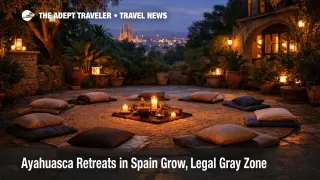
Ayahuasca ceremonies are increasingly being offered in Spain as a shorter trip alternative to South America, including in and around Barcelona, Spain, and in rural venues marketed as private wellness retreats. The shift is driven by practical travel factors, lower total trip cost, familiar accommodation standards, and the perception that Spain and Portugal operate in a more permissive legal environment than most of Europe. For travelers, the immediate planning change is that these retreats can look as easy to book as a yoga weekend, but the legal and safety realities still behave more like a controlled substance trip, with higher downside if something goes wrong.
The legal hook is not that ayahuasca is explicitly legal, it is that enforcement and court interpretation have often treated the brewed preparation differently than trafficking in isolated compounds. In practice, that means some organizers operate openly, others operate quietly, and outcomes can vary by setting, scale, and whether authorities view an event as private use or as commercial distribution. This is why the market can expand quickly, but also why it can contract quickly after a police action, a medical incident, or political pressure.
Who Is Affected
Travelers from across Europe are the primary customer base because Spain and Portugal are easy to reach by air and already familiar as leisure destinations. People booking short retreats around Barcelona and coastal regions are most exposed to schedule and logistics risk because they tend to pair ceremonies with return flights, and they may underestimate recovery time. Travelers combining a retreat with onward trips, for example Barcelona to Madrid, Spain, or Barcelona to Lisbon, Portugal, are also exposed because post ceremony fatigue can turn a normal transfer day into a missed train, a missed flight, or an unsafe drive.
Operators are also affected because the business model sits on a fragile set of assumptions. If a venue faces complaints from neighbors, if an organizer is perceived to be selling controlled substances, or if medical harm is alleged, authorities can treat the activity as trafficking or public health risk rather than private spiritual practice. That enforcement uncertainty is a travel issue because it can create last minute cancellations, venue changes, or sudden service shutdowns that strand participants with non refundable flights and hotels.
There is also a cultural layer that matters for travelers who care about ethics. Many retreats present themselves as bridges to Indigenous traditions, but there is no consistent standard for benefit sharing, consent, lineage claims, or how rituals are adapted for Western guests. If you are choosing Spain over the Amazon for convenience, you are still stepping into a context that can be extractive if the organizer treats Indigenous practice as a brand asset rather than a living tradition with obligations.
What Travelers Should Do
If you are considering a retreat in Spain or Portugal, treat the booking like a medical adjacent activity, not a normal wellness class. Ask what screening is required, who performs it, and what happens if you disclose medication use, cardiovascular conditions, seizure history, or a serious mental health diagnosis. If the answers are vague, or if the operator tries to talk you out of disclosing, that is a hard stop, because the largest preventable risks are predictable and tied to contraindications.
Build time buffer into your itinerary, and decide in advance what would make you rebook. A reasonable decision threshold is this, if you cannot afford to add at least one recovery day before flying, or if you must drive long distances right after the final ceremony, you should not book that schedule. If the retreat is positioned as "back to work Monday" with ceremonies through the final night, that is a reliability problem, because disrupted sleep, dehydration, and emotional volatility are common, and they translate directly into travel mistakes and misconnects.
Over the next 24 to 72 hours after booking, monitor two things that can change fast, the venue details and the legal posture. Confirm the exact location, the cancellation terms, and whether the organizer can move the event on short notice. Watch for red flags such as sudden changes to the address, requests to keep details secret beyond basic privacy, or pressure to pay in cash with limited documentation. If you proceed, keep your transport refundable where possible, and consider travel insurance that explicitly covers trip interruption for non medical reasons, because many policies will not treat a retreat cancellation as a covered event.
Background
Ayahuasca is a plant based brew traditionally used in parts of South America, and it can produce intense psychological and physical effects, including vomiting, altered perception, and profound shifts in mood. The legal complexity in Europe is tied to dimethyltryptamine, DMT, which is controlled in many jurisdictions, while the brewed preparation itself is not always named in national schedules. In Spain, reporting and legal analysis describe a pattern where courts and enforcement may distinguish between private, non commercial use and trafficking or public harm, creating a practical gray zone rather than clear authorization. In Portugal, the broader drug policy shift in the early 2000s is often described as health led decriminalization for personal possession, which shapes how risk is perceived by travelers, even though decriminalization is not the same as legalization.
For travel planning, the disruption ripples look like this. The first order effects happen at the retreat itself, screening quality, medical readiness, and venue stability. The second order effects hit transport and lodging, because short retreats compress recovery time, pushing travelers into day after flights, long drives, or tight rail connections while they are least resilient. Then the ripple reaches the broader local travel system, with demand spikes for private transfers, last minute hotel nights, and flexible air tickets if an event shifts dates or is interrupted. This is why the "closer to home" appeal can be misleading, you are trading long haul complexity for higher sensitivity to scheduling, refund terms, and enforcement uncertainty.
Sources
- Ayahuasca retreats are booming in Spain, one of the only European countries with a legal 'loophole'
- Spain, Legal situation of ayahuasca
- Portugal, Legal situation of ayahuasca
- Ayahuasca and the Limits of Criminal Law in Spain
- Ayahuasca and toad poison seized as police raid spiritual retreats in Spain
- Drug decriminalisation in Portugal: setting the record straight