

Rzeszow and Lublin Airports Reopen After NATO Scramble
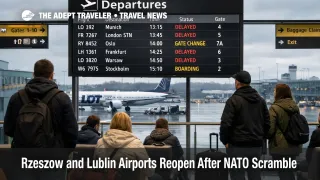
Civil flight operations at Rzeszów-Jasionka Airport (RZE) and Lublin Airport (LUZ) were temporarily suspended on Saturday, February 7, 2026, as Polish authorities prioritized military aviation activity in southeast Poland. The pause was tied to a wider security posture after Russian strikes on Ukraine, which led to NATO aircraft being activated in Polish airspace as part of protective measures. Both airports later reopened the same day after officials said the military aviation operation concluded, but travelers should still expect knock on schedule volatility as airlines work aircraft and crews back into position.
The practical traveler takeaway is that this is a repeatable trigger, not a one off. Similar short suspensions have occurred before during heightened alerts in the region, which means itineraries that rely on tight same day connections into or out of southeast Poland can be fragile during periods of cross border escalation.
Who Is Affected
Travelers departing from, arriving into, or connecting through Rzeszów-Jasionka and Lublin are the first affected group, especially if their trip includes onward connections on separate tickets or short layovers. Even when the airports reopen, earlier delays can force aircraft swaps, late departures, and crew legality constraints that push disruptions into later banks.
Passengers routed through alternates are the second affected group. When flights divert or are reaccommodated, carriers often protect travelers onto services via Warsaw and other nearby gateways, which can tighten seat inventory quickly and raise the odds of an overnight stay if same day options sell out.
Overland travelers can also feel the effects. When passengers spill from flights into rail and bus options, seats disappear fast on popular corridors, and ground transport timing becomes less predictable around peak disruption windows, particularly if multiple arrivals bunch into the same hour.
What Travelers Should Do
If your flight touches Rzeszów-Jasionka or Lublin within the next 24 to 72 hours, treat your schedule as flexible even if it currently shows on time. Reconfirm your flight status before leaving for the airport, arrive earlier than you normally would for check in and security, and keep receipts if you are forced into an unexpected hotel night or ground transfer. FAA and other NOTAM driven access limits can appear quickly during these events, and they are a strong signal that day of operations may change with little warning.
Decide in advance when you will rebook versus wait. If you have a hard commitment, for example a meeting, a tour departure, or a connection to an international long haul leg, rebooking earlier is usually the safer move once delays start stacking, because recovery inventory shrinks as reaccommodation queues grow. If your trip is noncritical and you are on a single protected ticket, waiting can be reasonable if the airline is still showing same day reaccommodation, but avoid self connecting plans that assume everything runs perfectly.
Over the next 24 to 72 hours, monitor three things: airline app alerts for aircraft changes and gate shifts, airport advisories for any renewed operational pauses, and credible security updates that imply another activation cycle. For helpful context on how these episodes can propagate across Poland's wider airport network, see Poland drone incursion disrupts flights, triggers NATO talks and, for a broader planning lens on geopolitics as a trip risk input, see Global Guardian Flags Geopolitics as Top Travel Risk.
Background
These temporary closures are usually operational measures, not a sign that civil aviation has become unsafe at the airports themselves. When military aviation is activated near a border area, air navigation services may reserve airspace, pause civilian takeoffs and landings, and hold or reroute aircraft so military flights can operate freely. In this case, public reporting linked the February 7 pause to a defensive posture after Russian strikes on Ukraine, with Poland's operational command later saying the operation ended, and that air defense and radar activity returned to standard operations.
The first order effect is straightforward: departures slip, arrivals are held or diverted, and connection plans break. The second order ripple is what often surprises travelers, because a short pause can still disrupt the day's rotation plan. A late inbound aircraft can miss its next scheduled leg, crews can time out, and airlines may cancel a later flight to protect the rest of the schedule. When that happens, passengers get pushed into alternate routings, often via Warsaw, Poland, or Kraków, Poland, which tightens last seat availability and compresses airport hotel inventory near alternates.
Sources
- Two Polish airports reopen after NATO jets activated over Russian strikes on Ukraine, Reuters
- Southeast Poland's Lublin and Rzeszow airports closed due to 'unplanned military activity', US FAA says, The Straits Times
- Poland scrambles fighter jets, closes airports as Russia strikes Ukraine, Polish Radio
- Ukraine war briefing: Russia launches 'massive attack' on energy sites, triggering widespread blackouts, The Guardian