

Fujiyoshida Cherry Festival Canceled at Arakurayama
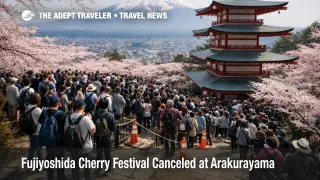
Fujiyoshida, Japan will not hold its signature cherry blossom festival at Arakurayama Sengen Park in spring 2026, after city officials said visitor volume and poor behavior have pushed the area beyond what residents can absorb. The decision affects travelers who planned to time Mt. Fuji viewing with the park's pagoda and peak bloom photo spot, as well as day trippers routing through the town from Tokyo. The practical next step is to treat the site like a high demand attraction without an organized festival, plan for heavier crowd control, visit on weekday mornings, and avoid tight connections tied to a single viewing window.
The Fujiyoshida cherry festival canceled decision means the city will stop positioning the blossom period as a formal event, while still running safety and traffic measures because crowds are expected to arrive anyway.
Fujiyoshida's announcement frames the move as a response to overtourism that is degrading daily life, including chronic traffic congestion, trespassing, litter, and sanitation problems during the bloom peak. In its official statement, the city says visitation has surged in recent years, driven by the weak yen and social media amplification, and that bloom season can bring more than 10,000 visitors per day to the area. Mayor Shigeru Horiuchi's quoted remarks emphasize protecting residents' living environment and dignity, and the city characterizes the decision as a shift toward more sustainable tourism management rather than a one off cancellation.
Importantly for trip planning, canceling the festival does not mean the park is closed. The city explicitly signals it still expects visitors during the blossom window, and it outlines a strengthened management period from April 1 to April 17, 2026, with traffic measures continuing through April 19, 2026. That distinction matters because a "no festival" year can still feel like peak season on the ground, except with fewer event cues for where to queue, park, or wait.
Who Is Affected
Travelers who built an itinerary around the classic postcard view, Mt. Fuji framed by cherry blossoms with the Chureito Pagoda in the foreground, are the most exposed. Without a festival program, you should not expect structured timing, managed photo lines, or an event schedule that spreads demand across multiple days, and you should expect crowds to self concentrate when bloom timing goes viral.
Day trippers from Tokyo, Japan are also affected because the town's transport and road network is not designed for sustained peak volume, especially when private vehicles compete with buses, taxis, and local traffic. Fujiyoshida's statement describes persistent congestion and spillover problems into residential areas, which is exactly the kind of friction that turns a simple visit into missed train reservations, late hotel check ins, or expensive last minute rideshare detours.
Residents and local businesses sit at the center of the change, and that influences how visitors should behave and what rules they should anticipate. The city describes repeated trespassing, unauthorized entry onto private property, litter, and sanitation incidents, and it ties the cancellation decision to the need to prioritize normal life over promotion. That combination usually leads to more visible enforcement, more barriers and routing, and less tolerance for improvised parking or cutting through neighborhoods to chase the best angle.
There is also a second order travel ripple that is easy to miss. When a single iconic spot becomes a social media funnel, it distorts demand across an entire region. The first order effect is crowding at Arakurayama Sengen Park itself, then the next layer is road congestion that slows buses and taxis, then the next layer is timing risk for rail connections, airport transfers, and timed ticket attractions elsewhere in the day. If travelers begin shifting plans to "alternate Mt. Fuji views" at the last minute, nearby transport nodes can see a spike in demand, which raises the odds of sold out seats, higher taxi fares, and hotel inventory tightening on the nights when bloom conditions look best.
What Travelers Should Do
If you are already committed to visiting, treat this as a capacity managed hotspot, even without a festival banner. Go early on a weekday, build buffer time on both sides of the visit, and plan to use public transportation where practical because the city warns parking is limited and congestion is expected to be severe. Keep your plan flexible enough that you can leave if conditions are unsafe or unpleasant, rather than trying to force a perfect photo during the densest crowd period.
Use clear decision thresholds to choose rebooking versus waiting. If your itinerary depends on a narrow window, for example a same day onward train booking, a fixed time airport transfer, or a non refundable timed entry elsewhere, rework the day now so the blossom stop is not the anchor. If you can shift, aim for a weekday morning, and consider adding a local overnight so you can pick the least crowded hours without gambling on same day transit reliability.
Over the next 24 to 72 hours before your visit window, monitor two things. First, watch for the city's traffic control guidance and any updates to the April management period, because routing and temporary lots can materially change walking time and pickup points. Second, watch bloom progression updates and weather visibility, because Mt. Fuji views are sensitive to cloud and haze, and poor visibility can push more people to linger longer when the mountain briefly appears, which amplifies congestion at the viewpoint.
Background
Arakurayama Sengen Park's cherry blossom period became a magnet because it compresses multiple "Japan in one frame" elements into a single viewpoint: cherry blossoms, a five story pagoda, and Mt. Fuji. That kind of photogenic bottleneck creates overtourism dynamics that do not behave like normal park visitation. The first order operational issue is physical capacity, narrow approaches, stairs, and limited viewing deck space, which produces queues and crowd control challenges. The second order issue is network spillover, because when roads clog, bus schedules degrade, taxis cannot cycle quickly, and travelers miss onward connections, which then pushes rebooking demand onto later departures and increases the chance of last minute hotel night adds. Fujiyoshida's statement makes clear the city is moving away from promoting a named event in 2026, while still running an intensive management period with security, traffic control, temporary parking, and portable toilets because the underlying demand signal has not disappeared.