

Minneapolis Travel Advisory Updates Before World Cup 2026
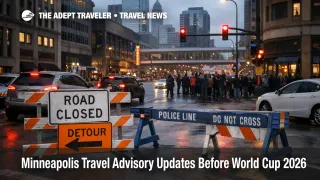
Several European governments have recently refreshed their U.S. travel guidance with Minneapolis specific language, a shift that matters for travelers building itineraries around major 2026 events, including the FIFA World Cup. France's Foreign Ministry published a "Dernière minute" notice for Minneapolis that tells travelers local authorities are urging residents to avoid the city center, to stay informed, to avoid gatherings, and to limit travel if necessary. Germany's Federal Foreign Office also updated its U.S. safety guidance, warning that demonstrations in Minneapolis, and other cities, can involve violent clashes with migration and security authorities, and advising travelers to avoid crowds and follow local reporting. Ireland's Department of Foreign Affairs likewise added Minneapolis St Paul caution language, telling Irish citizens to exercise caution and to follow local authority advice.
The nut graf is simple: the Minneapolis travel advisory updates are pushing visitors to plan for sudden protest driven mobility limits, and to treat major event days as higher friction travel days where buffers matter more than usual.
Who Is Affected
This guidance is most relevant for international visitors with planned time in Minneapolis, Minnesota, especially those staying downtown, attending large events, or relying on tight transfers between hotels, venues, and transport hubs. The advisories are not bans, and they do not automatically mean a trip is unsafe, but they are signals that conditions can change quickly, and that crowd risks are being emphasized by multiple governments at once.
Travelers connecting through Minneapolis can be indirectly affected even if they do not plan to spend time downtown. When demonstrations spike, the first order effect is localized, street closures, limited access to certain blocks, and heavier police presence, but the second order ripple often lands on the travel system. Rideshare pickup zones can be moved or temporarily restricted, traffic patterns can snarl around controlled areas, and public transit can slow or reroute, which raises the odds of missed check in windows, late arrivals to tours, and compressed connection margins for onward travel.
World Cup planning adds another layer. Canada has published World Cup specific guidance for Canadians traveling to the United States that advises carrying proof of match tickets and confirmed accommodations because border officers may request verification. That is not Minneapolis specific, but it is the same theme, higher documentation readiness and higher tolerance for questions at entry during a major global event period.
Separately, a coalition of civil rights and human rights groups issued a Florida focused travel alert ahead of the World Cup, urging international visitors to consider risks tied to immigration enforcement, including potential detention concerns. Florida is a different geography than Minneapolis, but the practical takeaway is similar, travelers should assume uneven conditions by state and city, and plan buffers and documentation accordingly.
What Travelers Should Do
If Minneapolis is on the itinerary, treat downtown plans as optional, and build a mobility buffer the way you would for a major storm day, not because weather is the issue, but because streets and access can tighten fast. Keep hotel check in and event arrival windows loose, pre map multiple routes between the hotel and key stops, and pick pickups in calmer zones outside the densest areas if crowds are building.
Decide in advance what would make you rebook versus wait. If official advisories start naming specific districts beyond the city center, if local authorities announce large scale closures, or if your hotel sits inside an area authorities recommend avoiding, that is a clean trigger to shift lodging to a different neighborhood or to move arrival a day earlier to reduce same day pressure. If the situation is limited to a planned march window, and your itinerary has slack, it is often safer to keep the trip but restructure daily movement around the affected hours.
Over the next 24 to 72 hours before key travel days, monitor three things rather than doomscrolling everything. First, the official advisory pages for your home country, because they sometimes add city specific language quickly. Second, local authority updates about closures and crowd controls, which is what the French and Irish advisories explicitly point travelers toward. Third, if you are entering the U.S. for a World Cup trip, make sure your documentation is complete, and easily accessible, including match and lodging confirmations if your government recommends carrying them.
Background
Travel advisories are not just about personal safety, they function as a planning signal that can shape traveler behavior. When multiple governments add city specific caution language, travelers tend to compress itineraries into fewer districts, avoid late night movement, and add buffer time, which changes demand patterns in the travel system. The first order impact is at the source, localized crowd risk, and potential mobility limits, but the second order ripple shows up as higher last minute rebooking, heavier reliance on taxis and rideshares, and tighter hotel inventory in "safer feeling" neighborhoods. A third layer often appears when large events are involved, documentation readiness and entry friction, since travelers arrive in waves, and border agencies may scrutinize plans more closely, which is why Canada's World Cup guidance emphasizes carrying proof of tickets and accommodations.
On the U.S. side, the Department of State has been pushing fans toward official World Cup visa and planning resources, and FIFA has highlighted a U.S. led initiative to prioritize visa interview appointments for ticket holders, while still requiring standard vetting. The combination, heightened city specific caution language abroad, and higher volume entry logistics at home, is why buffers and documentation matter more than the average summer trip.
Sources
- Conseils aux voyageurs, États Unis (Minneapolis, Publié le 24/01/2026)
- USA, Vereinigte Staaten, Reise und Sicherheitshinweise
- United States of America (USA), Travel Advice (Ireland)
- Advice for Canadians travelling to the United States, FIFA World Cup 2026
- Rights groups issue Florida travel alert ahead of World Cup, citing detention risks (Reuters)
- FIFA World Cup 2026 ticket holders to benefit from prioritised U.S. visa appointments (FIFA)
- FIFA World Cup 2026 Visas (U.S. Department of State)