

Air New Zealand Cabin Crew Strike Cancels Long Haul
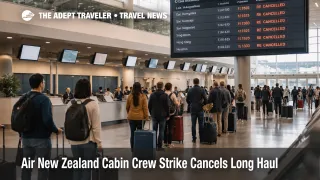
Air New Zealand has confirmed a two day strike by its international widebody cabin crew on February 12, 2026, and February 13, 2026, and it has already removed a large block of long haul flying from the schedule. Long haul passengers on routes to North America and Asia are the most exposed, because the affected crews work Boeing 777 and 787 services that carry the highest seat volume. The practical move now is to treat these two dates as high cancellation days, accept earlier reroutes if you must arrive on time, and rebuild any connecting itinerary so one disrupted sector does not collapse the whole trip.
The Air New Zealand strike long haul disruption matters because confirmed cancellations are already baked into schedules, shrinking rebooking capacity before the strike even starts.
Air New Zealand says it has cancelled 46 long haul widebody services, affecting around 9,500 customers, while protecting the majority of Tasman Sea and Pacific services through aircraft and schedule adjustments. The airline's domestic and regional network is expected to operate as normal, and it also plans some cargo only widebody flights to maintain freight connectivity. For travelers, that split is important because it means you may still be able to move within New Zealand or across shorter international sectors, even as the long haul segment you built the trip around is moved, or removed.
Who Is Affected
The highest risk group is anyone holding an Air New Zealand long haul ticket that departs, arrives, or connects across February 12, 2026, or February 13, 2026, especially where the itinerary relies on a single widebody sector out of Auckland Airport (AKL). If your trip is a chain, for example long haul into New Zealand followed by a domestic connection, or the reverse, the cancellation is rarely the only problem. When the long haul sector slides by one or two days, the domestic connection can become unusable, and the airline may not treat separately ticketed add ons, hotels, and tours as protected parts of the journey.
Travelers with split parties face an added complication. Even when rebooking is available, the system may find space for one or two passengers, but not a family, or a group, on the same flight. That can force parallel routings via Australia, or a mix of partner airline segments that arrive hours apart, which then ripples into ground transfers, check in windows, and car pickups.
This is also a meaningful disruption for travelers who are not flying Air New Zealand on every segment. When a carrier removes dozens of long haul departures, demand spills onto competing services and partner inventory, particularly on trans Pacific and Asia corridors. That tends to raise last minute fares, reduce award availability, and tighten same week seat supply, which makes the rebooking clock feel faster than usual.
What Travelers Should Do
Start with immediate triage and buffers. Confirm whether your long haul flight is still operating, and do it in two places, your booking record and the airline's travel alert page, because schedule changes can post unevenly during high volume disruption. If you are already away from home, plan for an overnight outcome near the departure point, keep essentials in carry on, and pre price backup hotel options near the airport so you are not making decisions at peak demand.
Use a clear decision threshold for rebooking versus waiting. If arriving on a specific day is essential, because you have a cruise embarkation, a wedding, a conference, a non refundable tour, or a short trip where losing a day breaks the purpose, take the earliest acceptable reroute now, even if it is less direct or uses Australia as a bridge. If your trip can absorb arriving a day or two later, waiting for the airline to finish reaccommodation can be rational, but only if you are comfortable with the likely outcome being a date shift rather than a same day substitute.
Over the next 24 to 72 hours, monitor three signals. First, whether your replacement itinerary still has legal and practical connection time, because disruption rebuilds often create tight connections that look valid on paper but fail in real terminals. Second, whether your accommodation and tour providers will move reservations without penalty when your flight changes, because that often determines whether a later arrival is acceptable. Third, whether your travel insurance or card coverage requires specific documentation, because industrial action outcomes can trigger different claim pathways than weather, and you will want screenshots of the cancellation notice, and receipts for any incremental costs.
How It Works
A widebody cabin crew strike is a capacity shock, not just a customer service event. The first order effect is straightforward, flights that need the striking crew cannot operate, so the airline cancels, retimes, or consolidates services before departure day to avoid last minute airport chaos. That is why the scale of pre strike cancellations matters, it reduces the number of seats that would otherwise be available to recover disrupted passengers.
The second order ripples spread through at least two other layers of the travel system. The first ripple is network positioning. When a long haul rotation is removed, the aircraft and crew that would have been in one place end up elsewhere, which can force additional retimes on following days as the airline rebuilds rotations and rest requirements. The second ripple is connection and inventory pressure. Passengers moved off cancelled flights compete for a smaller pool of long haul seats, and that pushes demand into alternate routings, which can fill up trans Tasman services, partner flights, and even airport area hotels when overnighting becomes the only workable bridge.
Air New Zealand's published guidance also shapes traveler outcomes. The airline says it will rebook impacted customers onto alternative flights, contact customers directly with changes, and offer refunds or credit if the new options do not work. For travelers booked through travel agents, the airline indicates agents will handle the outreach and rebooking, which is a practical detail that can affect speed, because many disruption queues prioritize direct channels and verified contact details.