

Azamara 2027 Alaska Cruisetours Add Rockies Rail
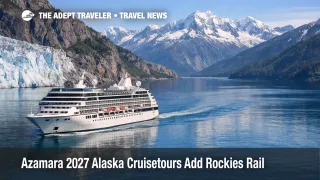
Azamara Cruises shared new details for its 2027 Alaska cruisetours, expanding its Alaska program beyond coastal ports with bundled land options that reach Alaska's interior and the Canadian Rockies. The update matters most for travelers who want Denali and rail experiences without stitching together hotels, transfers, and touring on separate reservations. The practical next step is to decide whether you want a pre cruise or post cruise land add on, then match it to the 10 or 11 night Alaska sailing week you can actually take, because the land inventory and the cruise inventory must align.
The change is that Azamara 2027 Alaska cruisetours now formalize four, five, and six night land programs that can be paired with the line's 10 and 11 night Alaska sailings, with logistics packaged as a single add on, rather than travelers building the interior portion independently. That pushes the "decision point" earlier, because you are no longer only choosing a ship, a cabin, and ports, you are also choosing a land sequence that affects flights, hotel nights in gateway cities, and total trip length.
Who Is Affected
Travelers targeting Alaska in summer 2027 are the primary audience, especially those who want Denali National Park touring, Alaska Railroad style rail segments, or a Canadian Rockies rail extension in the same trip. This also targets travelers who dislike the friction points that usually come with land add ons, separate luggage moves, self timed transfers, and the risk that one supplier's delay breaks a separate ticket or a nonrefundable hotel night.
The announcement also matters if you are considering a longer arc itinerary that starts in Asia and ends in North America. Azamara says select 2027 Alaska cruisetours can be paired with transpacific sailings from northern Japan, which creates a very different planning problem: you are coordinating a longer cruise, a land tour, and flights at both ends, across multiple time zones. That can be a great fit for slow travel, but it raises the stakes on travel insurance terms, medical coverage, and conservative buffer nights before the first embarkation.
What Travelers Should Do
Start by choosing the structure before you fall in love with a single sailing. Pick whether you want a pre cruise land program that ends at embarkation, or a post cruise land program that begins after you disembark, then shortlist two acceptable sailing weeks that can support that choice. Add at least one buffer night in the gateway city if you are flying in on a separate ticket, because the cruise line can manage ship to tour timing, but it cannot prevent airline irregular operations from breaking your arrival.
Use decision thresholds to avoid "hope based" planning. If your flights, work schedule, or school calendar leave you less than one day of slack at either end, a post cruise land program is usually safer than a pre cruise program, because you can protect embarkation by arriving early. If you must do pre cruise, treat any same day arrival into the embarkation city as a no go, and move to an arrival at least one day earlier. If your must have is Rocky Mountaineer, decide now whether GoldLeaf versus SilverLeaf is worth the premium to you, because the service tier is part of the product definition, not an easy last minute swap.
Over the next 24 to 72 hours after you pick a candidate trip, monitor three things: the exact inclusions list for your specific cruisetour, the cancellation and change terms for both the cruise and the land portion, and the flight schedule stability for your preferred gateway airports. If you are planning around Denali, also watch for any updates to the specific touring components named in the itinerary description, because wildlife and weather can drive substitutions even when the overall program runs as planned.
How It Works
Cruisetours are designed to solve a real systems problem in Alaska travel: the most sought after interior experiences are time bound, capacity constrained, and geographically far from the cruise ports. Denali access, railcar capacity, and hotel room blocks in small markets create pinch points that do not show up if you only look at the ship itinerary. By bundling hotels, transfers, luggage handling, escorted touring, select meals, and admissions, the cruise line is essentially buying and sequencing capacity on your behalf, then selling it back as a packaged extension.
First order effects show up at the source, which is the land capacity itself. If a four night interior program includes rail segments and a Denali touring day, you are depending on limited seats, fixed departure windows, and a hotel supply that can be tight in peak weeks. When those blocks fill, the cruisetour can become the limiting factor even if the ship still has cabins.
Second order ripples hit at least two other layers. One ripple is gateway city hotel and flight timing pressure: adding a land program tends to shift your arrival and departure days, which changes airfare pricing, hotel demand, and the risk profile of late flights. Another ripple is on ship operations and excursion behavior: travelers who know they are going inland often treat the final cruise port day differently, saving energy and avoiding late independent activities that could increase the chance of a missed meet time. For longer arcs that include a transpacific segment from Japan, crew flow and ship schedule integrity also matter more, because a long repositioning voyage has fewer easy recovery options if irregular operations compress the timeline.
Azamara's highlighted options illustrate the planning differences. The Alaska Explorer cruisetour is positioned as a four night interior program that can run pre or post cruise, with Denali National Park touring and a rail component. The Canadian Rockies options are positioned as a five night post cruise program with Rocky Mountaineer in either GoldLeaf or SilverLeaf service, plus a longer six night pre cruise program that adds Whistler and a Calgary to Vancouver flow.
For broader context, Azamara has framed Alaska as a return market driven by guest demand and destination immersion positioning, which helps explain why the line is investing in inland extensions rather than only adding coastal port calls. If you want a comparison point for how fast 2027 cruise inventory can move once details drop, see Disney Summer 2027 Cruises, Booking Opens Feb 23. If you are still deciding whether Alaska is a 2026 trip or a 2027 trip, and you are weighing deal structures, see Princess Cruise Sale Alaska and Europe 40% Off. For additional Alaska cruise context and related coverage, see Alaska Cruise.