

Cambodia Thailand Border Clash Cuts Angkor Tour Demand
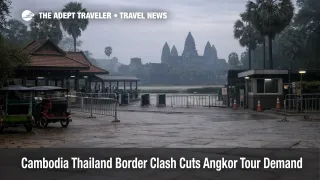
Cambodia's tour and cruise sellers are describing a split market for 2026 travel, with softer demand showing up more clearly on land itineraries than on Mekong river cruises. The backdrop is a renewed Thailand Cambodia border conflict that reignited in July 2025, resumed again in December 2025, and then moved into a late December ceasefire framework that still leaves travelers and operators cautious about routing close to the frontier. For travelers, the practical change is that Cambodia Thailand border conflict tours now come with more itinerary editing, more avoided areas, and more emphasis on flexible planning, especially if your trip is built around Angkor Wat in Siem Reap.
One signal that matters to travelers is what is happening at Angkor itself. Angkor Enterprise, the official Angkor pass issuer, reported 93,491 ticket purchases in January 2026. That compares with reporting that January 2025 purchases were about 146,150, a sharp year over year drop landing in the middle of the normal high season demand window. Fewer tickets do not automatically mean your visit will be disrupted operationally, but it does indicate tour operators are reacting to traveler risk perception, and that some suppliers may adjust staffing, departure pacing, or day trip patterns if softness persists.
At the same time, operator commentary suggests the Mekong segment is proving more resilient. In the same tour trade reporting, Avalon Waterways said Mekong sales are up, and sailings through the first quarter are close to sold out. Tauck also described strong interest across its Cambodia land tours and Mekong river cruise products, which is consistent with a pattern where travelers who have already committed to higher value packaged travel stay the course, while more modular land travel hesitates or reshuffles.
Who Is Affected
Siem Reap bound travelers are the most directly exposed, because Angkor Wat is the anchor attraction that shapes hotel nights, guide schedules, and onward connections. If your itinerary is a short stay that hinges on one or two fixed Angkor touring days, the value of flexibility is higher than usual, since even small itinerary edits, guide availability changes, or tour departures being consolidated can force you into last minute rebooking decisions.
Overland travelers who planned to move between Thailand and Cambodia by land, or who planned excursions that run close to disputed border areas, remain the highest risk segment. Even when a ceasefire is announced, operators and insurers often treat frontier bands as unstable until there is sustained calm, and that can trigger proactive reroutes that bypass certain provinces, crossings, and road corridors.
Tour customers should also notice supplier specific changes, because these can affect what you can reasonably do inside Cambodia. G Adventures said it has seen a drop in Cambodia bookings that it links to the conflict, and it is avoiding impacted areas. Intrepid Travel said it has not seen a broad demand drop, but it removed Battambang from itineraries through July 2026 due to the conflict's effects in that area, including deaths and displacement. If Battambang was the cultural bridge between Phnom Penh and Siem Reap in your plan, your alternatives will shift toward more time in either city, or toward different routes that concentrate on lower risk corridors.
What Travelers Should Do
If you are traveling in the next few weeks, set your plan around what your operator will and will not run, not what was in the brochure six months ago. Ask for the current avoided zones in writing, and confirm whether day trips, overland legs, and hotel nights can be swapped without penalty if the security picture changes. If you are booking independently, prioritize refundable lodging in Siem Reap, and avoid locking in nonrefundable transport that forces you to transit near the frontier.
Decide now what would make you rebook versus wait. A reasonable threshold is whether your itinerary depends on border area road travel, or on specific cities that your operator is already trimming, such as Battambang. If your must do items are Angkor and the Mekong corridor, and your routing stays well away from border provinces, waiting can be rational, but only if your tickets and hotels remain flexible. If your trip requires land crossings, tight same day repositioning, or multiple separate tickets, rebooking to a flight based routing, or moving dates, is usually the lower risk call.
Over the next 24 to 72 hours, monitor three things that translate directly into traveler friction. First, border area advisories and operator notices, because these drive the avoided zone map and can remove stops with little warning. Second, Angkor Enterprise ticket sales and any local operational updates in Siem Reap, because that is the clearest real world barometer for whether the headline risk is changing traveler behavior. Third, your tour operator's day by day program, because the most common real impact is not a trip cancellation, it is a substitution that changes what you see, how long transfers take, and whether you need extra hotel nights.
Background
The Thailand Cambodia border dispute is decades old, but what matters for travelers is how even localized fighting propagates through the tourism system. The first order effect is simple, operators avoid frontier areas, some land itineraries lose key stops, and travelers who were considering modular land travel delay their decision. That is the mechanism behind a mixed demand picture, where tour brands see a bookings dip tied to conflict headlines, even if much of Cambodia remains operational for tourism.
The second order ripples show up in at least two other layers. One layer is connections and capacity. When overland plans become provisional, more travelers shift to flights, and that can tighten limited seat inventory on domestic or regional routings that feed Siem Reap and Phnom Penh, pushing prices up and reducing the number of workable same day misconnect buffers. Another layer is hotels and guides. When Angkor demand softens, some suppliers consolidate departures, shorten or combine guide programs, and change staffing patterns, which can make last minute changes more disruptive for travelers who built tight schedules around sunrise tours, timed entry, or onward departures.
Cambodia's broader inbound numbers provide more context for why operators are sensitive to another shock. Cambodia's Ministry of Tourism statistical reporting for the first eleven months of 2025 shows international arrivals running below 2024 levels, and some reporting places the full year 2025 total at about 5.57 million, down about 16.9% from 2024. Against that backdrop, a winter high season Angkor pullback matters more, because it hits the country's flagship attraction, and it lands in the revenue window that many local operators rely on to carry them through shoulder season.
Sources
- Cambodia border fighting has hurt Angkor Wat but not Mekong cruising
- [OFFICIAL] Angkor Pass Ticket Angkor Enterprise
- Cambodia: Tourism Statistics Report in the First Eleven Months 2025
- Thailand and Cambodia sign new ceasefire agreement to end border fighting
- Thailand and Cambodia ceasefire holds 72 hours but breaches alleged