

Dublin Airport Passenger Cap Could Cut 2026 Seats
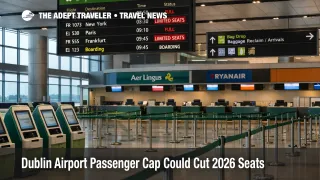
An EU court adviser has issued an opinion that strengthens the legal footing for using a passenger cap when allocating airline slots at Dublin Airport (DUB). For travelers, the practical takeaway is not that flights are suddenly canceled, but that the risk of capacity being constrained, or schedules being trimmed, is now more plausible for the 2026 peak season than it looked a week ago. If you are planning Ireland trips that rely on specific departure days, nonstop transatlantic timing, or tight onward connections, this is the kind of policy and slot story that can quietly translate into fewer seats and higher peak day fares.
The Dublin Airport passenger cap is a planning condition that has been associated with an annual limit of 32 million passengers. The Advocate General's view is that a cap imposed by a state planning authority can still function as an operational constraint that slot coordinators may take into account when assessing capacity. The opinion is not a final judgment, but it is a meaningful signal because the Court of Justice of the European Union often follows Advocate General opinions, and a final ruling is expected later in 2026.
Who Is Affected
The most exposed travelers are those flying through Dublin as a primary hub in summer 2026, especially on days when demand concentrates into limited departure banks. That includes Ireland bound leisure travelers, business travelers with fixed meeting times, and anyone connecting onward to regional Ireland, the United Kingdom, or continental Europe on the same day. Transatlantic flyers are particularly sensitive because frequency reductions, even small ones, can remove the exact departure time that makes a same day onward plan work.
If capacity limits bite, the first order effect is seat supply. Fewer available seats on peak days tends to push travelers into earlier purchasing, higher last minute fares, and less choice on nonstop versus one stop routings. The second order effects are where travel plans often break. When a nonstop option disappears or a preferred departure time is cut, travelers shift to alternative airports and extra legs. That rerouting can spill demand into Cork Airport (ORK) and Shannon Airport (SNN), as well as Belfast International Airport (BFS), Belfast City Airport (BHD), and nearby UK hubs, which then raises pressure on hotels, airport transfers, car rentals, and even the reliability of tight connections.
There is also a network planning layer that travelers usually do not see. If airlines anticipate constraints at Dublin, they can respond by swapping aircraft gauge, trimming frequencies, moving growth to other bases, and protecting the most profitable banks first. That means some routes may look stable, while others see reduced flexibility, or fewer daily departures, even without a headline grabbing cancellation wave.
What Travelers Should Do
If you are booking summer 2026 Ireland travel now, prioritize flexibility over perfection. Pick fares that allow changes, or use points bookings with favorable redeposit rules, and avoid building an itinerary that collapses if you must move your Dublin flight by a day or by several hours. If your trip hinges on a specific event start time, a cruise embarkation, or a same day tour in another city, add a buffer night on the front end, or choose an arrival that leaves recovery time.
Set clear decision thresholds before prices move. If the fare you are seeing is already near your acceptable ceiling, lock it in with flexibility rather than waiting for more clarity, because capacity uncertainty usually reduces cheap inventory first. If you are holding an itinerary with tight connections or separate tickets, consider proactively shifting to a routing that keeps all legs on one ticket, even if the connection is longer, since reaccommodation is far more straightforward when one carrier is responsible end to end.
Over the next 24 to 72 hours, monitor signals that precede traveler facing disruption. Watch for airline schedule updates for summer 2026, any public statements from Irish authorities on legislative timing, and the cadence of reporting around the EU case as it progresses toward a final ruling later in 2026. If you need a fallback plan, price a parallel routing via Shannon or Cork, or via a UK hub, and compare the total cost once you include positioning flights, baggage rules, and a conservative transfer buffer.
Background
The dispute sits at the intersection of planning conditions, airport capacity, and the EU slot allocation regime. Airlines value predictable slots because schedules, crews, and aircraft rotations are built around them, but slot rules also tie allocation to what an airport can actually accommodate. The Advocate General's opinion emphasizes that slots are authorizations to use infrastructure, not property rights, and that a passenger cap can be treated as a relevant operational constraint when determining capacity for slot purposes.
For travelers, it helps to think of this as a system ripple story, not a single airport rule. First, any binding cap tightens the supply of seats at the source, Dublin, which reduces peak period options and can raise fares. Second, constrained supply pushes rerouting behavior, and that behavior spills into adjacent layers, including hotel inventory near alternative airports, ground transport demand for longer positioning legs, and greater misconnect exposure when itineraries add extra segments. Third, airline fleet constraints can amplify the impact, because when the global fleet is tight, carriers have fewer spare aircraft to add back capacity quickly, which can make reduced schedules stick longer than travelers expect. For broader context on how aircraft availability can tighten seat supply system wide, see FAA Delays on Boeing 737 MAX 10 Hit Airline Capacity.
Ireland's government has also been signaling a policy response, pursuing legislation intended to remove the cap, but that legislative timeline, and how it interacts with courts and planning authorities, remains a key uncertainty for 2026 travel planning.
Sources
- PRESS RELEASE No 17/26, Advocate General Opinion on Dublin Airport Slots
- Ryanair warns Dublin Airport capacity may be slashed after EU court adviser backs cap
- EU top court's adviser says passenger cap 'may be taken into account' on Dublin Airport slots
- Ireland Moves To Lift Dublin Airport Passenger Cap
- Airport cap relevant factor in allocating slots
- Airport Policy, Oireachtas written question February 4, 2026