

Bolivia Chikungunya Travel Advisory for Santa Cruz
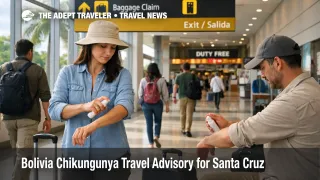
The Centers for Disease Control and Prevention has issued a Level 2 Travel Health Notice for chikungunya in Bolivia, advising travelers to practice enhanced precautions because of an outbreak. The CDC notice points specifically to outbreak activity in Bolivia's Santa Cruz and Cochabamba departments, which matters for travelers routing through the country's main gateways and spending time in large urban areas and surrounding day trip zones. The practical takeaway is straightforward, treat mosquito bite prevention as a trip critical task, and make lodging and itinerary choices that reduce exposure rather than assuming you can manage risk on the fly.
The "president issued a travel advisory" framing circulating in tabloids is misleading. CDC Travel Health Notices are published by CDC, and the operational guidance travelers see at check in, on arrival, and in travel clinics is tied to CDC's notice level and the airline or insurer's policies, not a White House directive. The actionable part is the Level 2 status and the prevention steps it triggers in real travel workflows.
Who Is Affected
The highest relevance is for travelers headed to, or spending meaningful time in, Santa Cruz and Cochabamba departments, including many visitors who arrive via Viru Viru International Airport (VVI) or Jorge Wilstermann International Airport (CBB) and then move onward by road. Business travelers on fixed meeting schedules, tour groups with dense day by day itineraries, and VFR travelers staying with friends or relatives can all face higher bite exposure because they spend more time in local neighborhoods, outdoor venues, and informal dining settings where screens and climate control are inconsistent.
Pregnant travelers, older adults, and travelers with underlying health conditions should be more conservative, because CDC and many public health advisories flag higher complication risk in certain groups, and because the travel impact of getting sick away from home can be outsized even when the clinical course is not severe. Separately, travelers connecting onward to other regions should recognize the second order effect, infections acquired early in a Bolivia trip can surface as fever and joint pain later, after the traveler has already moved to a different country, boarded a cruise, or started a guided circuit, which complicates medical care, insurance documentation, and rebooking.
What Travelers Should Do
Start with the basics you can control immediately. Pack and actually use an EPA registered insect repellent, and plan clothing that covers arms and legs during peak mosquito hours, even in warm climates. Choose lodging with reliable air conditioning or intact window and door screens, and treat "open air" design as a tradeoff that can increase bite exposure in an outbreak setting.
Decide in advance when you will rebook versus wait. If you are on a tightly timed itinerary, for example a same day international arrival followed by a fixed tour departure, a wedding, or a nonrefundable event, build a buffer night at the front of the trip in Santa Cruz or Cochabamba, or shift flights so you are not forced to push through if you develop symptoms and need evaluation. If you can absorb a slower start, the threshold for holding plans is higher, but you should still plan for friction, including clinic visits that can consume half a day and trigger missed excursions.
Over the next 24 to 72 hours, monitor three signals that change real world risk. First, watch CDC's notice page for any scope updates, including whether additional departments are referenced or the guidance level changes. Second, if you are eligible, discuss chikungunya vaccination with a travel medicine clinician, because CDC's current guidance supports vaccination for travelers going to an outbreak area, and a clinician can help weigh timing, availability, and your individual risk profile. Third, confirm your travel insurance medical coverage and trip change provisions, since the most common traveler cost is not the mosquito bite itself, it is the cascade of flight change fees, extra hotel nights, and missed prepaid activities when an itinerary breaks.
Background
Chikungunya is a mosquito borne viral illness that can cause fever and significant joint pain, and the travel problem is how quickly it can derail a fixed schedule. CDC's Level 2 designation, "Practice Enhanced Precautions," is designed to change traveler behavior at the point of exposure, not after symptoms begin. In practice, the first order effects show up at the source, travelers in affected areas spend more time outdoors than planned, choose lodging that is not well sealed, or skip repellent during short outings, and the bite prevention gap compounds over multiple days.
The second order ripple is where trips fail. A traveler who becomes symptomatic mid itinerary may miss an internal flight or long distance bus, and that can cascade into missed international departures, missed first nights at nonrefundable hotels, and broken tour sequences that are hard to rejoin. On the system side, outbreaks also increase the number of travelers seeking same day medical care for febrile illness, which can slow group departures, add documentation friction for insurers, and push more travelers into last minute rebooking, raising prices on the remaining seats and rooms.
In the United States, public health reporting underscores why CDC emphasizes prevention for outbound travelers. Florida's arbovirus surveillance has reported hundreds of travel associated chikungunya cases with onset in 2025, and it also reported at least one locally acquired case in 2025, reinforcing the pattern that imported infections can create localized risk when competent mosquito vectors are present. New York State also confirmed a locally acquired chikungunya case in October 2025, another reminder that "it is abroad" is not a permanent boundary, especially during warm season conditions that support mosquito activity.