

Italy Feb 16 Air Strike, Flights Still at Risk
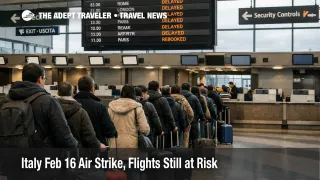
A national air transport strike is still scheduled in Italy for Monday, February 16, 2026, and airlines, airports, and ground handlers are treating the notice as the operational baseline. What changed in the last 48 hours is a second, political layer of uncertainty, Italy's transport minister has said the government is preparing a compulsory order to avoid strike driven disruption during the Milano Cortina Winter Olympics and the March Paralympics window. For travelers, that creates a fork, disruption may still proceed under the original notice, or a late change to timing or minimum service rules may trigger last minute rescheduling that is chaotic in a different way.
The practical planning point is simple, until a formal order is published and reflected in airline operating plans, you should assume you could face cancellations, longer check in and baggage lines, and missed same day connections on February 16. ENAC, Italy's civil aviation authority, also reiterates the protected time windows used for minimum service in Italian air strikes, 7 to 10 a.m. and 6 to 9 p.m., which is where you should concentrate any "must travel" flights if you cannot move the date.
Who Is Affected
Travelers flying within Italy, or transiting Italy on February 16, 2026, are the core risk group, especially those touching the biggest connection and event markets. That includes Milan Malpensa Airport (MXP) and Milan Linate Airport (LIN) in the Olympic corridor, Rome Fiumicino Leonardo da Vinci Airport (FCO) for long haul connectivity, and Venice Marco Polo Airport (VCE) for northeast Italy demand. Airports are already warning that scheduled flights may be delayed or canceled during the strike window, which is a sign the disruption is being treated as real even as the government signals it may intervene.
You are also affected if your itinerary relies on tight layers that sit just outside aviation. The first order effects start at the source, fewer staffed check in positions, slower turnaround services, and a higher chance your aircraft, crew, or bags do not get to the next leg on time. The second order ripples show up fast, missed onward rail connections when inbound flights arrive late into Milan or Rome, rebookings that spill into late arrivals that trigger hotel first night loss, and inventory compression near hub airports as stranded travelers need overnight rooms. Even if the strike is curtailed, a same weekend or same day policy shift can still cause schedule turbulence because carriers may have to replan staffing, rotations, and reaccommodations with very little lead time.
What Travelers Should Do
If you are booked February 15 to 17, set your immediate action to reduce fragility, not to predict politics. Move critical, time fixed trips off February 16 when you can, and if you cannot, pick flights that depart within ENAC's protected windows and avoid the last flight of the night. Keep receipts and screenshots of airline notifications, and assume airport processing and baggage delivery may run slower even for flights that operate.
Use a clear decision threshold for rebooking versus waiting. If your trip involves a separate ticket connection, a same day rail transfer, a cruise embark, a wedding, a business meeting, or anything with a hard arrival time, waiting for "clarity" is usually the losing bet, rebook now to February 15 or February 17, or route around Italy if that is realistic. If your trip is flexible, nonstop, and you can tolerate arriving later the same day or the next morning, it can be rational to wait for the final operating plan, but only if your fare rules, travel insurance, or airline waivers let you change without punitive costs.
Over the next 24 to 72 hours, monitor three signals that actually change outcomes. First, look for the published compulsory order, if issued, and whether it reduces the strike duration, shifts it outside the Olympic competition window, or imposes specific minimum service levels beyond the standard protected windows. Second, watch for airline specific waivers that open free changes and refunds, because those often matter more than the headline about the strike itself. Third, check your departure airport's notice page the day before and the morning of travel, airports will often update passenger instructions and timing once they see how staffing will hold.
Background
In Italy, strikes in essential public services, including transport, operate under a framework that tries to balance the constitutional right to strike with the public's right to mobility. For aviation, ENAC publishes minimum service guidance and, for specific strike days, lists flights and time bands tied to the guaranteed service rules, including the protected windows from 7 to 10 a.m. and 6 to 9 p.m.
What the minister is signaling is a "precettazione," a compulsory administrative order that can require a strike to be reduced in duration, shifted, or shaped to protect minimum service. Under the relevant Italian law on strikes in essential services, the mechanism is designed to avoid a total shutdown of services, not to permanently ban strikes, and it is typically framed as a targeted limitation to prevent disproportionate harm to the public. That legal nuance is why travelers should not treat "halt" as guaranteed, the likely outcomes are narrower, a reduced strike window, a moved date, or stricter minimum service levels, all of which can still create last minute schedule churn.
This matters more during the Olympics and Paralympics period because demand is peaky and recovery capacity is limited. When flights are canceled, seats on later departures fill quickly, airport staffing is already stretched by event demand, and displaced passengers compete for hotel rooms and ground transport in cities that are also handling major event flows. Even a partial disruption can propagate through aircraft rotations and crew legality, then surface a day later as knock on delays on routes that were not originally in the strike footprint.
Sources
- Salvini, precettiamo per evitare lo sciopero durante le Olimpiadi
- Scioperi confermati durante i Giochi, nuovo scontro Salvini-sindacati
- Voli garantiti in caso di sciopero
- Dettaglio sciopero, 16 febbraio 2026
- National air transport strike on Monday 16 February
- Scioperi aerei febbraio e marzo, Garante: spostarli dopo le Olimpiadi
- Legge 12 giugno 1990, n. 146