

Italy Olympic Rail Sabotage Risk on Lake Como Line
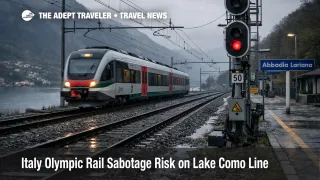
A second suspected sabotage incident has been reported on a northern Italy rail line that helps feed access to Milano Cortina Winter Olympic mountain venues, this time near Abbadia Lariana on Lake Como's eastern shore. Police said a fire damaged cables in a trackside switching unit on the Lecco to Tirano route, a corridor used by travelers moving toward Valtellina, and onward ground links to Bormio and Livigno. Even when trains continue running, heightened security can translate into precautionary inspections, temporary speed limits, or short closures that add real delay risk for tourists, and event attendees.
The nut of it for travelers is simple. Italy Olympic rail sabotage concerns are no longer confined to a single hub disruption, and a second incident on a venue access line raises the odds that authorities and operators will slow traffic to verify infrastructure, especially around peak arrival banks.
Who Is Affected
Travelers headed into Lake Como rail stops such as Abbadia Lariana, plus passengers using the Lecco to Tirano line as the backbone for Valtellina access, sit closest to the risk because localized checks can produce rolling delays that are hard to predict from a timetable alone. That matters most for visitors trying to preserve same day onward moves, for example a regional train that is meant to connect to a prebooked coach transfer into a resort town.
Anyone routing through northern hubs is also exposed because the earlier incident near Bologna demonstrated how infrastructure damage can force broad operational changes, including reroutes, and temporary station restrictions, affecting high speed, Intercity, and regional services with delays reported up to about 2.5 hours. If you are landing into Milan, Italy, or arriving from another Italian city and relying on a tight same day rail chain toward the mountains, the risk is less the single damaged component and more the system response, inspections, and capacity throttling.
Travel advisors managing clients for Olympic period travel should treat this as a reliability story. The corridor is not just a scenic commuter line, it is an access spine that feeds hotel check ins, and timed experiences. When trains slow, arrivals shift into late evening, road traffic increases as travelers abandon rail, and hotel inventory tightens when rebookings spill to the next day.
What Travelers Should Do
If you are traveling on this corridor between February 13, 2026, and the next week of peak Olympic demand, build a larger buffer than your usual regional rail margin. Aim to arrive in Lecco, or your Lake Como base, at least 2 hours before any fixed commitment, and treat same day rail plus bus transfers into the mountains as a chain that can break with a single short hold.
Set a decision threshold before you start moving. If your train is delayed and your plan depends on a timed coach, a ferry, or a hard hotel check in window, switch modes earlier rather than later, for example by shifting to a later rail departure with fewer connections, or booking a private road transfer once you see repeated inspection related holds. If you are still within the first 30 to 45 minutes of disruption and you have two later departures that preserve the day, waiting can be rational, but only if you are not on separate tickets.
Over the next 24 to 72 hours, monitor operator advisories and station notices, not just third party journey planners. Look for language about technical checks, infrastructure verification, security measures, or speed restrictions, because those are the phrases that often precede rolling delays even when the timetable appears intact. Reuters reported that technicians worked overnight to keep morning operations running after the Abbadia Lariana incident, which is good news, but it also signals that conditions can change quickly with new inspections.
Background
Rail disruptions from sabotage propagate differently than weather delays. The first order effect is local, a damaged switching unit, a cut cable, or a forced equipment shutdown that reduces line capacity or speed until checks are complete. The second order ripple is network wide, because trains that arrive late into hubs displace platform slots, break timed regional connections, and consume spare rolling stock, which then pushes delays into later departures even on adjacent lines.
The February 7 incident near Bologna shows this pattern clearly. Authorities reported multiple acts of infrastructure sabotage that affected different parts of the system, and the result was delays across high speed, Intercity, and regional services with knock on impacts far beyond the immediate site. A second reported incident near Lake Como increases the likelihood of precautionary slowdowns on feeder corridors that Olympic travelers depend on, and those slowdowns tend to push demand onto roads, increasing congestion and transfer times into resort areas.
For travelers, the practical lesson is that "trains still running" is not the same as "arrival time reliable." When security posture tightens, operators may run service but pad schedules, hold departures for checks, or impose temporary speed limits. Those measures preserve safety, but they compress your connection margins.
Sources
- Suspected sabotage hits rail line to Italian Olympic venues, no service disruption
- Suspected saboteurs hit Italian rail network near Bologna, police say
- Anarchists claim responsibility for rail sabotage during Italy Olympics
- Milano Cortina, sabotata linea per la Valtellina ma nessuna conseguenza
- Lecco, sabotaggio sulla linea ferroviaria delle Olimpiadi
- Sabotaggio linea Lecco Tirano, Fontana: azioni inaccettabili
- Lecco Colico Sondrio Regional Line