

Universal Orlando Tunnel Transit Bid Picks Boring Co
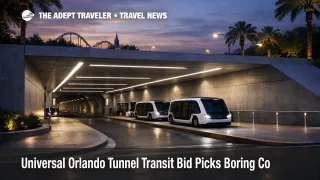
Universal Orlando's local special purpose district moved a step closer to a new on property transportation system after its board adopted a resolution on February 11, 2026, identifying The Boring Company as the top ranked respondent for a transportation infrastructure improvements project in Orlando, Florida. The decision matters most to travelers who move between Universal's parks and hotels, and especially anyone planning to split time between the new Epic Universe campus and the legacy parks area. For now, the practical takeaway is to treat this as an early selection and negotiation step, keep your current trip plans built around existing buses, walking paths, and rideshare, and watch for feasibility and timeline signals before assuming any future "monorail like" convenience.
The Universal Orlando tunnel transit shift is that the district has formally signaled an intent to negotiate with a tunneling focused contractor for design, build, operate, and maintain services, while explicitly noting it still must evaluate scope, operational and financial feasibility, scalability, and other terms before any final commitment.
Who Is Affected
Travelers who currently experience Universal as two campuses separated by surface traffic are the core audience. Universal Studios Florida, Universal Islands of Adventure, and Universal CityWalk are clustered, and they already offer a mix of walking, water taxi, and shuttle options across many on site hotels. The more consequential friction point is the longer cross property move that relies on public roads, a transfer that becomes more common as Epic Universe grows into multi day itineraries. If a point to point system eventually launches, it would be most valuable for guests who hop parks midday, return to hotels for breaks, or time dining and shows across different zones on the same day.
Travel advisors and planners are also indirectly affected because transportation capacity shapes itinerary structure. When surface streets are the only high volume connector, every delay driver, crash, rain, event surge, or peak arrival window can expand the "hidden cost" of moving between hotel check in, parks, and dining. A dedicated guideway changes where time buffers should be allocated, and it can shift which hotels feel closest in real minutes, not map distance.
Local stakeholders near project interfaces are another layer because resort scale infrastructure changes rarely stay invisible. Even if an eventual system reduces some road demand, the build phase can add short term disruption through staging, utility work, lane shifts, and permitting constraints, which matters for travelers arriving by rideshare, taxi, rental car, or private car service who are navigating the same corridors.
What Travelers Should Do
If you are booking Universal Orlando now, pick hotels and ticket plans based on today's transportation reality, not on the promise of a future tunnel. Build your itinerary assuming the same transfer methods you would use without this project, and keep extra buffer on days when you plan to move between campuses with timed reservations, dining deposits, or separately ticketed events.
Set a clear decision threshold for changes once more details become public. If you already have a reservation and later announcements show a realistic opening window that overlaps your dates, then it may be worth reconsidering hotel placement or park day sequencing. If updates remain in the feasibility and negotiation phase, keep your plan intact, because shifting lodging prematurely can cost money without delivering time savings.
Over the next 24 to 72 hours, monitor three practical signals rather than general headlines. Watch for any published project timeline, watch for proposed station locations or stop names that clarify which hotels and assets benefit first, and watch for whether the district frames delivery as phased. Phasing matters because early service often covers one high value segment first, then expands, which changes who sees real benefits on an actual trip.
Background
The board action is not a final build authorization, it is a formal designation step that starts contract negotiations after a competitive request process. In its adopted resolution, the Shingle Creek Transit and Utility Community Development District describes an RFQ driven evaluation, ranks The Boring Company as the most qualified respondent, and then emphasizes that the district will negotiate terms including scope, feasibility, and scalability, while retaining discretion not to award a contract or to implement the project in phases. That framing is important for travelers because it means there is no confirmed construction start date, no confirmed opening date, and no published rider service plan yet.
The district also did not publicly lock in a single "method of transportation" in the selection step, which is why coverage describes this as a likely underground concept rather than a guaranteed tunnel build. Still, selecting a contractor best known for tunnel networks, including the Vegas Loop, tilts expectations toward a subsurface approach, even in a region where engineering constraints such as groundwater and soil conditions can shape design choices and costs.
For the travel system ripple, the first order effect is internal to the resort, a dedicated connector can reduce dependence on surface congestion, tighten transfer time variability, and make it easier to plan split day touring across campuses. The second order effect shows up across at least two other layers. On the lodging layer, reduced transfer friction can change which hotel categories feel viable without a car, and it can redistribute demand across on site and nearby off site corridors because perceived "distance" becomes a schedule question, not a mile count. On the operations layer, a high frequency internal people mover can change crowd flow patterns, which can shift security, entry, and end of night departure surges, and that can feed back into rideshare pricing and pickup congestion at peak times. Those second order effects are why it is reasonable to watch this project even before there is a final build contract, because the planning implications can show up as soon as timelines and stop locations become clearer.