

Delta Hawaii Winter Flights Add MSP Maui Route
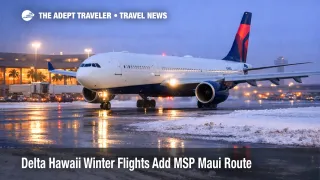
Delta Hawaii winter flights are expanding with new and returning nonstop options aimed at the heaviest winter demand. Delta says it will launch nonstop service from Minneapolis Saint Paul International Airport (MSP) to Kahului Airport (OGG) on Maui, Hawaii, and it will restore nonstop flights from Boston Logan International Airport (BOS) to Daniel K. Inouye International Airport (HNL) in Honolulu, Hawaii, with both routes beginning December 19, 2026. Travelers planning peak holiday and spring break trips should expect the most capacity on those peak weeks, and they should treat the rest of the winter season as tighter, frequency limited inventory that can sell out early.
Delta Hawaii winter flights now include two additional long haul mainland gateways for winter 2026 and 2027, which changes the nonstop map for travelers who previously relied on connections through West Coast hubs.
For Minneapolis Saint Paul to Maui, Delta plans daily flying during peak holiday and spring break windows, and five weekly flights through the core winter season, using the Airbus A330 300. For Boston to Honolulu, Delta plans daily flights during peak late December demand before shifting to four weekly frequencies for the balance of the winter season, also using the Airbus A330 300. Delta framed the move as part of its largest Hawaii seasonal schedule, and it positioned the aircraft choice as a premium option on longer stage lengths.
The airline also paired the new routes with frequency and timing changes across its existing Hawaii network. Delta plans to increase John F. Kennedy International Airport (JFK) to Honolulu to daily service starting April 1, 2026, using the Boeing 767 300. For winter 2026 and 2027, Delta plans daily Detroit Metropolitan Wayne County Airport (DTW) to Honolulu starting November 9, 2026, and it plans to add a second Atlanta, Georgia to Honolulu frequency three times weekly from January 4, 2027, through March, both on the Airbus A330 300. On the Big Island, Delta plans to start daily Salt Lake City International Airport (SLC) to Ellison Onizuka Kona International Airport at Keahole (KOA) on November 9, 2026, and it plans to upgauge Los Angeles International Airport (LAX) to Kona to the Boeing 767 300 for the winter season starting November 9, 2026.
Who Is Affected
Travelers based in Minnesota, Wisconsin, Iowa, the Dakotas, and nearby Midwest markets that connect through Minneapolis Saint Paul gain a new one stop free path to Maui, which matters most for families targeting holiday weeks and school break dates when same day connections can be fragile. The A330 300 schedule also tends to concentrate more seats into fewer departures, so the trade is usually fewer total departure choices, but a larger pool of seats on the days it operates.
New England travelers, and anyone connecting into Boston Logan from secondary Northeast airports, regain a true nonstop option to Honolulu for winter 2026 and 2027. That is a meaningful change for itineraries that used to require West Coast connections, because it cuts out one mainland connection point that can fail during winter weather and tight connection banks. The Boston Honolulu market also intersects with prior airline pullbacks in the region, including Hawaiian Airlines Route Suspension Cuts Boston, Seoul, which is a useful reference point for why nonstop Hawaii service from Boston can be seasonal and sensitive to aircraft availability.
Travelers starting in Atlanta, Detroit, New York, Utah, and Southern California are affected even if they do not care about the new MSP or BOS routes, because the added Hawaii flying shifts widebody aircraft and crews across Delta's long haul leisure network. When an airline adds winter Hawaii capacity, it often reshapes connection opportunities through its hubs, and it can change award availability, upgrade odds, and reaccommodation options when irregular operations force reroutes.
What Travelers Should Do
If your trip is anchored to a specific week, especially the Saturday before Christmas, New Year's week, or common March spring break windows, prioritize locking in flights early and choosing schedules with buffer on the front end of the trip. For Hawaii trips, the first night is usually the most expensive to lose, so conservative planning often means arriving with enough margin to avoid missing the first hotel night, and avoiding separate ticket connections that cannot be protected during rebooking.
If fares look high, the decision threshold is usually whether you need the nonstop, or whether you can tolerate a connection and a longer travel day. Nonstop flights typically price at a premium in peak weeks, and they can sell out in the higher fare buckets first, so travelers who value certainty often book and then reprice if a sale appears. If you are flexible, a connection through a West Coast gateway can still be cheaper, but it brings a higher misconnect and baggage delay risk during winter disruption patterns.
Over the next 24 to 72 hours after a schedule announcement, monitor inventory release timing, aircraft assignment stability, and the fine print on seasonal end dates, because those are the areas that tend to shift first. Then, from late summer through fall 2026, keep checking for schedule changes as airlines finalize winter fleet plans, and watch your itinerary for aircraft swaps that can change seat maps and upgrade space without changing the flight number.
Background
Airlines build Hawaii winter schedules around a simple constraint, demand spikes hard during holiday and school break periods, but long haul widebody aircraft are scarce, and they are shared across multiple premium leisure and international markets. Adding a new nonstop such as Minneapolis Saint Paul to Maui is not just a route decision, it is a fleet and crew decision that can ripple into other stations through aircraft rotations, maintenance positioning, and crew legality limits on long duty days. Those first order constraints show up as fewer frequencies outside peak weeks, and that, in turn, increases the chance of sold out flights and limited same day reaccommodation when weather disrupts the origin hub.
Second order effects show up quickly outside aviation. More nonstop seats into Maui and Honolulu can shift hotel check in patterns, raise the value of early booking for rental cars, and compress inventory on peak arrival days, even when the total weekly visitor count does not change much. If a winter storm disrupts a Midwest departure bank, the most common traveler pain point is not the cancellation itself, it is the lack of equivalent seats on the next day's nonstop, which pushes people onto indirect routings, later arrivals, or an unplanned overnight at the hub.
If you want the structural why behind tight peak season supply, and why airlines sometimes shift routes late in the cycle, the capacity side of the story matters. FAA Delays on Boeing 737 MAX 10 Hit Airline Capacity explains how delayed aircraft deliveries can keep networks more constrained than demand would suggest, which is one reason airlines protect widebody utilization for the highest yield weeks and keep shoulder weeks thinner.