

El Paso Airspace Shutdown Reroute Risk for Flights
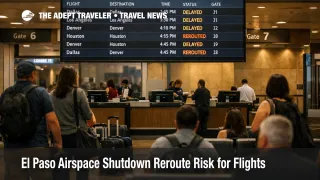
An overnight FAA action briefly shut down flight operations around El Paso International Airport (ELP), then reversed within hours, creating a classic "restart" problem where flights may be back, but schedules stay fragile. The restriction was published as a Temporary Flight Restriction, TFR, and it was unusually sweeping because it prohibited all aircraft operations in the defined area for "special security reasons," rather than allowing common exceptions. The FAA later said the temporary closure had been lifted and that there was no threat to commercial aviation, allowing airlines to resume normal operations.
The fallout risk for travelers is less about the hours the airspace was closed, and more about what airlines did in response. When a hub, even a mid size one, experiences a full stop, carriers may cancel, divert, or re time flights, and then spend the next day or two repositioning aircraft, re pairing crews, and reaccommodating passengers. That is why an El Paso disruption can still show up as reroutes, longer connections, or last minute equipment swaps after service resumes, especially for tight itineraries across the U.S. Southwest.
Who Is Affected
Travelers departing from, arriving into, or connecting via El Paso are the obvious first tier. If your trip depends on same day arrival for a cruise, a wedding, a work start time, or a medical appointment, the recovery tail matters because even small delays can eliminate your last viable option of the day, and force an overnight.
The second tier is anyone routed through nearby Southwest banks where reaccommodation tends to land when El Paso goes sideways. In practice, that can mean being pushed onto longer paths through other Texas airports, New Mexico, or Arizona, depending on airline networks and seat availability. When those alternates fill up, delays spread outward, not because the airspace is closed again, but because the system is trying to fit displaced passengers into flights that were already close to full.
The third tier is travelers on separate tickets, or travelers mixing air and ground segments. A sudden stop can trigger improvised backups, one way car rentals, last minute hotels, or alternate airport transfers. When flights resume, some people try to unwind those choices, while others double down, and that demand swing is what breaks "normal" assumptions about car availability, hotel pricing, and late check in flexibility in the region.
For additional continuity on what happened in the initial event window, see El Paso Airspace Shutdown Tied to Drone Laser System.
What Travelers Should Do
Start with immediate actions and buffers. Confirm your flight is operating in the airline app, then cross check the airport's own departures and arrivals feed, and take screenshots of any waiver language you are offered. If you have checked bags, add extra time for counter lines, because restarts often concentrate passengers onto fewer flights, and that spikes check in demand.
Use decision thresholds for rebooking versus waiting. If your connection margin is under 90 minutes, or you are on separate tickets, treat any renewed FAA restriction signal, airline advisory, or rolling delay trend as your trigger to rebook. The practical reason is inventory, once alternate routings sell out, you are no longer choosing the least risky option, you are taking what is left.
Over the next 24 to 72 hours, monitor the specific indicators that predict renewed disruption. Watch the FAA's TFR updates and any airline operational alerts mentioning El Paso or nearby airspace, then watch your aircraft's inbound leg on the day of travel because late arriving equipment is a common post event failure mode. If you want broader context on why airspace actions can ripple nationwide even when a single airport is the focal point, see U.S. Air Traffic Control Privatization: Reality Check.
How It Works
A Temporary Flight Restriction is the FAA's mechanism to restrict aircraft operations in a defined area for a defined time, most commonly for safety, security, or special events, and it is distributed through FAA systems used by dispatchers, pilots, and air traffic control. In the El Paso case, the FAA's TFR detail page shows an effective window beginning February 10, 2026, at 1130 p.m. MST, with an end time that originally extended to February 20, 2026, at 1130 p.m. MST, even though the restriction was later lifted.
The first order travel impact is straightforward at the source, departures stop, arrivals divert or hold, and airlines begin canceling or re timing flights to protect crews and aircraft rotations. The second order ripple spreads across at least two other layers of the travel system. One layer is network flow, aircraft and crews that were supposed to operate later legs are now out of position, which can delay unrelated routes later in the day, and can force reroutes through different airports as carriers rebuild the schedule. Another layer is the ground system, hotels, rideshares, and car rentals absorb the shock when passengers are stranded overnight, and then absorb another shock when passengers return in a compressed wave once flights resume.
What made this incident especially confidence shaking is the reporting that tied the shutdown to counter drone activity and coordination issues between federal entities, including claims involving a laser based counter drone system and a rapidly evolving threat picture. That matters to travelers because it increases the chance of precautionary actions repeating if similar alerts or tests recur, even if the actual risk to commercial aviation remains low.
Sources
- Federal Aviation Administration, Graphic TFRs, Detail (6/2233)
- FAANews on X: Temporary closure of airspace over El Paso lifted
- Pentagon let CBP use anti drone laser before FAA closed El Paso airspace, AP sources say
- El Paso airspace closure due to use of U.S. military anti drone technology (NPR)
- The El Paso No Fly Debacle Is Just the Beginning of a Drone Defense Mess (Wired)