

Southwest Assigned Seats Boarding Kinks, Feb 2026
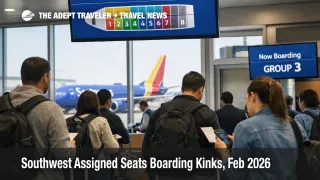
Southwest Airlines has begun assigning seats on flights departing on or after January 27, 2026, ending the carrier's long running open seating model. The change affects every passenger, but it hits hardest for families, Basic fare travelers, and anyone who built habits around the old 24 hour check in race. Travelers should now focus on seat selection timing, family seat placement, and carry on strategy because early flights under the new system show that gate flow and bin behavior are still adjusting.
The Southwest Assigned Seats Boarding rollout shifts the main traveler stress point from boarding position to seat assignment, and that is already changing how gates load and how cabins fill.
Southwest says most fares can select seats during booking, while Basic fare customers receive seat assignments at check in, unless tier status or eligible Rapid Rewards credit card benefits apply. Southwest also replaced the A, B, C boarding lanes with Groups 1 through 8, and it says stanchions will no longer be used in gate areas, which removes the familiar numbered post lineup that shaped old boarding behavior. Under the new structure, Southwest says boarding priority is tied to seat location, starting with extra legroom seats in Groups 1 and 2, and then layering fare bundles, tier status, and credit card benefits into the later groups.
This is not just a signage change. Assigned seats reduce the incentive to sprint to check in exactly 24 hours before departure, but they also change how travelers manage overhead bins. In the open seating era, some passengers informally used bin availability as a reason to choose a row. With assigned seats, the seat is fixed, so a traveler who finds a full bin above their row is more likely to push forward, stash a bag elsewhere, and then move back against oncoming traffic. That behavior is at the center of several early complaints about aisle crowding and slower boarding.
Who Is Affected
Families are a core group to watch because the failure mode is more personal and more disruptive than a slower boarding line. Southwest says families traveling on the same confirmation number will be assigned to the same boarding group. It also says it will work to seat children ages 12 and younger next to at least one adult in the party, including on Basic fares where seats may be assigned at check in or at the gate. That still leaves room for real world frustration when flights are full, when families did not select seats early, or when a party expects adjacent rows and gets separated across the cabin even if one adult ends up next to the child.
Basic fare travelers face the most uncertainty because the seat assignment step happens later, when the remaining inventory is thinner. Southwest's own description makes the tradeoff clear, Basic fares can be assigned at check in or at the gate, while higher fare bundles can select seats at booking. If a trip depends on sitting together, or on keeping a carry on close by, the Basic fare pathway introduces more ways for the plan to break on a peak day.
Frequent flyers and credit card holders are affected in a different way, their benefits now translate into earlier boarding groups rather than a better boarding position inside A, or a purchased upgrade. Southwest says A List Preferred members will board no later than Group 2, A List members will board no later than Group 5, and Rapid Rewards credit card members who do not already qualify earlier will board with Group 5, with the benefit extending to additional travelers on the same reservation. That creates a new incentive to consolidate bookings under one confirmation number, because split reservations can produce split boarding outcomes even for a single family traveling together.
Operationally, anyone with a tight connection, a last flight of the night arrival, or a short turn itinerary is exposed to any boarding slowdown. Even small delays at the gate can cascade into missed connection windows, rebooking competition, and crew legality constraints that force a later flight to cancel or swap aircraft. That is why early boarding friction matters beyond comfort, it can propagate into schedule reliability across the day.
What Travelers Should Do
Select seats as early as your fare allows, and confirm every traveler in your party is on the same confirmation number before you arrive at the airport. If you are traveling with children, verify the child's exact seat assignment in the app, or on your boarding documents, and do not assume a shared boarding group guarantees adjacent seats on a full flight. If sitting together is essential, avoid late assignment pathways, and treat Basic fare seat assignment as a risk factor rather than a minor inconvenience.
Use a clear rebook versus wait threshold when you see separated seats, or when your party is split across multiple rows. If you have a child 12 or under who is not seated next to at least one adult, address it at the gate early, and be prepared to change flights if the aircraft is full and the remaining seat inventory cannot be rearranged without multiple passengers moving. If your trip is flexible, moving to a less full flight often fixes the problem faster than negotiating swaps in a packed cabin.
Over the next 24 to 72 hours before departure, monitor for seat map changes, aircraft swaps, and any app prompts that alter your boarding group, especially if you are relying on tier, or credit card boarding benefits. Build extra time at the gate because early reports describe confusion during the transition, and because carry on volume can turn a normal boarding into a stop and go aisle. If you must travel with a full size carry on, consider checking a bag to reduce your dependence on overhead space near your assigned row.
How It Works
Open seating shaped Southwest's entire airport experience, because check in timing effectively acted as a bidding system for earlier boarding, better seat choice, and easier access to overhead bins. Assigned seats break that linkage. Southwest now centers priority on what a traveler bought, which seat they hold, and what loyalty benefits apply, then boards in Groups 1 through 8 rather than in the old A, B, C pattern, with Basic fares generally last and premium seats earlier. Southwest also says EarlyBird Check In and Upgraded Boarding are no longer available once assigned seating begins, and it points travelers to a newer Priority Boarding purchase window closer to departure.
The first order impact shows up at the gate and in the aisle. When travelers no longer choose seats on entry, they may be less willing to take the first available open row, and more likely to insist on reaching their assigned seat even if the bins above it are full. That creates a backtracking problem that slows boarding, and it can produce the scramble behavior described in early first person accounts of the rollout. Southwest has acknowledged the feedback loop. In a February 11, 2026, statement to the San Antonio Express News, a Southwest spokesperson said the airline is monitoring real world behavior and using those insights to make early adjustments.
The second order ripple is network level. Slower boarding increases the odds of a late push, and a late push can compound into missed connections, crew duty time issues, and tighter same day rebooking inventory on later departures. That, in turn, can pressure airport hotels when travelers roll to the next day. The assigned seating shift is also part of a broader set of customer experience changes at the carrier, including connectivity upgrades that Southwest says will roll out over time, which Adept Traveler tracked in Southwest Starlink WiFi Upgrade For Summer 2026.