

Star Seeker Miami Christening, Windstar Suite Choices
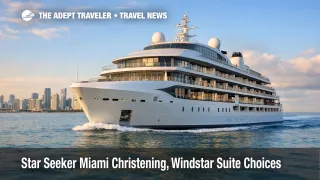
Windstar's new yacht Star Seeker is now in active service after a christening in Miami, marking the line's biggest hardware refresh in years. The change matters most for travelers who want Windstar's small ship style but have been holding out for more private outdoor space, newer suite layouts, and updated onboard venues. The practical next step is to book with your cabin priorities and flight buffers in mind, because a 224 guest ship sells differently than mass market vessels, and balcony categories can disappear first.
The Star Seeker program moved quickly from handover to revenue sailing. Windstar took ownership on December 15, 2025, in Viana do Castelo, Portugal, then launched a 16 night Atlantic crossing from Málaga to Miami that departed on December 28, 2025, and scheduled the Miami christening for January 15, 2026. Windstar has framed the maiden season as a multi region deployment, with the Caribbean first, then a full Alaska season, plus Japan later in the year.
For travelers, the most meaningful onboard shift is the suite and balcony mix. Star Seeker carries 224 guests across 112 suites, and Windstar says nearly all have either a full private veranda or a floor to ceiling infinity window. The top end Horizon Owner's Suites are listed at 548 square feet, and their wraparound balconies add another 248 square feet, while typical veranda category suites show 225 square feet inside with about 55 square feet of outdoor space.
Who Is Affected
Windstar repeat guests are the obvious audience, especially anyone who likes the line's destination forward pacing but has wanted a more modern outdoor private space standard than older small ships can offer. First time Windstar travelers are also affected, because Star Seeker narrows the gap between boutique yacht cruising and the balcony expectations that have become default across contemporary fleets, without pushing capacity into the thousands.
Gateway planning is where the ripple effects show up first. Miami embarkations tend to pull demand into the same few hotel clusters, and they increase exposure to flight delays into Miami International Airport (MIA) and Fort Lauderdale Hollywood International Airport (FLL), especially if you are trying to fly in on embarkation morning. On itineraries that end in San Juan, Puerto Rico, the pressure shifts to Luis Muñoz Marín International Airport (SJU) for same day departures, and that can tighten your margin if immigration, luggage, or transfer timing slips.
Destination driven travelers see the second order effects across the season. When a ship swings from the Caribbean into Alaska and then onward to Japan and Southeast Asia, the cruise decision starts to behave like a multi trip air planning problem, because you may be comparing different gateway flights, different hotel strategies, and different documentation requirements in one product line. If your late 2026 plans include Vietnam calls, this is the point where Vietnam Entry Requirements For Tourists In 2026 becomes part of the cruise research, not an afterthought.
What Travelers Should Do
Lock your logistics first, then pick your suite. For Miami starts, treat a hotel arrival the day before as the default, and aim for flights that land by mid afternoon so you have time to absorb a delay and still reach the port calmly. If you are ending in San Juan, assume you will want a later flight out of Luis Muñoz Marín International Airport (SJU) unless Windstar explicitly offers a protected transfer that matches your departure bank.
Decide upfront whether a veranda is a requirement or a preference. If you truly want outdoor private space, book a veranda category early and do not assume an infinity window will feel equivalent once you are underway, particularly on scenic heavy Alaska days where you may want air, light, and an unobstructed horizon. If veranda categories are sold out or priced beyond your threshold, compare the real tradeoff against a different Windstar ship or sailing, and use Maiden Voyage Malaga to Miami, Windstar Star Seeker as a reference point for how quickly inaugural season inventory can move.
Over the next 24 to 72 hours after you book, monitor the variables that actually change outcomes. Watch Windstar for any schedule notes tied to early season operations, keep an eye on airline schedule changes into your gateway airport, and confirm your cruise documents and passport validity window early, not the week you travel. If you are also shopping value adds, check whether current promos resemble the structure in Windstar Beyond Inclusive Wave Offer Through Mar 31, because inclusions can swing total trip cost more than a small fare difference.
Background
Star Seeker is part of a two ship expansion rooted in Windstar's 2024 deal to acquire vessels tied to Mystic Invest's expedition platform, then convert them into what Windstar leadership described as full Windstar ships. In that plan, Star Seeker was the newbuild coming in December 2025, and Star Explorer was slated for December 2026, expanding the brand's small ship capacity while keeping the guest count at 224 per ship. The conversions were designed around Windstar's signature marina water sports concept, changes to the aft structure, and the replacement of a helipad concept with large owner suite space, which signals a warmer weather, guest comfort priority rather than polar mission hardware.
Operationally, a ship like this propagates through the travel system differently than a mega ship. At the source, the ship's small size supports ports and island calls that bigger vessels cannot reach, which can change shore excursion availability and tender timing. The next layer is air and hotel flow into gateway cities like Miami, where even a single additional ship can tighten the pre cruise hotel market on peak turnover days. The third layer is seasonality, because moving from Caribbean to Alaska to Japan and beyond forces travelers to solve different gear, weather, and flight problems, and it forces the operator to manage crew flow, provisioning, and regional compliance across long repositioning arcs.
Windstar has also positioned Star Seeker as a newer tech platform, citing tier III NOx rated Rolls Royce engines, shore power connectivity, forward facing sonar, pump jet thrusters, and advanced wastewater treatment among its systems. For travelers, that is not just an environmental claim, it can influence port access rules in places that increasingly scrutinize emissions, wastewater, and shore power readiness, which is one reason newbuild capability can matter even on an itinerary that looks similar on paper to older ships.