

U.S. Airlines Pilot Hiring Rule Ends DEI Programs Feb 2026
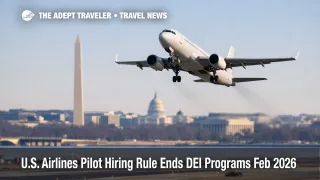
Federal regulators moved to add a new Operations Specification to U.S. airline operating certificates, requiring carriers to attest that pilot hiring is exclusively merit based. The change was rolled out through the Federal Aviation Administration for scheduled airlines operating under 14 CFR Part 121, and it was amplified in Department of Transportation messaging from Washington, D.C. Travelers are not facing new cockpit licensing rules, but they are likely to see a new round of public statements, compliance paperwork, and potential legal challenges tied to how airlines describe their recruiting and selection practices.
The US airlines pilot hiring rule is meant to force a formal certification trail around pilot hiring criteria, and it introduces an enforcement posture that could spill into staffing plans and schedule reliability later in 2026.
The FAA issued Notice N 8900.767 on 02/13/2026 creating mandatory OpSpec A134, "Merit Based Pilot Hiring," for Part 121 certificate holders. The sample language is short but absolute, it says the certificate holder "shall ensure pilot hiring is exclusively merit based" to meet its duty to provide the highest possible degree of safety in the public interest. The notice also ties the policy to White House actions that directed DOT and FAA to rescind DEI initiatives and return to merit based hiring inside the agencies, framing the new OpSpec as consistent with that posture.
Timing matters because this is not an instant operational flip for every carrier on the same day. The FAA instructs principal operations inspectors to send a notification letter within two business days of publication, allow the carrier seven days to submit written information, then issue OpSpec A134 within 30 days after the FAA completes its disposition. If the OpSpec is adopted, the template letter says it becomes effective 30 days after the carrier receives the FAA notification, which pushes real effective dates into a rolling window that can vary by airline.
DOT's public framing is broader than the OpSpec itself, and it is where the DEI language is most explicit. In its release, Transportation Secretary Sean P. Duffy said the action responds to "allegations of airlines hiring based on race and sex," and that carriers will be required to certify that the practice is terminated, warning that failure to comply will trigger federal scrutiny. Reuters also reported that the FAA did not cite evidence that any U.S. airline is employing unqualified pilots, which is an important distinction for travelers separating political messaging from actual safety qualification standards.
Who Is Affected
Passengers flying any scheduled U.S. airline that operates under Part 121 are in scope, including the big brands and the regional carriers that feed them. For travelers, the most immediate effects are informational, expect airlines and trade groups to emphasize that pilot qualifications, training, and licensing already follow federal rules, and expect unions and advocacy groups to challenge the premise that pilot quality was in doubt.
Pilots and pilot applicants are more directly affected than customers, because the OpSpec requirement sits inside the hiring pipeline. Carriers may need to adjust how they document selection criteria, how they describe pathways and scholarships, and how they demonstrate that hiring decisions align with job specific experience and aptitude. If this becomes an investigation driven issue rather than a paperwork exercise, airlines could face discovery requests, audits, or litigation that makes hiring slower, more conservative, or more centralized.
The ripple effects that matter for travel show up when staffing plans meet a busy schedule. If hiring and training throughput slows, or if airlines pause certain programs while lawyers review language, the second order impact can surface as thinner reserve staffing, fewer spare crews to recover from weather, and less flexibility during irregular operations. Those crew flow constraints are rarely visible when you buy a ticket, but they are a common reason why delays cascade across a network, which then hits hotel check in times, cruise departures, tours, and onward rail or road transfers.
What Travelers Should Do
If you are booking travel in the next four to eight weeks, prioritize itineraries that are resilient to schedule changes, choose nonstop when practical, avoid ultra tight connections, and consider refundable fares or points bookings that preserve flexibility if timetables shift.
If you already have tickets and see a schedule change, use a simple threshold, small shifts of minutes are common and not meaningful, but a departure move of multiple hours, a forced connection, or an arrival that breaks a same day cruise or tour start is a reason to rebook rather than wait.
Over the next 24 to 72 hours, monitor official airline statements, Airlines for America updates, and pilot union responses for signs of litigation, injunction requests, or compliance deadlines that differ by carrier. Also watch whether airlines revise recruiting program language, because that is an early indicator of how disruptive the internal compliance work will be.
How It Works
Operations Specifications are the FAA's mechanism for embedding carrier specific authorizations, limitations, and procedures into an airline's operating certificate. Airlines already live and die by OpSpecs for many operational details, so inserting a mandatory OpSpec changes the compliance surface area in a way that is enforceable through certificate oversight rather than only through public messaging.
In this case, OpSpec A134 is paired with an administrator initiated amendment process that starts with an FAA notification letter. The carrier has a short window to submit information, then the FAA issues a disposition and, if adopted, the OpSpec becomes effective after a 30 day clock. That structure suggests the near term impact is mostly compliance and documentation, but it also creates a ready hook for investigations if regulators decide an airline's hiring process conflicts with what it certifies.
For travelers, the key is separating three layers that often get blended together in public debate. First, the baseline pilot qualification and training regime is still set by federal regulations and carrier training programs, and the new OpSpec does not rewrite those standards. Second, the hiring pipeline is where airlines will feel pressure to prove their process is defensible, which can change how fast new pilots enter training. Third, network reliability is where those staffing decisions can show up months later, because a tight labor market and training bottlenecks reduce slack, and low slack makes disruptions last longer.
That same labor and throughput dynamic is why airline maintenance staffing and aircraft delivery delays matter in the background, even though OpSpec A134 is about pilots. The maintenance workforce is older, and women remain a small share of certificated mechanics in published pipeline reporting, which has fueled repeated warnings about shortage risk. Separately, IATA has argued that supply chain delays and a record order backlog are costing the industry billions and keeping aircraft out of service longer, which raises the operational premium on having enough crews and mechanics to keep schedules stable. Travelers looking for context on how FAA actions can affect real world capacity can also reference FAA Delays on Boeing 737 MAX 10 Hit Airline Capacity.
Sources
- Trump's U.S. Transportation Secretary Sean P. Duffy Doubles Down on Purging DEI from Our Skies
- New Mandatory Operations Specification A134 Merit-Based Pilot Hiring
- FAA Notice N 8900.767 (PDF)
- US airlines must certify use of merit-based hiring for pilots, FAA says
- ALPA Statement on FAA Action Regarding Pilot Hiring
- Ending Illegal Discrimination And Restoring Merit-Based Opportunity
- Keeping Americans Safe in Aviation
- Reviving the Commercial Aircraft Supply Chain
- Aviation Technician Workforce Pipeline Report 2024 (PDF)