

U.S. Nonprofit Library Passport Fees Blocked
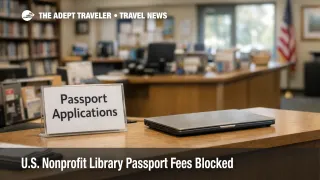
The U.S. Department of State has ordered certain nonprofit public libraries to stop processing in person passport applications in the United States. First time applicants, families applying for children, and travelers who relied on evening and weekend library appointments in states where public libraries are structured as 501(c)(3) nonprofits are most affected. Travelers should identify an alternate passport acceptance facility now, book an appointment early, and add extra time buffers if their trip is close.
The change is being driven by U.S. nonprofit library passport fees, specifically the execution fee that acceptance facilities charge for taking an application in person. The State Department says federal law and regulations prohibit nongovernmental organizations from collecting and retaining that execution fee, and it has begun enforcing that interpretation by removing affected libraries from the Passport Acceptance Facility program.
This is not just a bookkeeping change. In the reporting and in library notices, removal from the program means the library cannot accept, execute, and forward in person applications at all, even if it wanted to waive the fee, or route it elsewhere. Government run libraries remain eligible, and the State Department says it will look for new eligible partners where a removal creates a service gap.
Separately, viral claims have tried to connect the library passport issue to federal voting proposals sometimes labeled the SAVE Act or SAVE America Act. Those bills are distinct from the passport acceptance facility enforcement action, and they are still moving through Congress, which means they have not changed voter registration rules nationwide as of today.
Who Is Affected
The biggest traveler impact is on people who must apply in person rather than by mail. That includes many first time adult applicants, most child applications, and some replacement cases where an in person execution step is required. Travelers who previously used a nearby library because it offered walk ins, Saturday hours, language help, or a calmer setting for families will likely feel the change most.
The disruption is not evenly distributed across states. Many public libraries are departments of municipal or county governments, and those government run libraries are not affected. The pain concentrates in states where a large share of public libraries are organized as nonprofit entities even while serving the public, which is why lawmakers and library groups have highlighted Pennsylvania and parts of the Northeast in early pushback.
If you are traveling soon, the real risk is not that passports have become harder everywhere. The risk is that the nearest remaining acceptance sites, often post offices and county clerks, can fill up quickly, and they may have fewer evening and weekend appointment windows. That pushes more travelers into expedited service, schedule changes, or last minute travel rebooking when documents do not arrive on time.
What Travelers Should Do
If you need an in person application, treat it like a scarce appointment. Find the closest alternate passport acceptance facility today, confirm its hours and appointment rules, and secure the earliest slot you can. If your local nonprofit library still offers passport photo service, you can often still use it for compliant photos even after acceptance services end.
If you are within about four to six weeks of departure, decide based on risk, not hope. If you cannot get a local appointment within a week, or if standard processing would cut it close to your departure date, shift immediately to expedited processing, and consider adjusting your travel dates before you lock in nonrefundable costs. If your trip is fully refundable and your document timeline is uncertain, rebooking is usually cheaper than trying to solve a passport crunch in the final days.
Over the next 24 to 72 hours, monitor three things: your ability to get an acceptance appointment, any State Department clarification about how nonprofits could handle the execution fee, and the progress of the bipartisan bills that would restore library eligibility. Do not assume a legislative fix will arrive in time for your departure unless it has actually passed and been implemented.
How It Works
A U.S. passport application has two different payment flows when you apply in person. One fee goes to the State Department for the passport book or card itself. A separate execution fee is charged for the in person acceptance step, where a trained acceptance agent verifies identity and citizenship documents, witnesses the signature, and forwards the application for adjudication. The State Department's public guidance describes that execution fee as payable to the acceptance facility, which is why many local facilities treat it as cost recovery for staffing, training, and secure handling.
The enforcement conflict sits inside the execution fee authority. The Passport Act provision the State Department is leaning on says the execution fee is collected and paid into the U.S. Treasury, except that the Secretary of State may authorize state or local officials, or the U.S. Postal Service, to collect and retain the execution fee. The State Department's implementing regulation on the same point similarly ties retention of the execution fee to execution services provided by an official of a state or local government, or by the U.S. Postal Service. Under that reading, a nonprofit public library that is not part of a state or local government cannot lawfully keep the execution fee, even if it reinvests the money into public services.
That explains the core question travelers keep asking: is it that nonprofit libraries cannot submit applications, or just that they cannot keep the fee. In theory, the statute's baseline structure contemplates execution fees being paid into the Treasury unless an entity is authorized to collect and retain them. In practice, the modern Passport Acceptance Facility program is built around local sites collecting that execution fee as their compensation. The State Department is treating fee ineligibility as program ineligibility, and the cease and desist letters described in reporting, plus library statements, indicate affected nonprofits are being deactivated as acceptance facilities, which blocks them from executing and forwarding in person applications at all.
So why were nonprofit libraries doing this for years. Two dynamics appear to explain how the system got here, even if the State Department has not publicly laid out a detailed timeline. First, libraries have been part of the broader acceptance network for decades, and the acceptance agent rules allow the Department to designate specific persons as acceptance agents, with requirements like being a permanent employee and meeting training and oversight standards. Second, U.S. public library governance varies by state, and many communities are served by "public" libraries that are organized as private nonprofits, often with public funding, public missions, and close ties to local government, which can blur the line between a government office and a nonprofit service provider in day to day operations.
A useful way to see when and how nonprofit libraries started issuing passports is to look at the demand shocks and the adoption pattern. In the mid to late 2000s, the Western Hemisphere Travel Initiative tightened documentation expectations for travel between the United States and nearby countries, and a surge in applications around the 2007 phase in caused processing delays and widespread confusion, pushing more Americans to seek passports. Around that same era, many libraries expanded "gateway to government services" offerings, and some nonprofit libraries became Passport Acceptance Facilities, with the James V. Brown Library, a 501(c)(3), reporting that it has held that status since January 2008. Reporting from Connecticut also describes an affected library providing passport services for 18 years before it was told to stop, which points to roughly the same period for program expansion into the nonprofit library segment.
Were those libraries accepting fees, or doing it purely as a public service. Both can be true, but the fee was real, and many libraries depended on it. The execution fee is an explicit part of the in person application process, and libraries commonly also offered passport photos as an add on. In Pennsylvania, the James V. Brown Library said passport services brought in nearly $90,000 in revenue in 2024, which it used to support operations, staffing, technology, and programs. That is consistent with how many acceptance facilities, not only libraries, treat the execution fee as the funding mechanism for providing the service.
What is different now is not a newly published fee rule, but a newly visible enforcement posture. The State Department spokesperson cited the same law and regulations, and did not answer why it became an issue now, which is why members of Congress and library associations are pushing for an explicit statutory fix rather than relying on program discretion. The bipartisan Community Passport Services Access Act proposals are designed to do exactly that, by amending the Passport Act framework so eligible nonprofit public libraries can collect and retain execution fees without being treated as ineligible acceptance facilities.
Sources
- State Department orders nonprofit libraries to stop processing passport applications
- Federal Enforcement Change Will End Library Passport Services
- Enforcement Change Threatens Library's Passport Acceptance Services
- 22 U.S. Code § 214, Fees for execution of passport application
- 22 CFR § 51.51, Execution fees
- 22 CFR § 51.22, Acceptance agents
- Passport Fees
- Joyce, Dean Introduce Bipartisan Solution to Restore Public Library Passport Services
- American Library Association statement on State Dept passport action
- Passports: Current Regulations (CRS RS22802)