

SFO Wind Delays Hit Flights February 16 and 17
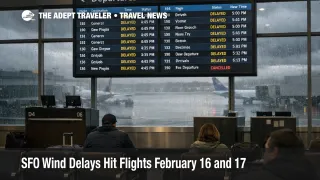
Strong winds around the Bay Area slowed arrival acceptance rates into San Francisco International Airport (SFO), triggering an FAA ground delay program and long inbound holds on February 16, 2026. Travelers arriving into SFO, connecting onward, or trying to make same day meetings faced the highest exposure as origin airports held departures to meter traffic into the airport. The practical move is to treat February 16 and into February 17 as a fragile recovery window, add buffers, and rebook away from tight connections before remaining seats vanish.
The SFO wind delays flights problem is that wind constrained arrival rates forced the FAA to meter inbound traffic, which pushed average arrival holds above four hours for some periods, then cascaded into cancellations and late departures as rotations broke.
Who Is Affected
Travelers flying into SFO are the immediate impact zone, especially those scheduled to arrive in the late afternoon and evening banks. Those are the periods when reduced acceptance rates collide with the day's accumulated delay, and when long haul and transcontinental arrivals feed hotel check in windows, car rental counters, and onward domestic connections. If an itinerary includes a late arrival followed by a same night drive, a final train, or a time sensitive event, the risk is not just being late, it is losing the entire onward plan.
Connecting passengers are the next group at risk, including travelers using SFO as a bridge to the Pacific Northwest, Southern California, Hawaii, and international departures. When inbound aircraft are held at origin, the delay is often "baked in" before a traveler even reaches the airport, and rebooking options can thin quickly because later flights fill with displaced passengers. Separate ticket itineraries are particularly fragile because a missed first leg can erase protection for the second leg even when the disruption cause is weather.
The disruption can also hit travelers who are not touching SFO at all. Aircraft and crews operate multi leg sequences, so an arrival bank that lands hours late can push a later departure out of sequence, or force substitutions that do not perfectly match seat count or route needs. That drift tends to propagate to other West Coast stations, and it can show up the next morning as delayed first departures, reduced standby capacity, and constrained reaccommodation across the region.
What Travelers Should Do
Start with immediate actions and buffers. Check your airline for a waiver or free change option, then look up the inbound aircraft that operates your flight, because a held inbound is a strong predictor of a late departure. If you are arriving into SFO on February 16 or February 17, build a realistic ground buffer for hotel check in, car rental pickup cutoffs, and any time bound meeting or tour. If your trip depends on making a same night connection, assume the connection is at risk until the FAA ground delay program is clearly winding down.
Use decision thresholds for rebooking versus waiting. If your connection time is under 90 minutes, or you are down to the last same day flight that still gets you where you must be, rebook earlier or reroute now rather than hoping the system snaps back late in the day. If you have a longer cushion and you are on a single protected ticket, waiting can be reasonable, but the cutoff is when your arrival delay pushes you past key trip breakpoints, like missing the last airport train, losing a prepaid lodging night, or blowing up a cruise or event embarkation plan.
Over the next 24 to 72 hours, monitor three signals. First, watch whether the FAA lists SFO wind and low ceiling constraints as active again, because repeated initiatives can reset delays just as recovery begins. Second, watch the cancellation count on your airline's route, because cancellations are the clearest sign that rotations are being intentionally reset, which can strand travelers who wait too long to move. Third, watch nearby airport conditions, because Oakland and San Jose can be useful alternates, but weather bands and regional crew positioning can still create delays, and ground transfer time can erase the advantage if traffic, rain, or flooding worsens.
For a broader same day network snapshot, compare your plan against Flight Delays and Airport Impacts: February 16, 2026. For deeper context on how air traffic control constraints and capacity management ripple across airline schedules, see U.S. Air Traffic Control Privatization: Reality Check.
How It Works
A ground delay program is a traffic management tool that meters arrivals when an airport's safe arrival rate drops due to weather or other constraints. Instead of letting dozens of aircraft launch and then stack in holding patterns near the destination, the FAA assigns controlled departure times at origin airports, spreading delay across the network and reducing airborne congestion. For travelers, that means a flight can be delayed before boarding even starts, and it also means departure boards at the origin airport can look normal until the assigned delay hits.
The first order impact at SFO is straightforward, reduced arrival rates create inbound holds, missed arrival slots, and gate congestion as late arrivals overlap with scheduled departures. The second order ripple is where the trip damage compounds. Aircraft that arrive late may miss their next departure bank, and crews can run into duty time limits that force swaps or cancellations, which then pushes reaccommodation demand into later flights that are already full. That is how a wind constraint at one major airport can turn into missed connections, forced overnights, stressed hotel inventory near the airport, and downstream delays at other West Coast stations that rely on the same aircraft and crew rotations.
This week's storm sequence risk matters because recovery depends on stable conditions long enough to unwind the backlog. When a second system arrives before the first wave of delays is cleared, the network has less slack, and airlines may choose to cancel selectively to reset rotations rather than carry late aircraft forward for multiple days. Travelers should plan with that reality in mind, earlier flights and larger buffers reduce exposure, and flexible reroutes are most effective when executed before the evening banks compress remaining options.
Sources
- ATCSCC ADVZY 029 DCC 02/16/2026 Operations Plan (FAA)
- San Francisco International Airport (SFO) Real-time Status (FAA ATCSCC)
- FAA Daily Air Traffic Report (FAA)
- Strong winds delay inbound flights to SFO by more than four hours (San Francisco Chronicle)
- Area Forecast Discussion (NWS San Francisco Bay Area)