

Brazil Carnival Crowds Push Rio Hotels, Flights Tight
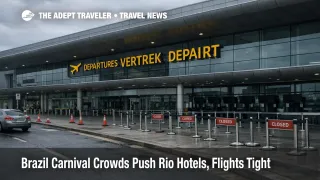
Brazil's Carnival week is scaling toward a record tourism moment across multiple capitals, and the practical impact for travelers is straightforward: beds and seats are tightening fast. Brazil's Ministry of Tourism says more than 65 million people are expected to participate nationwide in 2026, a 22 percent increase versus 2025, with more than 40 million concentrated in major cities including Rio de Janeiro, São Paulo, Salvador, Belo Horizonte, Olinda, and Recife. For visitors, that kind of volume turns normal planning assumptions upside down, because it compresses lodging, air inventory, and local mobility into a few peak days.
In Rio de Janeiro, the Ministry's summary of city reporting points to more than 462 registered street blocos and a projection of more than 8 million people in the streets, alongside an estimated 98 percent hotel occupancy level. Those numbers matter less as civic bragging rights and more as a signal that last minute travelers should expect limited room choice, higher nightly prices, and stricter booking terms.
Air demand is also climbing in ways that affect travelers outside Brazil, not just those already on the ground. Embratur says purchases of international airline tickets for Rio de Janeiro travel during February 13 through February 18 are projected up 9 percent versus last year, and it also reports a 21 percent year over year increase in searches for international tickets to Brazil during the Carnival period.
Who Is Affected
International travelers arriving into Rio de Janeiro Galeão International Airport (GIG) and São Paulo Guarulhos International Airport (GRU) are most exposed to price spikes and limited flight options, because the highest demand concentrates around the same inbound and outbound windows. Even if you are headed to Salvador Deputado Luís Eduardo Magalhães International Airport (SSA) or Recife Guararapes International Airport (REC), the same dynamic applies, because domestic banks and repositioning flights fill up as visitors disperse across multiple Carnival hubs.
Domestic travelers inside Brazil face a different problem: local mobility becomes the constraint. When major avenues are closed for blocos, when security perimeters expand around parade venues, and when ride hail demand spikes, a short cross town trip can become a long, unpredictable transfer. That uncertainty then cascades into missed restaurant reservations, late check ins, and missed departures for onward flights, long distance buses, and intercity connections.
Travelers planning Recife and Olinda should take the warning seriously even if Rio feels "sold out," because Embratur reports a 49 percent increase in international air tickets issued for Pernambuco's Carnival period. Higher air demand usually precedes tighter hotel inventory, and it also increases the odds that disruptions propagate across the network when a single delay forces airline reaccommodation.
What Travelers Should Do
Act like inventory is already constrained, because in several hubs it is. If you still need lodging in Rio, São Paulo, Salvador, Belo Horizonte, Recife, or Olinda, book cancellable rooms now, then keep checking for better value as properties release inventory or adjust minimum stays. If you are arriving on peak days, consider splitting your stay between neighborhoods to reduce cross town transfers when blocos and closures shift daily.
Use clear decision thresholds for rebooking versus waiting. If your preferred flights are down to bad connection times, or your hotel choices force long daily transfers, reprice the trip around less popular arrival days and departure days, even shifting by one day can change both fare and room selection. If you are holding a tight domestic connection after an international arrival, treat that as a rebook trigger, because Carnival week delays can turn a normal immigration and baggage claim process into a time sink.
Monitor the next 24 to 72 hours using signals that actually move your odds. Watch airline load factors and schedule changes on your route, not just citywide headlines, and check your hotel's minimum stay rules and cancellation deadlines daily. For entry requirements, especially for travelers who need an eVisa, confirm your documentation early through Brazil Entry Requirements For Tourists In 2026, because high demand weeks are when airlines enforce document checks most strictly at boarding.
Background
Carnival creates a specific kind of system stress that is different from storms or strikes, because it is predictable demand with unpredictable movement. The first order effect is a surge in people concentrated in a few corridors, Sambadrome parade nights, and high density street bloco neighborhoods, which drives hotels toward capacity and pushes travelers into farther out districts. The second order ripple is that longer daily travel distances collide with closures and crowding, raising the probability of missed reservations and missed departures, even when nothing is "wrong" operationally.
Air networks feel this in two layers. At the source, flights fill up and fares harden as load factors rise, which is visible in Embratur's year over year lift in international ticket purchases to Rio during February 13 through February 18 and the broader rise in Brazil flight search demand. Then the knock on effect appears when cancellations or misconnects force reaccommodation into an already full market, which can push travelers into next day inventory and create unplanned hotel nights.
On the ground, cities try to keep the event flowing with planned logistics, but the travel experience still hinges on micro decisions. A hotel that is "close enough" on a map can be functionally far when a bloco route blocks the most direct road, and a ride that is usually 20 minutes can become an hour when traffic and pickup restrictions pile up. That is why the Ministry of Tourism's city level projections, such as Rio's blocos and crowd forecasts, and the reported near maximum hotel occupancy, matter to travelers as operational risk indicators, not just tourism stats.
Sources
- Carnaval 2026: Mais de 65 milhões de foliões devem tomar as ruas pelo país (Ministério do Turismo)
- Alta na emissão de passagens internacionais para o Rio de Janeiro no carnaval promete aquecer a folia carioca (Embratur)
- Emissões de passagens aéreas internacionais para o Carnaval do Pernambuco crescem quase 50% em 2026 (Embratur)
- Em parceria com a Beautiful Destinations, Embratur promoverá Carnaval brasileiro no mercado internacional (Embratur)