

Germany Deutsche Bahn Booking Outage After DDoS
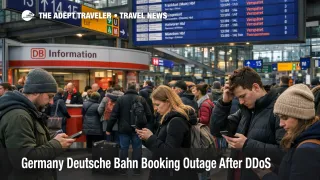
A cyberattack disrupted Deutsche Bahn's booking and passenger information systems in Germany, affecting bahn.de and the DB Navigator app during the afternoon of February 17, 2026. The travelers most exposed were those trying to buy tickets close to departure, add a seat reservation, or follow live platform changes and disruption alerts during connections. If you are traveling in the next few days, treat rail planning as intermittently unreliable, carry offline proof of your ticket, and build extra time into transfers where you would normally depend on last minute updates.
The Deutsche Bahn booking outage matters because it breaks the normal digital loop that travelers use to plan, pay, and adapt in real time, especially on busy long distance corridors where platform changes and short delays can quickly cascade into missed connections.
Who Is Affected
Travelers using Deutsche Bahn's digital channels are the most directly affected, including anyone relying on bahn.de, DB Navigator, and third party platforms that pull schedule, platform, and disruption data through Deutsche Bahn interfaces. Deutsche Bahn said the attack was directed at its IT systems, occurred in waves, and was significant in scale, while emphasizing that its defense mechanisms were working and that it was coordinating with federal authorities.
If your trip depends on a same day decision, for example deciding whether to take an earlier train, switch to a different connection, or add a seat reservation for a long ride, you are more exposed than someone traveling on a fixed plan with a ticket already stored offline. International visitors are also at higher risk because they often plan on mobile and may not know the station layout, the platform signage norms, or how to find staffed help quickly when an app fails.
Airport rail links deserve special caution. When the digital system is unstable, travelers arriving for flights often default to taxis or ride hails as a backup, which can spike road demand near terminals and raise the cost of last minute ground transport. If you are connecting from rail to air on the same day, the best protection is time, meaning earlier trains, longer buffer, and a plan for what you will do if the app cannot confirm the latest platform or delay information.
What Travelers Should Do
First, make your ticket portable. If you already have a ticket, pull it up while you have connectivity and stability, then save offline proof, such as an in app offline view if available, a PDF download, or a screenshot of the QR code and booking details on your device. If you are traveling with companions, share copies to a second device in your group so a dead battery or a single app login problem does not strand everyone at once.
Second, decide when to rebook versus when to wait. If you have a tight connection, a timed arrival, or a flight at the end of the rail segment, waiting for perfect real time data is usually the wrong move when systems are unstable. The better threshold is to switch to an earlier departure, or a simpler routing with fewer transfers, as soon as you can confirm that your ticket is valid and you can physically navigate the station without relying on push alerts. If your itinerary is flexible and you can tolerate a later arrival, waiting can be reasonable, but only if you have a clear fallback, such as an alternate train you are willing to take, and a way to verify the departure boards at the station.
Third, monitor the next 24 to 72 hours like an operations problem, not just a purchase problem. Deutsche Bahn said systems were available again on February 18, 2026, but also described the attack as wave like, which is the kind of pattern that can produce short, recurring interruptions even after service is restored. Before you leave for the station, check for status updates, and assume that you may need to rely on station boards and staffed counters for final confirmation. Once you are moving, protect your connection by arriving at platforms early, and by avoiding last minute platform sprints that are usually guided by app notifications.
Background
A distributed denial of service attack attempts to overwhelm online services with traffic so legitimate users cannot access them. In this case, Deutsche Bahn said its booking and information systems were disrupted on February 17, 2026, and Reuters reported that services were back online for all customers on February 18, 2026. The practical travel impact is not only that you cannot buy a ticket, it is that you also lose the high frequency stream of operational changes that helps you adapt, including platform updates, delay alerts, and itinerary re suggestions.
The disruption propagates through the travel system in predictable layers. The first order effect is digital friction at the source, meaning failed searches, failed payments, missing reservation inventory, and stale disruption notices. The second order effect shows up in stations, where more passengers need human assistance, lines grow at service points, and travelers cluster around the same information screens. That crowding increases missed connection risk, which then spills into hotel nights in hub cities for some travelers, and into alternative transport demand for others, especially on airport rail segments where the perceived cost of a missed flight is high. Even if trains themselves are running, the loss of reliable information and ticketing pushes travelers into more conservative choices, earlier departures, simpler routings, and more expensive backups.