

Storm Nils Spain, Portugal Transport Disruption Updates
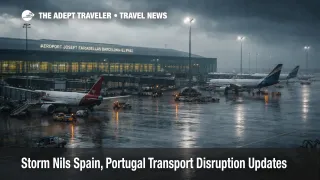
Storm Nils drove high alert conditions across parts of Spain and Portugal, combining damaging wind, coastal hazards, and heavy rain impacts that spilled directly into transportation. In Spain, authorities issued top level alerts in northern coastal regions, and Catalonia saw extreme wind that disrupted road and rail movement, along with flight cancellations at Josep Tarradellas Barcelona El Prat Airport (BCN). In Portugal, flooding damage around Coimbra, Portugal, included a collapsed stretch of the A1 motorway after a levee failure, a hit that matters because it forces detours and concentrates traffic onto fewer crossings while waters recede. The practical result is that even where the worst gusts pass, recovery can remain uneven because airport flow limits, ground access constraints, and aircraft rotation gaps do not reset instantly.
The key change for travelers is that this is no longer a vague weather risk. It has produced confirmed cancellations at a major hub, and confirmed infrastructure damage on a major Portuguese north south artery, which raises the odds of missed flights, missed trains, and forced overnight stays if you keep tight buffers.
Who Is Affected
Air travelers using Barcelona as a gateway are most exposed, especially anyone connecting onward on short haul European rotations where a single cancellation can break a same day chain. Reuters reported more than 100 cancellations at Barcelona El Prat during the peak wind window, and that scale matters because it implies aircraft and crews were displaced across multiple routes, not just a handful of flights.
Travelers moving through northern coastal Spain, or planning scenic coastal drives, are also exposed because the highest hazard messaging focused on coastal phenomena, including very large wave forecasts and red level alerts in the north. Even if you are not on the coast, these alerts often trigger precautionary closures, local access restrictions, and slower emergency response that can spill into intercity travel times.
In Portugal, drivers transiting through central corridors near Coimbra, Portugal, should plan for longer transfer times and detours. Reuters described damage around the A1 motorway and warned repairs could take weeks, a meaningful planning horizon for anyone relying on road transfers between Lisbon, Porto, and interior stops, or for reaching airports on fixed schedules.
What Travelers Should Do
If you are traveling in the next 24 hours, treat airport access as the fragile link, not just the flight itself. Aim to arrive earlier than usual for departures, and build a plan that still works if your preferred rail line, bus corridor, or motorway segment is partially suspended or slowed. Where feasible, shift to routings that reduce dependence on a single tight connection, and avoid separate tickets that leave you unprotected if the first leg slips.
If you are deciding whether to rebook or wait, use clear thresholds. Rebook when your itinerary has a same day international connection, a cruise embarkation, a nonrefundable timed entry, or any meeting you cannot miss, because the cost of a missed commitment is usually higher than a proactive change. Waiting can be rational if your schedule is flexible and you have protected tickets on one booking, but only if you can tolerate arriving a day later and you are watching airport and weather warning updates closely.
Over the next 24 to 72 hours, monitor operational sources that move the system, not reposts. Track airport operator updates for BCN, national weather warning services for Spain and Portugal, and any local civil protection guidance that restricts nonessential travel. If your Barcelona plan also depends on urban mobility, keep an alternate transfer map ready, and use verified service notices rather than viral strike or disruption claims, for example by cross checking against current official postings. A nearby example of how fast city mobility assumptions can break is Barcelona Metro Strike Claim For Feb 22 and 24, 2026.
Background
Storm driven disruption spreads through the travel system in layers. The first order effect is capacity reduction at the source, for example wind can force runway configuration changes, spacing increases for arrivals, and temporary ground holds that make scheduled banks impossible to run on time. Once cancellations start, the second layer is rotation breakage, aircraft and crews end up in the wrong place, duty time limits bite, and carriers must rebuild the day with less spare capacity, which is why disruption can linger after forecasts improve.
A parallel propagation happens on the ground. Flood or wind damage can close one critical road segment, and the detours then push more traffic into fewer corridors, slowing transfers to airports, stations, hotels, and car rental facilities. That congestion then raises misconnect risk even for flights that operate, and it can force unplanned overnights that tighten hotel inventory in the nearest functioning hubs. In Portugal's case, the reported A1 damage near Coimbra is exactly the kind of constraint that can turn a normal drive into an uncertain transfer, especially during ongoing high water flow periods.