

World Legacy Fire Near Singapore Cruise Ship Evacuation
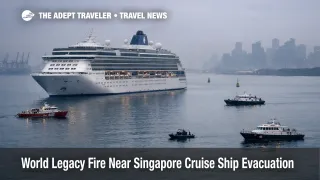
A fire broke out in the lounge area on Deck 9 aboard the Liberia registered passenger vessel WORLD LEGACY as it was en route to Singapore. Travelers tied to this sailing, including anyone planning onward flights, hotels, or ferries from Singapore, faced an early morning disruption that quickly became an evacuation and medical assessment event. The practical next step is to treat this as an incident driven schedule break, gather written rebooking and refund options, and avoid building same day connections until the operator publishes a confirmed recovery plan.
The World Legacy cruise ship fire changed plans because the ship was taken to anchor and handled as a managed emergency rather than a normal arrival. The Maritime and Port Authority of Singapore (MPA) said the vessel was in stable condition and anchored at Raffles Reserved Anchorage while MPA patrol craft, the Police Coast Guard, and the Singapore Civil Defence Force (SCDF) Marine Division attended.
Early figures often move in fast incidents, and this one did. MPA initially reported 224 passengers, including 185 Singaporeans, and 388 crew members onboard. In a later update, MPA clarified that the passenger count was reconciled against onboard records to 271 total passengers, including 139 Singaporeans, because the earlier number was preliminary information.
On injuries, the signal is clearer than the social chatter. MPA reported one Indonesian crew member died. MPA also said SCDF conveyed four passengers to the hospital for further medical assessment after evacuation. That hospital figure explains why some outlets described "no other injuries" early, then reported hospital transports later, because hospital assessment for smoke exposure does not always map cleanly to "injured" in initial briefings.
Who Is Affected
Passengers booked on the WORLD LEGACY sailing are the direct group, including travelers who were relying on a tight chain of onward plans from Singapore. Even if you were not onboard, you can still get hit if you were scheduled to meet arriving passengers, booked pre planned transfers, or were part of a group itinerary built around the ship's arrival and debark flow.
Families and groups are more exposed than solo travelers because the failure mode is coordination, not just delay. Evacuations and processing compress hundreds of people into the same terminals, transport nodes, and hotel inventory at the same time, which drives scarcity and price spikes. If your plans included last flight of day departures from Singapore, or a same day check in at a resort with strict arrival windows, your risk is not the fire itself, it is the cascade that follows.
Crew and labor details also matter for how long disruption can last. MPA said a core crew would remain onboard to conduct safety checks, support investigations, and manage essential vessel operations while at anchor. That is a signal the ship was being treated as a controlled scene, which usually means timelines are driven by inspection, evidence handling, repairs, and clearance, not by passenger preference or commercial pressure.
For additional detail on the deceased crew member, the Indonesian Embassy in Singapore said he was a 23 year old laundry attendant, identified only by initials, and he was found collapsed in the lobby of Deck 9. The same reporting said the cause of death was cardiopulmonary arrest secondary to asphyxiation.
What Travelers Should Do
If you were onboard, or you have a family member who was, treat documentation as a first class task. Save screenshots of operator messages, keep receipts for hotels, meals, taxis, and replacement transport, and request a written statement of disruption from the operator or agent before you scatter. If you experienced smoke exposure symptoms, get evaluated and keep the discharge summary, because medical documentation is what turns "a rough night" into an insurable, claimable event.
For rebooking decisions, use a simple threshold. If your onward travel depends on a same day chain, separate tickets, or late evening departures, rebook now rather than waiting for optimistic estimates, because the system will prioritize safety, inspections, and controlled passenger processing over speed. If you have a flexible schedule and a protected itinerary, wait only if the operator provides a written, time bound plan that includes where you will be housed, how meals are handled, and when you will receive the next verified update.
Over the next 24 to 72 hours, monitor three things, the MPA incident updates, the operator's repair and return to service messaging, and your own insurer or card benefits rules for trip interruption triggers. MPA said classification society surveyors engaged by the vessel's owners would assess damage and required repairs before returning to service, and investigations into the cause were ongoing. That is the gating item, and it is rarely solved on a tourist timeline.
Background
A shipboard fire is not just a safety story, it is an operations bottleneck that spreads outward in predictable layers. First order effects are on the vessel, suppression, smoke management, compartment checks, accountability for passengers and crew, and then the decision to anchor, evacuate, and lock down the scene for investigation. MPA's updates show that pattern, stabilize the vessel at Raffles Reserved Anchorage, evacuate passengers to HarbourFront Ferry Terminal, and keep a core crew onboard for safety checks and essential operations while authorities attend.
Second order effects hit the travel system around the ship. Evacuation means hundreds of people need ground transport, medical screening for smoke exposure, re accommodation, and new bookings, all at the same time. That surges demand for hotels, rides, and last minute flights, and it increases call center congestion and rebooking friction. It also disrupts any shore side logistics that assumed a normal arrival, including group tours, cruise transfer desks, and any pre arranged meet and greet services.
Third order effects show up as uncertainty, and uncertainty is what damages traveler outcomes. Passenger counts being corrected from preliminary numbers to reconciled onboard records is normal in fast moving incidents, but it also shows why travelers should avoid building tight plans on early headlines. The right posture is to plan around the authoritative operational sources, not the first viral clip. In this case, the authoritative signal is MPA's sequence of releases, and the clear statement that repairs and return to service depend on surveyors' assessments and ongoing investigation, not on public pressure.
Sources
- Fire Onboard Liberia-Registered Passenger Vessel WORLD LEGACY
- Fire Onboard Liberia-Registered Passenger Vessel WORLD LEGACY Extinguished
- All Passengers Onboard Liberia-Registered Passenger Vessel WORLD LEGACY Safely Evacuated
- 'Truly terrible': Passenger describes escape after fatal fire breaks out on World Legacy cruise ship