

MSC Cruises 2026 Entertainment Adds Shows, Parties, Robots
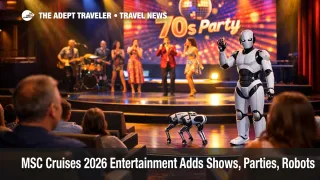
MSC Cruises is expanding its onboard lineup for 2026 with a fleetwide refresh of signature parties, new game show formats, more live music concepts, and a set of family focused digital experiences. The practical impact for travelers is not just "more to do," it is that the evening schedule, family programming, and venue demand patterns on many sailings will look different than in 2025, especially on sea day heavy itineraries where entertainment is a core part of the value proposition. MSC is also testing AI powered robotic dogs from Unitree Robotics, paired with humanoid robots, on select ships, a high visibility pilot that could become a ship selection factor for families and tech curious guests.
The 2026 changes include a fully renewed 70s Party rolling out fleetwide, two new original shows built around participation (Chart Toppers and Quiz O'Clock: The Battle), and updates to established stage and activity brands that MSC already uses to drive repeat attendance. MSC's broader entertainment push also sits inside a wider sales environment where cruise lines compete on onboard experience as much as itinerary, so this is partly about differentiation, not just variety.
MSC Cruises Entertainment 2026, What Is New and What Changes Onboard
The most concrete adds for 2026 fall into three buckets, nighttime participation, refreshed stage production, and expanded family programming. On the participation side, MSC is introducing Chart Toppers as a high energy music game, plus Quiz O'Clock: The Battle as a competitive game show style format, both designed to pull guests into the action rather than relying only on passive theater attendance. These formats tend to matter most on longer sailings and sea day itineraries because they create repeatable, weather proof options when outdoor plans are limited.
On the production and live music side, MSC is pointing to upgrades such as a refreshed Paz Flamenco show, new big band performances, Dueling Pianos, an American Country Band experience, and an updated MasterChef at Sea offering for adults, kids, and teens. Separately, "Dirty Dancing: In Concert" continues to spread across the fleet, with MSC confirming a 90 minute live to film concert format on MSC Poesia tied to its Seattle based Alaska and Canada season.
For families, MSC is leaning harder into LEGO branded programming with a refreshed, digital first LEGO Family Game Show slated to go fleetwide, plus an expansion of the LEGO Parade footprint to more ships in 2026. The line has also framed Ocean Day by the MSC Foundation as a kid oriented educational entertainment offering available across the fleet, which means families should expect more structured programming that mixes play with conservation themes, rather than purely arcade style time fillers.
Who Benefits Most From The 2026 Entertainment Rollout
This rollout is best for travelers who pick ships based on onboard life, not just ports, especially families, multigenerational groups, and first time cruisers who plan to spend more time onboard. If your itinerary includes multiple sea days, or you are sailing in seasons when weather can compress outdoor options, expanded indoor programming has an outsized effect on how "full" the cruise feels, and how well you can avoid crowd pinch points by choosing the right show times.
Families should see the biggest day to day change because MSC is combining LEGO formats, broader kids club programming, and MSC Foundation themed activities that are designed to keep younger guests engaged without requiring parents to constantly invent plans. If you are traveling with teens, pay attention to how a given ship schedules teen specific versions of game formats, because the same branded activity can be materially different depending on the target age group and staff delivery.
The robotics pilot is likely to be most meaningful for families with younger kids and for guests who prioritize novelty experiences. Because MSC says the Unitree robotic dogs and accompanying humanoid robots are only on select ships at first, this is the one piece of the 2026 push where ship choice can be the difference between "definitely available" and "maybe not on my sailing."
How Travelers Should Plan Around New Shows, Parties, and Pilots
If entertainment is a primary reason you are booking MSC, treat 2026 as a ship selection and sailing selection problem, not a vague promise. Before you put money down, confirm which ship you are on, then check how that ship handles its theater reservations, its family programming blocks, and whether the sailing has a high share of sea days where demand spikes for indoor venues. This is also a good moment to align your booking strategy with broader cruise pricing dynamics, because onboard experience upgrades can tighten demand on specific ships, even when the itinerary looks similar. The site's Wave guidance is useful here because it helps you weigh refundable terms versus chasing perks that may not matter as much as getting the right ship. See Wave Season.
Use a simple decision threshold for the robotics pilot, if that experience is a must have for your group, do not assume it will appear fleetwide in time for your sailing. Instead, look for ship specific confirmation in pre cruise communications, or in credible reporting that names the ships and deployment windows, then book that ship rather than hoping for a late expansion.
For groups, the operational play is early coordination. Entertainment heavy sailings create internal competition for venue capacity, dining times, and family scheduling, which means you will have a better trip if you pre decide priorities (must see theater night, must do family game show, preferred dining window) before you board. If you are organizing multiple cabins, this is where group planning discipline pays off, and Ultimate Guide to Planning a Group Cruise: Tips & Tricks offers a practical framework.
Why Cruise Lines Refresh Entertainment, and How The Effects Spread
Entertainment refreshes are partly about guest satisfaction, and partly about flow management. On a modern ship, theater shows, parties, and family events are not just "extras," they are tools that move crowds through time and space. When a line introduces more participation formats like music games and competitive quizzes, it can smooth demand peaks by giving guests more reasons to split across venues rather than piling into the same bar, atrium, or theater at the same hour.
The first order effect is simple, more scheduled options, and more refreshed versions of proven hits like themed parties and cooking competitions. The second order effect is that dining, bar service, and even shore excursion desk demand can shift when the "prime time" onboard window changes. If a show becomes the must see event on a sailing, late dining becomes harder, early dining becomes more valuable, and families may plan port days differently to avoid burning out before big evening programming.
Finally, brand partnerships, such as LEGO family programming and a conservation themed MSC Foundation day, are designed to create repeatable, recognizable moments across ships. That consistency is why you are seeing expansions measured in ship counts, because once MSC standardizes the content and training, it can scale the experience across the fleet and reduce the variability that frustrates repeat cruisers who expect the same "headline" activity to exist on their next ship.