

Cuba Collapse Risk: Blackouts, Fuel, Travel Limits
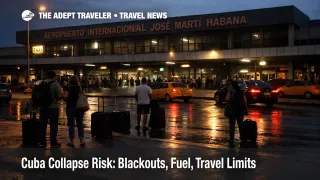
Cuba is not "collapsed" in the formal sense, but it is operating in a failure mode that looks and feels like a slow motion collapse for travelers, meaning unreliable electricity, scarce fuel, and rapidly changing transport capacity. What changed in February 2026 is that the fuel crunch has moved from being a background hardship into a direct travel systems constraint, with aviation fuel availability at Cuban airports becoming unreliable enough that multiple foreign carriers paused service and governments escalated warnings.
The practical travel signal is simple. When a destination cannot reliably power its grid and cannot reliably supply fuel for vehicles and aircraft, everything that tourists assume is "always on" becomes conditional, including airport operations, hotel services, payments, cellular data, and ground transfers. Canadian and U.S. government travel guidance has explicitly called out prolonged power outages and shortages that can affect services, including at resorts.
Cuba Collapse Risk for Travelers: What Changed
The most traveler relevant escalation has been the aviation fuel shock. Air Canada publicly cited government advisories and the projected unavailability of commercially available aviation fuel at Cuban airports, then suspended service and described operational workarounds such as tankering extra fuel and making refueling stops outside Cuba when needed. WestJet also announced it suspended sales for remaining service to Cuba and planned flights that did not rely on local fuel availability for departure, while prioritizing getting customers home.
At the same time, the broader energy shortage is showing up in daily life as extended blackouts and transport disruption, which is exactly the kind of systemic fragility that turns small travel problems into trip ending failures. Reuters reporting this month has described widening blackouts and households trying to self supply power, and it has also tied the current squeeze to efforts that block oil shipments reaching the island.
Which Trips Are Most Exposed in Cuba Right Now
Trips with tight timelines are the most exposed, because the failure mode is not one dramatic event, it is compounding delays. If you are arriving for a short stay, a wedding, a cruise like day schedule, or any itinerary with timed connections, the risk is that a fuel shortage or blackout does not just make things inconvenient, it can break the critical path, including airport departure reliability, the ability to get a taxi, and the ability to pay when card networks or ATMs are down.
Resort based travel is not immune, even if the property itself runs generators. The constraint often shifts to what sits outside the resort fence line: fuel for buses and taxis, food supply logistics, staffing movement, and excursions that depend on reliable transport and power. Canada's advisory explicitly warns that shortages can affect services at resorts and that fuel availability can disrupt ground transportation.
Air travel risk is currently asymmetric by carrier and routing. Airlines that can tanker sufficient fuel for a round trip, or can operationally absorb technical refueling stops, are better positioned than airlines that rely on local uplift in Cuba. The near term traveler consequence is less redundancy, fewer seats, and fewer recovery options when something goes wrong, because suspended routes remove the easy backup flight you would normally rebook onto.
What Travelers Should Do Now
If you have not departed yet and your trip is discretionary, treat this as a planning threshold moment. Canada is advising avoiding non essential travel due to worsening shortages of fuel, electricity, and basic necessities, and that is a high bar warning aimed at exactly the kind of uncertainty travelers cannot easily self mitigate. If you must go, build your plan around self sufficiency for outages, and around the assumption that ground transport may be scarce, slow, or expensive, especially outside major hotel zones.
If you are already in Cuba, the decision is less about fear, and more about preserving your exit options. Confirm your outbound flight status directly with the carrier, and ask what their fuel plan is for the return leg, because the operational constraint is not abstract, it is whether the aircraft can legally and safely depart without relying on local fuel. Keep devices charged, keep offline copies of bookings and travel documents, and assume connectivity will be intermittent, because U.S. travel guidance already warns to prepare for prolonged power outages.
For travelers deciding whether to wait or reroute, use a simple rule. If you have a critical date, a family obligation, or any onward connection you cannot miss, reroute or move your trip window now while inventory exists, because recovery capacity shrinks when multiple flights are cut at once. If your trip is flexible, you can wait, but only if you have a credible backup plan for leaving on a different date, or via a different carrier, if outages and fuel constraints tighten further.
Why Cuba Feels Like It Is "Collapsing," and What That Means for Travel
"Collapse" is a loaded word, but the travel system test is straightforward: can the country reliably supply the basics that keep visitors moving and safe, meaning power, fuel, communications, and logistics. Right now, multiple credible signals say those inputs are failing intermittently and, in some cases, predictably. That is why the travel impacts are showing up in blackouts, transport disruption, and airline decisions, not just in economic commentary.
The mechanism is energy first, then everything else. Cuba imports a large share of its fuel, and when those flows are disrupted, the grid cannot generate reliably, transport cannot move reliably, and hard currency earning sectors like tourism become harder to operate, which then reduces the ability to pay for imports, creating a feedback loop that looks like managed decline. Recent reporting has connected the current acute squeeze to actions aimed at blocking oil shipments and to widening blackouts and shortages that raise food and transportation costs.
It is also important not to overstate the conclusion. Some analysts argue Cuba is in severe crisis but not on the edge of sudden state collapse, partly because the government still maintains coercive capacity and can ration scarcity, even if living standards deteriorate. For travelers, that nuance matters because it suggests the most likely near term risk is not an overnight fall of government, it is persistent infrastructure failure, service degradation, sporadic unrest risk, and sudden transport interruptions that strand people, or force expensive, and complicated exits.
Sources
- Canada plans to assist Cuba while Washington squeezes the island
- Sun, sand and empty beaches: Trump oil squeeze chokes Cuba's tourism
- Cubans fight blackouts with solar as US extends oil chokehold
- Air Canada Suspending Cuba Service in Response to Aviation Fuel Shortage
- Guest Updates, WestJet
- Travel advice and advisories for Cuba, Government of Canada
- Cuba Travel Advisory, U.S. Department of State
- Cuba International Travel Information, U.S. Department of State
- Cuba Isn't Headed for Collapse