

InsideJapan, JNTO Push Aomori, Nagasaki, Shikoku
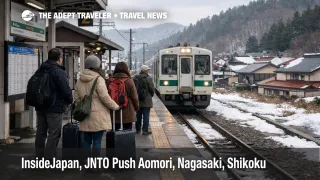
InsideJapan, the Japan focused brand of Inside Travel, is partnering with the Japan National Tourism Organization (JNTO) to promote travel beyond Japan's traditional Golden Route by pushing three trade ready itineraries centered on Aomori, Nagasaki, and Shikoku. The practical change for travelers and advisors is simple, this is more packaged, saleable Japan inventory designed to move demand away from Tokyo and Kyoto pressure points without forcing travelers to self build complex regional logistics.
JNTO's New York office framed the move as a way to "go beyond the familiar" and engage with "quieter regions" where local culture and everyday life drive the experience, while also spreading tourism benefits more sustainably across the country. In plain terms, this is overtourism management by product design, give the market itineraries that still feel like "real Japan," but do not stack every trip on the same city pair and day trip loops.
Japan Undertourism Itineraries: What Changed
The partnership spotlights three itinerary themes that are easy to sell because they map to familiar traveler motivations, heritage, landscapes, onsen, food, and craft, but they anchor those motivations in places many first timers skip. Aomori is positioned as rural northern Japan with samurai culture, hikes, hot springs, traditional crafts, and meals with locals. Nagasaki is pitched as a Kyushu based itinerary that leans into volcanic landscapes, tea terraces, coastal life, and layered history. Shikoku is framed around art islands, vine bridges, deep valleys, mountain temples, and local crafts, effectively a rural Japan circuit that adds geographic breadth beyond Honshu.
This matters now because Japan demand has been strong enough that the "default loop" is no longer just busy, it is operationally brittle, meaning the same crowding that degrades the on the ground experience also reduces last minute flexibility when something slips, whether that is lodging availability, rail seat inventory, or timed entry capacity. Product that disperses demand does not solve every constraint, but it gives travelers a different set of constraints, and often a better trade for people who care more about texture than checklists.
Who These Routes Fit Best
These itineraries are best for travelers who want Japan's cultural signals but do not need to optimize for "most famous sights per day." First timers who feel boxed into Tokyo and Kyoto can use Aomori, Kyushu, or Shikoku as an anchor that still feels distinctly Japanese, but swaps dense corridors for places where the trip's pace is set by geography and community scale, not queue management.
Repeat visitors, and travelers booking through advisors, may get the biggest upside because they are more willing to accept non default routing, and they often value depth over landmark coverage. That matters commercially because a "beyond the Golden Route" trip is easier to defend at higher price points when the story is immersion, craft, and access, not just upgrading hotels in the same saturated cities. InsideJapan has been explicit in prior strategy messaging that it sees undertourism as a way to benefit local communities while improving the visitor experience, which aligns with how these itineraries are described.
The tradeoff is that quieter regions can have thinner inventory, fewer hotel equivalents at each price tier, and longer transfer days if a traveler tries to stitch multiple remote areas together too aggressively. Aomori and Shikoku, in particular, reward travelers who build in slack, because the charm is often one village, one craft stop, one hike, then a slower evening, not a high velocity checklist.
What Travelers Should Do Now
If you are deciding between "book the classic loop" and "go regional," treat this like a risk and experience trade. The Golden Route is efficient, but it concentrates you in the same crowd and availability spikes everyone else is fighting. A regional anchor, Aomori, Kyushu via Nagasaki, or Shikoku, can reduce crowd exposure, but it raises the value of planning transfers, lodging nights, and rail seats earlier, because recovery options are not as abundant as they are in Tokyo or Osaka.
Use a simple decision threshold. If your trip is short, and you want one "pressure valve" region without blowing up logistics, choose one quieter area and commit to it, rather than trying to sample all three. If your trip is longer, and you are comfortable with regional pacing, you can stack two regions, but only if you protect the itinerary with buffer days so a missed connection does not erase a whole segment. Advisors should push clients to decide on the anchor region first, because that choice determines the correct gateway airports, the realistic rail plan, and where it makes sense to spend money for comfort.
Monitor the variables that change cost and feasibility more than the sightseeing list. Currency still matters for U.S. travelers planning Japan, and a less favorable USD to JPY rate can change the felt value of longer regional trips, especially if you are adding nights, private guides, or boutique lodging. If you are budgeting in dollars, use U.S. Dollar Outlook and Travel Impact for 2025 as a reference point for how FX shifts can change the real cost of a Japan itinerary.
Why This Partnership Matters for Overtourism
This is a classic demand shaping play. Overtourism is not only about total visitor volume, it is about where volume concentrates, when it arrives, and how tightly travelers are funneled into the same corridors by habit, social media, and "must see" list design. When a tour operator and a national tourism organization jointly push trade ready itineraries, they are effectively trying to change defaults, meaning they want advisors, and eventually travelers, to think of Aomori, Nagasaki, or Shikoku as normal choices, not niche detours.
The first order effect, if it works, is experience quality, less time spent in queues, fewer hotel compromises in the most saturated cities, and more itinerary resilience when something shifts. The second order effect is economic distribution, regional suppliers gain steadier demand, and pressure on the hottest neighborhoods and attractions can ease at the margins. None of this eliminates crowding in Tokyo or Kyoto, but it creates more viable substitutes, which is how travel systems actually rebalance over time.
For Adept Traveler readers, the concrete takeaway is that "Japan beyond the Golden Route" is moving from inspirational talk to sellable product. If you are planning Japan for 2026, compare this approach to other recent pushes toward alternative regions, such as Goway Adds Kyushu, Shizuoka Japan Tour Packages, and decide whether your priority is speed, certainty, and landmark density, or pacing, texture, and lower crowd exposure.