

Canary Islands Locust Swarms: What Travelers Should Know
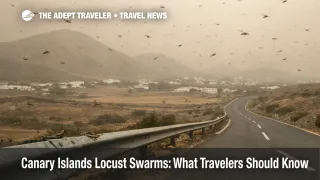
Authorities on multiple Canary Islands are monitoring reports of locust swarms, and local officials have issued a "stay calm" style message as videos circulate showing large numbers of insects moving through rural and coastal areas. The sightings have been reported across Lanzarote, Tenerife, Gran Canaria, and Fuerteventura, with Lanzarote drawing the most detailed public updates so far.
For most visitors, the immediate travel impact is nuisance rather than danger. Officials have emphasized the insects are not a direct risk to the public, and the near term focus is whether the insects die off after arrival, or settle and reproduce, which is the threshold that turns an unpleasant episode into an agriculture problem.
Travelers should expect occasional pockets where locusts collect around lights, vegetation, and sheltered areas, especially if winds ease after a calima event. If you have asthma or strong insect sensitivities, the practical risk is irritation and anxiety rather than toxicity, so plan around comfort, not emergency care.
Where Tourists Will Notice It Most
Visitors are most likely to notice locusts outdoors, on exposed roads, viewpoints, and rural edges near fields, rather than inside hotels. On Lanzarote, local reporting has cited sightings in and around Arrecife, Costa Teguise, Famara, Uga, and Tahíche, which matters because those are common bases for resort stays and day trips.
If you are staying in a coastal resort zone, you may still see insects on balconies, pool decks, and open air dining areas, but the experience usually comes in waves tied to wind direction. The tradeoff is simple, indoor plans reduce the nuisance immediately, while outdoor excursions stay viable if you bring eye protection, keep car windows up in affected areas, and avoid stopping where insects are actively pooling.
For travelers driving, the main exposure is distraction and reduced comfort if locusts strike windscreens or gather on the roadside. If you are planning a long drive on Lanzarote or Fuerteventura, consider shifting to morning hours when conditions are calmer, and build extra time so you are not pressured to push through an unpleasant stretch.
What Travelers Should Do Now
If you are already on the islands, treat this like a short lived operational annoyance unless official updates shift to confirmed breeding. Keep windows closed at night if your accommodation is near vegetation or bright exterior lighting, and ask your hotel whether they are doing extra exterior cleaning, or pest control around entrances, because that is where guests feel it most.
If you are traveling in the next 24 to 72 hours, monitor local island government updates and reputable local media for one specific signal, evidence the insects are settling and reproducing. Lanzarote officials have framed the next 48 hours as the key window to see whether the insects die off, linger briefly, or begin reproductive activity, and that distinction matters more than the raw number of social videos.
If you are deciding whether to reroute a trip, do not do it solely because you saw dramatic footage online. Rerouting makes sense if you have a farm stay, vineyard visit, or rural trekking itinerary where comfort and crop area access are the entire trip. For a standard beach, resort, and city mix, the better choice is usually to keep the booking and stay flexible on day trips, shifting to indoor attractions or different parts of the island if a particular area gets unpleasant.
Why This Is Happening, and When It Becomes a Real Problem
The insects being discussed are desert locusts, Schistocerca gregaria, which can shift from scattered individuals into dense, highly mobile swarms when environmental conditions align. The UN Food and Agriculture Organization describes desert locusts as the world's most destructive migratory pest, and notes that a single square kilometer of swarm can contain up to 80 million adults, consuming the equivalent daily food of about 35,000 people, which is why agriculture agencies track them aggressively.
In the Canary Islands context, the key mechanism is transport, not local emergence. Episodes are often associated with easterly winds and calima conditions that carry Saharan dust, and can physically push insects from the African continent toward the islands. That is why the same event can feel intense to tourists, while still failing to become a true local "plague" if the insects arrive exhausted, and cannot settle into a breeding cycle.
The second order effect travelers should watch is not tourism infrastructure, it is agriculture response. If authorities see signs of reproduction, the islands may move from monitoring to control, which can include localized treatment in agricultural areas and more frequent advisories. That can affect rural excursions, scenic drives through farm corridors, and the outdoor dining experience more than it affects airports, hotels, or ferry operations. As of the latest local reporting, officials are describing vigilant monitoring and scenario planning, rather than confirmed escalation into a crop damaging outbreak, which keeps the traveler decision in the "monitor and adapt" category for now.
Sources
- Desert Locust, Food and Agriculture Organization of the United Nations (FAO)
- Vigilancia extrema a "decenas de miles" de langostas en Lanzarote, Cadena SER Lanzarote
- Alarma en Lanzarote por la llegada masiva de langostas africanas, Diario de Avisos
- Locusts appear in Lanzarote dragged with the calima, La Voz de Lanzarote
- El sector agrícola en Canarias pide calma ante las langostas, Atlántico Hoy
- Locust invasion subsides on Canary Islands, Spain, ReliefWeb archive (2004)