

Frankfurt Hbf Closes Platforms 15 and 16 Until July 10
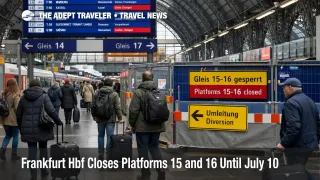
Deutsche Bahn, via DB InfraGO, will close tracks and platforms 15 and 16 at Frankfurt (Main) Hauptbahnhof from Friday, February 27, 2026, through July 10, 2026, for a bridge renewal in the pedestrian underpass area. Trains will continue running through the station, but the two platforms will be fenced off, and services that normally use 15 and 16 will be reassigned to other platforms.
For travelers, this is less about a total shutdown and more about day to day friction at Germany's most connection heavy interchange. Expect longer walks, more last minute platform changes, and a higher chance that a tight ICE to regional transfer turns into a miss because your arriving train and your departing train are no longer in the same "neighborhood" of the station.
Which Itineraries Are Most Exposed
The highest risk group is anyone chaining a long distance arrival into a short regional departure with a small margin, especially if the onward leg is infrequent. Local reporting notes that many regional services that start or end in Frankfurt, including trains tied to Mittelhessen connections, have historically used these platforms, which is why reassignment pressure is real, not theoretical.
Airport bound travelers are the second big exposure group, not because Frankfurt Airport is closing rail access, but because Frankfurt Hbf is where itineraries often lose their buffer before the airport leg even begins. If you are using rail to position for a flight, a missed connection at Frankfurt Hbf can cascade into a missed check in window, a forced same day rebook, or a hotel night. The practical detail that matters is that Frankfurt Airport's long distance station connects to Terminal 1 in about a 10 minute walk, so your real risk is usually upstream, at the interchange and the platform change, not the final walk at the airport.
How To Plan Around the Closure
Treat every Frankfurt Hbf transfer as "variable platform" during the closure window. The habit that protects you is checking your assigned platform in DB Navigator before you leave for the station, then checking again when your inbound train is approaching Frankfurt, because the last minute platform change is what breaks tight chains.
Add buffer based on what you are protecting. For ICE to regional, or regional to ICE, a 30 to 45 minute planned connection at Frankfurt Hbf is the safer baseline during this project, because it absorbs a platform reassignment plus a longer walk. If you are connecting onward to an airport train, or you are protecting a separate ticket flight, push that buffer toward 60 minutes at Frankfurt Hbf, because you are not only protecting the transfer, you are protecting schedule recovery if your inbound arrives late and the next viable departure fills.
If your itinerary is already tight and you cannot add time, change the shape of the trip instead of hoping for perfect operations. Either take an earlier inbound into Frankfurt, or route through an alternate interchange where your transfer is simpler. The right move is whichever option reduces the number of dependent steps, because this closure increases variance, and variance is what kills precision connections.
Why Two Closed Platforms Create System Wide Friction
DB InfraGO's plan keeps neighboring platforms operating while isolating 15 and 16 behind construction fencing, which is why trains can still run but passengers still feel disruption. You lose capacity in a very specific way, two platform faces disappear, and the remaining ones have to absorb those arrivals and departures, which increases the odds of platform swaps and imperfect sequencing.
First order effects are physical and immediate, longer wayfinding, more crowding at stairs, escalators, and underpasses, and more "run now" moments when your departure platform changes late. Second order effects are network effects, dwell time creep at the hub, connection padding that gets consumed, and harder recovery when something else goes wrong elsewhere on the network the same day. DB explicitly frames the work as being executed in a tight footprint during ongoing operations, which is another way of saying the schedule will be functional, but less forgiving than normal.
One more practical point: the riskiest period is usually the early phase, when dispatch patterns and passenger flow re normalize, plus any days where other construction or incidents compress available platforms even further. If you are traveling in the first two weeks after February 27, 2026, or near the end of the project when testing and reinstatement steps can create additional short term constraints, plan like you will see more last minute platform moves than usual.
Sources
- Frankfurt (Main) Hauptbahnhof: Gleisbrücke wird fit für die Zukunft gemacht (DB press release)
- Die Bahn sperrt zwei Bahnsteige am Frankfurter Hauptbahnhof bis Juli (Frankfurter Rundschau)
- Modernisierungen am Hauptbahnhof Frankfurt betreffen Züge aus und nach Marburg-Biedenkopf (OP Marburg)
- Travel by train, Frankfurt Airport, walking times to terminals (Fraport)