

Italy Feb 26 Aviation Strike, Cancellations Spill Over
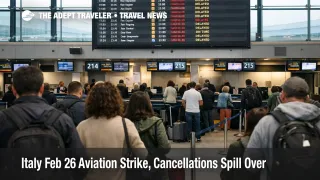
Italy's 24 hour aviation strike on Thursday, February 26, 2026 is no longer just an "alert day." It has moved into visible schedule cuts, published protected flight windows, and airline specific cancellation lists, which is why disruption risk now realistically stretches into late Wednesday, February 25, and early Friday, February 27 rotations. Travelers should treat this as a decision window, not a wait and see headline, because once mispositioned crews and aircraft start stacking, the system usually takes at least one operating bank to unwind.
One traveler relevant anchor is that Italy's aviation regulator, ENAC, protects two daily operating bands during strikes, 700 a.m. to 1000 a.m., and 600 p.m. to 900 p.m. local time. Those windows do not guarantee smooth airport processing, but they do change the odds that your flight operates, and they are the first filter you should use when deciding whether to rebook proactively or ride out day of travel uncertainty.
Italy Aviation Strike Feb 26, What Changed for Travelers
The key change since the last 48 hours is that the disruption is now expressed in concrete traveler pain points: cancellations posted in advance, narrower same day reroute inventory, and more pressure on the two protected operating windows. Several airports are advising passengers to expect delays and cancellations on February 26, and ENAC has issued strike specific guidance and documentation for guaranteed flights and protected time bands.
For travelers, this creates two immediate consequences. First order impact is the obvious one, canceled departures, late arrivals, and higher misconnect risk at the biggest gateways. Second order impact is the shoulder day problem: late evening flights on February 25 can be trimmed to protect aircraft and crews for the next morning, and early flights on February 27 can be disrupted while airlines reposition aircraft and crews back into sequence.
Which Itineraries Are Most Exposed in Rome, Milan, and Connections
The most exposed itineraries are the ones that depend on tight timing and full staffing, including domestic Italy feeders into international departures, same day connections through Rome and Milan, and trips on separate tickets where a missed first leg strands you without protected onward rebooking. Travelers using Leonardo da Vinci Fiumicino International Airport (FCO), Milan Malpensa Airport (MXP), Milan Linate Airport (LIN), and Venice Marco Polo Airport (VCE) should plan for higher cancellation probability outside ENAC's protected time bands, plus longer processing times even for flights that still operate.
If your itinerary includes a cruise embarkation, an event check in, or a prepaid rail connection that you cannot miss, the strike risk is less about the cancellation itself and more about the recovery queue. Once mass rebooking starts, the "good" alternatives disappear quickly, hotel nights cluster in Rome and Milan, and travelers who pivot to trains can find crowded corridors and limited remaining inventory, especially when many passengers make the same substitution at the same time.
What Travelers Should Do Now, Rebooking, Refunds, and a 12 Hour Checklist
Start with a simple classification of your flight: protected window, explicitly guaranteed, or neither. If your scheduled departure time is within 700 a.m. to 1000 a.m. or 600 p.m. to 900 p.m. local time, you are inside the protected bands that ENAC requires airlines to operate during strikes, and your flight is generally more likely to run than departures outside those windows. Next, check whether your exact flight number appears in ENAC's published guaranteed flight documentation for February 26, 2026, and compare that against your airline's own cancellation list or flight status page, because airline schedule cuts can still remove flights outside the guaranteed requirements.
Then decide early whether you are protecting money or protecting the itinerary. Rebooking early can cost more, but it often saves the trip when the alternative is a forced overnight and a next day scramble for inventory. If you have a tight connection, or if a delay would leave you with under 3 hours for a long haul international connection, treat that as a reroute trigger before you leave for the airport, not after you are already in a line that may not move quickly.
In the final 12 hours before departure, the highest value monitoring is operational, not social. Watch for your airline to expand the canceled flight list, watch for airport operator advisories that mention staffing strain or ground handling bottlenecks, and watch for your booking to be reprotected automatically, which can happen quietly if your original flight is pulled. If you have not received a clear rebooking option by the time online check in opens, that is usually the moment to move from waiting to action, because seat inventory tends to collapse after the first wave of cancellations posts.
For passenger rights, separate "care" from "cash." Under EU rules, travelers generally remain entitled to rerouting or a refund when a flight is canceled, and to assistance such as meals and accommodation when stranded, even when compensation depends on cause and notice. Cash compensation under EU261 can hinge on whether the disruption is considered within the airline's control, but your practical win condition on strike days is getting moved to an acceptable routing with minimal additional cost and minimal overnight exposure.
Why the Disruption Spreads Into Feb 25 and Feb 27 Shoulders
A 24 hour strike breaks aviation in layers. The first order failure is reduced staffing at check in, baggage acceptance, gates, ramp, and turnaround services, which is why airports can look open while throughput collapses and lines grow. ENAC's protected time bands ensure minimum flight operations at two daily peaks, but they do not ensure normal airport processing around those peaks, so travelers can still see long waits for bag drop, slower security feed, and delayed boarding.
The second order effect is network recovery. Aircraft and crews have to be in specific places, in a specific sequence, and once a rotation breaks, airlines often protect tomorrow morning by trimming tonight, then spend the next day rethreading crews and aircraft back into legal duty and rest patterns. That is why late February 25 departures and early February 27 departures can be meaningful risk periods even if your ticket is not dated February 26. If your itinerary matters, the right mental model is not "one strike day," it is "a disruption wave with shoulders."
Sources
- Voli garantiti in caso di sciopero (ENAC)
- Comunicazione Scioperi del 26 febbraio 2026 (ENAC PDF)
- Scioperi (Ministero delle infrastrutture e dei trasporti)
- National air transport strike on Thursday 26 February (Treviso Airport)
- Delays and Cancellations (ITA Airways)
- Air passenger rights (Your Europe, European Union)