

Galápagos: New 9-Day Cruises on La Pinta, Isabela II
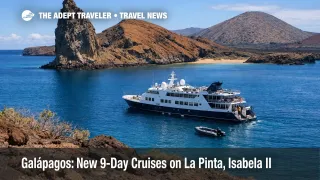
Metropolitan Touring is expanding its Galápagos cruise lineup with two longer, nine-day itineraries that bundle more landings into a single sailing, without asking travelers to stitch together back-to-back segments. The new voyages, "Islands of Fire Adventure" on Isabela II and "Origin of the Species Adventure" on La Pinta, are being positioned as a deeper, more immersive way to see the archipelago's headline wildlife and geology in one trip, with lead-in pricing starting at $9,208 per person and $11,974 per person, respectively.
For travelers, the practical change is simple: these Galápagos 9-day cruises increase the odds you will hit both the iconic "first-timers" islands and at least one of the harder-to-reach wildlife magnets in the north, without having to manage separate itineraries, different ships, or different weekly operating patterns. Metropolitan Touring and TravelPulse also describe limited-time incentives, including 50% off for children ages six to 11, and $1,000 off select departures, which can materially change the economics for families and for travelers comparing small-ship inventory across peak weeks.
Galápagos 9-Day Cruises Add Two Longer Voyages
The headline update is that Metropolitan Touring is formally selling two nine-day programs as "new" extended options, rather than relying on travelers to piece together shorter loops. "Islands of Fire Adventure" on Isabela II is built to move guests across eight islands, with marquee stops that include Santa Cruz, Bartolomé, Santiago, Fernandina, Isabela, and Genovesa.
The "Origin of the Species Adventure" on La Pinta starts on Baltra, then runs through a set that includes South Plaza, Santa Fe, San Cristóbal, Española, and ends on Genovesa, which is often treated as the closer because it concentrates seabirds and dramatic cliffside nesting in a way that feels like a finale.
If you have followed Galápagos small-ship product for a while, this is part of a broader pattern: operators keep trying to solve the same traveler problem, which is how to maximize wildlife variety and "signature sites" inside a tightly regulated destination with limited berths and strict visitor-site scheduling. The longer format is a direct answer to that friction, especially for travelers who only want to make the long-haul Ecuador commitment once.
Who These Longer Itineraries Fit Best
These sailings are most valuable for travelers who care about breadth, and who do not want a "one-zone" Galápagos week that leaves them feeling like they missed either the northern seabird colonies or the central volcanic icons. If your goal is to see penguins in the water at Bartolomé, land iguanas on South Plaza, tortoise conservation on Santa Cruz, and then stack in a big-nature day like Genovesa's seabird cliffs, a longer itinerary increases your chances of hitting that mix in one controlled sequence.
Families can also be a strong fit if the child discount is available on the dates you can travel, because Galápagos is often priced like a scarcity product rather than a mainstream cruise, and family totals balloon quickly when you add flights to Ecuador, hotel nights, and park-related fees. The tradeoff is that longer sailings compress more activity into the trip, so travelers who prefer long downtime blocks, or who know they are sensitive to frequent wet landings and Zodiac operations, should think through pacing before booking.
Finally, advisors and travelers comparing operators should treat the nine-day format as a planning tool. In a destination where cabin inventory can be thin, a longer sailing can reduce the risk of "I had to take what was left," because one booking can cover more of the archipelago's greatest hits, even if your ideal week is not available.
How To Book These Offers Without Getting Burned
If you are shopping the discounts, the decision threshold is whether the promotion is applied cleanly to the sailing you actually want, and whether it is compatible with the cabin category you would book anyway. "$1,000 off" and "kids 50% off" can be real value, but only if the fare basis is not quietly higher on the promoted departure, or if restrictions do not push you into a less flexible deposit and cancellation profile.
Ask for a dated line-item quote that shows the exact sailing date, cabin category, the promotion line, and how it is applied per guest, then compare that against a nearby non-promoted departure. If you are planning far out, prioritize terms that let you adjust flights and hotels without turning the cruise deposit into sunk cost, because Ecuador air can move, and Galápagos itineraries are timing-sensitive. For a broader playbook on evaluating cruise promotions and fine print, see Wave Season.
Once you have a sailing target, build your plan around the true constraint in Galápagos, which is not what you do onboard, it is how you protect the "travel ribbon" into and out of the islands. Even in luxury product, late arrivals and tight same-day connections can turn into missed embarkation stress, so most travelers should plan at least one buffer night on the mainland before boarding, and should avoid fragile same-day sequencing on the back end unless the operator explicitly manages it.
Why Longer Galápagos Sailings Matter Operationally
Galápagos cruises are a regulated, capacity-constrained system. The islands are not a place where operators can simply add another ship, or add another daily landing, when demand spikes. As a result, itinerary design is the lever that brands use to deliver more perceived value, and to reduce traveler regret, inside a fixed set of visitor sites, time windows, and licensed guide requirements.
The first-order effect of a nine-day itinerary is obvious: more islands, more landings, and more chances to see different ecological niches, from penguin waters to seabird cliffs. The second-order effect is more subtle, and matters for trip quality: longer sailings can reduce the pressure to "do Galápagos fast," which is when transfers, missed bags, and rigid flight timing start to dominate the experience. By selling a single, longer voyage, the operator is implicitly telling the traveler to stop thinking in fragments, and to treat the trip as one integrated system that needs buffer, not just a cruise product.
If you want additional context on how Galápagos inventory, partnerships, and long-range planning affect availability, pricing, and booking windows, Galapagos 2027 28 Cruise Itineraries Open For Booking is a useful reference point. For a separate example of how operators try to "own" the end-to-end logistics into the islands, Silversea Cuts Travel Time with Direct Galápagos Charter Flights shows the same system logic applied to air, not ship routing.