

UK Dual Nationals Boarding Risk Starts Feb 25
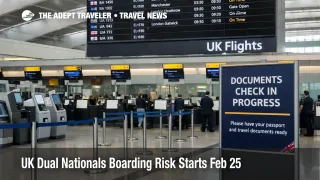
The UK dual nationals boarding risk moved from theory to counter decisions on February 25, 2026, because carriers are now expected to verify "permission to travel" before they let passengers board UK bound flights, ferries, or international rail. For British dual nationals, the practical change is blunt, showing up with only a non British passport can now trigger a denied boarding outcome even when the traveler is legally entitled to enter the UK. The traveler facing failure point is check in, not UK Border Force on arrival, and that shift can strand people mid itinerary, break onward connections via London, and trigger emergency document scrambles.
UK Dual Nationals Boarding Risk, What Changed On Feb 25
Day 1 behavior is being driven by what airline systems can validate quickly, not by what a traveler can argue at the counter. GOV.UK's dual citizens guidance is explicit that dual British or Irish citizens cannot use an ETA as a workaround, and that they should prove permission to travel with a valid UK passport, a valid Irish passport, or another valid passport that contains a certificate of entitlement. If the traveler cannot present an accepted document set, GOV.UK warns they may not be able to board, and it underlines that the carrier makes the final call on whether to accept any temporary alternative.
Which Travelers Get Stuck At Check In First
The highest denial risk is concentrated in predictable edge cases. The first is the "foreign passport only" traveler, meaning a British citizen who has been traveling for years on their second nationality passport and never had to prove right of abode upstream. The second is families, especially when a child is British by descent but has never held a British passport, or when one parent has a British passport and the other does not, because mixed document sets slow verification and increase the chance a counter agent defaults to the conservative interpretation. The third is anyone with mismatched biographic details across documents, even small differences in names, middle names, or date formats, because the temporary workaround requires that the personal details match, and the carrier is deciding under time pressure.
A separate segment is impacted even if they are not dual nationals, which matters because it raises congestion at the same counters. Reuters reported the broader ETA enforcement phase beginning February 25, with airlines preventing boarding when passengers lack an ETA, eVisa, or other valid documentation. That parallel surge increases counter transaction times and call center load, which can slow reaccommodation for unrelated passengers when flights are missed due to document issues.
What To Do Before You Leave For The Airport
Start with the document hierarchy carriers are most likely to accept without escalation. A valid British passport is the cleanest path, and a valid Irish passport is also listed by GOV.UK as an accepted way for dual Irish citizens to prove permission to travel. If you are relying on a certificate of entitlement, confirm it is tied to the passport you will physically present, because the point of the new upstream model is that the carrier expects confirmation it can rely on, not a story about citizenship.
If you do not have a valid British passport in hand, treat the temporary exception as a risk instrument, not a guarantee. GOV.UK says carriers may allow travel if you have an expired UK passport issued in 1989 or later, plus a valid passport for a nationality that can get an ETA, with matching personal details, and it adds the key operational sentence, it is the carrier's decision whether to allow you to travel. In practice, that means you should plan for variability by route and carrier, and you should assume a same day airport argument is the worst possible venue for discretionary acceptance.
For travelers who are already inside a tight departure window, set a hard decision threshold. If you cannot assemble one of the accepted document sets before leaving home, protect the rest of the itinerary by moving the UK segment rather than hoping for a counter override. This is where second order costs become real, missed onward Europe connections via London, reissued tickets at higher last minute fares, and time lost to emergency documents and helplines that are also handling the day 1 ETA surge.
Why Carriers Became The Enforcement Point
This shift is part of the UK's move toward upstream permission checks that stop problems before a passenger enters the transport network. The House of Commons Library summarizes the operational reality clearly, there may not be a specific legal requirement to travel on a British passport, but pre departure checks make it difficult to travel without a British passport or a certificate of entitlement, and people who cannot provide satisfactory evidence can be denied boarding because carriers do not want the cost and liability of transporting inadequately documented passengers.
The certificate of entitlement path matters more now because it is one of the only "non British passport" proofs carriers are instructed to recognize. GOV.UK lists the fee as £589, and it also notes the system is transitioning from physical vignettes to digital certificates, with changes tied to February 26, 2026, which adds another near term complexity layer for travelers managing passport renewals and entitlement linkage.
Sources
- Electronic travel authorisation (ETA): guide for dual citizens, GOV.UK
- Prove you have right of abode in the UK: Apply for a certificate of entitlement, GOV.UK
- Can a British citizen travel to the UK using a non-British passport?, House of Commons Library
- UK to enforce travel permit requirement on foreign visitors, Reuters, February 24, 2026
- Dual nationals who don't have British passport could be denied UK entry, Sky News