

Capella Kyoto Opens March 22, 2026 in Gion
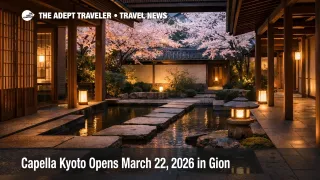
Capella Kyoto will open on March 22, 2026, adding a new 89 room luxury option in Gion's Miyagawa cho district, right as Kyoto's spring travel demand typically spikes. The hotel is positioned next to the Miyagawa cho Kaburenjo theatre and near Kenninji Temple, with design led by Kengo Kuma and Associates and Brewin Design Office. For travelers, the immediate relevance is simple: a new high end inventory drop in one of Kyoto's most constrained, most walkable neighborhoods, arriving inside the city's peak seasonal pressure window.
Capella is also tying the opening to an early package, "Whispers of Gion," with rates starting at ¥394,200 (JPY), about $2,527.00 (USD) at current exchange levels. That headline price anchors expectations for what this property is aiming to be, it is not a "new hotel deal," it is a premium, peak season play where availability, not discounting, is likely to be the constraint.
What Is New With Capella Kyoto, and When It Starts
The confirmed start date is March 22, 2026. Capella describes the property as a modern day interpretation of Kyoto machiya, with 89 rooms in a four storey layout and a courtyard centered plan. Six suites include private onsens, which is a meaningful differentiator in Kyoto where private bathing experiences are often either off property, or concentrated in ryokan style inventory that books out early.
From a traveler perspective, the other "new" is the integrated cultural access proposition. The hotel sits within a broader redevelopment tied to the restored Kaburenjo theatre and a community facility on the former Shinmichi Elementary School site, and Capella is explicitly positioning theatre adjacency as an access advantage for guests.
Dining is a core part of the launch story, not a footnote. Capella's signature restaurant, SoNoMa by SingleThread, is framed as the first international expression of SingleThread, built around a 12 seat counter and a 20 seat lounge bar concept.
Who This Hotel Is Best For in Kyoto's Spring Peak
This opening best fits travelers who want to stay inside the Gion and Higashiyama sightseeing radius and reduce daily transit friction during cherry blossom season. If the trip is built around early mornings at temples, late evenings in the older lanes, and short walks back to a quiet base, this location strategy matters more than almost any single amenity.
It also fits travelers who value "rare access" programming and are willing to plan around fixed time windows. Capella Curates is being used as a reason to choose this hotel over other luxury inventory, especially for theatre related experiences tied to the Kaburenjo and curated artisan visits. If your itinerary is already packed with timed entries and day trips, the tradeoff is that curated programming can become one more fixed commitment that reduces flexibility during a season where crowds and transport queues can already compress the day.
Finally, it fits travelers who want larger room baselines than many central Kyoto options. Capella says its rooms start at 50 square meters, which is notably spacious relative to much of Kyoto's city center hotel stock. That matters for families, multi generational travel, and anyone arriving with large luggage during a rail heavy Japan itinerary.
How To Book It, and How To Protect Your Itinerary
If you want this specific opening window, treat it like a limited inventory event, not like a normal city hotel booking. Your first decision threshold is whether March 22 to early April is a "must," or whether you can shift earlier or later to get the same Kyoto experience with less crowd density and more rate flexibility. If it is a must, book early, and then build the rest of the itinerary around protecting mornings and evenings in Gion and Higashiyama, because those are the highest payoff hours for this location.
Second, price the trip correctly. Kyoto's accommodation tax increases on March 1, 2026, with the largest tier hitting luxury stays, so the all in cost can be meaningfully higher than the nightly rate you see first. That matters most for longer stays and for travelers booking multiple rooms. If you want the details and the brackets before you commit, see Kyoto hotel tax targets luxury stays to fund fixes.
Third, operationally protect the spring peak basics. Add buffer time for transfers, especially if you are arriving by rail with luggage, and keep your day trip plan modular so you can swap in neighborhood walking days if one hotspot becomes a bottleneck. Kyoto in blossom season can punish rigid plans, not because anything is "wrong," but because volume concentrates into a few famous viewpoints, and then cascades into taxis, buses, and restaurant waits.
Finally, do the boring hotel health check work that prevents a trip ruining downstream problem. High demand periods increase room turnover pressure across the city, so it is rational to do a fast arrival inspection routine and keep luggage off soft surfaces. This is not a Capella specific claim, it is a peak season hotel operations reality, and if you want the practical checklist for Japan stays, see Bed Bug Dogs In Japan Hotels, Room Check Playbook.
Why This Launch Matters for Kyoto Travel Planning
Kyoto's spring peak is a capacity and friction story. New luxury inventory in a prime neighborhood matters because it can reduce the daily transit tax for travelers who would otherwise commute in and out of Gion, and because it reshuffles demand in a market where premium rooms are often the first to sell out on the most desirable dates. The first order effect is straightforward, more high end rooms, suites, and a new set of on property dining options in the Gion orbit.
The second order effects are about how travelers move and book. When a high profile opening lands in late March, it can pull bookings forward and tighten availability not only at the new hotel, but also at nearby comparables, especially for travelers trying to stay walkable to Higashiyama icons. It can also shift dining demand patterns, because hotel restaurants that are "destination worthy" become reservation competitors with the city's existing hard to book counters, particularly when the concept is tied to a well known three Michelin star operator.
There is also a practical pricing mechanism at work. Kyoto is simultaneously raising its lodging tax tiers starting March 1, 2026, concentrating the largest increases on luxury stays. Put those together and you get a simple traveler takeaway: late March 2026 in Kyoto is likely to be expensive, busy, and operationally unforgiving of tight schedules. If you are going anyway, the value is in buying location, room comfort, and time savings, not in hunting for marginal nightly rate wins.